
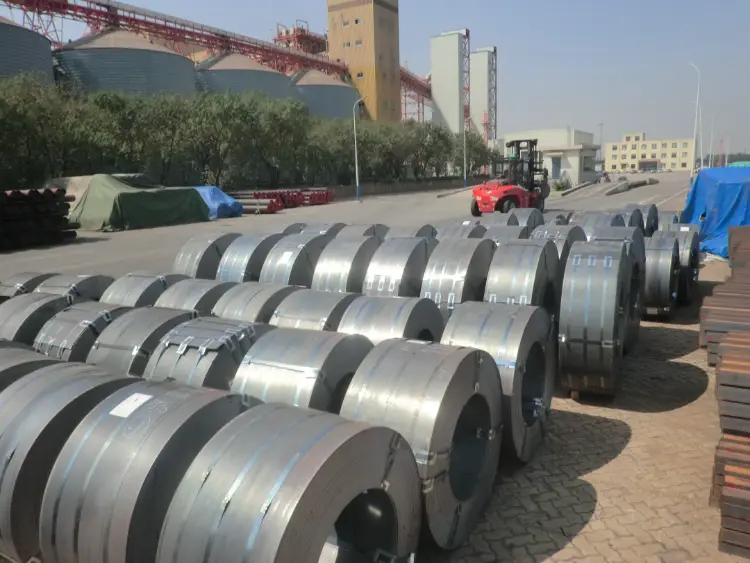
ABS Grade EQ56 Shipbuilding Steel Coil
ABS Grade EQ56 Shipbuilding Steel Coil: High Strength Quenched & Tempered Plate for Marine Structures
Comprehensive properties and equivalent grades for ABS Grade EQ56 shipbuilding steel coil, a quenched and tempered high strength steel with minimum yield 550 MPa and excellent low-temperature toughness.
Hot rolling, controlled rolling, quenching and tempering, cutting, welding, forming
- Phone : +8618037372205
- Email : [email protected]
- WhatsApp: Contact via Whtsapp
- WeChat: +8618037372205
ABS Grade EQ56 Shipbuilding Steel Coil Introduction
ABS Grade EQ56 is a high-strength quenched and tempered (Q&T) shipbuilding steel coil classified under the American Bureau of Shipping (ABS) rules. It features a minimum yield strength of 550 MPa, excellent weldability, and superior notch toughness at low temperatures down to -40°C (E grade). The steel is microalloyed with elements such as niobium, vanadium, and titanium to achieve a fine grain structure and high strength. Typical applications include critical structural components in large container ships, naval vessels, and offshore platforms where weight savings and reliability are paramount.
- Minimum yield strength 550 MPa (80 ksi)
- Charpy V-notch impact energy ≥31 J at -40°C
- Excellent weldability with low carbon equivalent
- Supplied in quenched and tempered condition
ABS Grade EQ56 Shipbuilding Steel Coil Chemical Composition
The chemical composition of ABS Grade EQ56 steel coil is controlled to ensure high strength, toughness, and weldability. Microalloying additions such as niobium, vanadium, and titanium provide grain refinement and precipitation strengthening. Values are ladle analysis limits according to ABS Rules Part 2.
| Element | Specification (wt%) | Remarks |
|---|---|---|
| Carbon (C) | ≤ 0.20 | Max. |
| Manganese (Mn) | 0.90 - 1.60 | Range |
| Silicon (Si) | ≤ 0.50 | Max. |
| Phosphorus (P) | ≤ 0.025 | Max. |
| Sulfur (S) | ≤ 0.025 | Max. |
| Chromium (Cr) | ≤ 0.25 | Max. |
| Nickel (Ni) | ≤ 0.40 | Max. |
| Molybdenum (Mo) | ≤ 0.08 | Max. |
| Copper (Cu) | ≤ 0.35 | Max. |
| Aluminum, Acid Soluble (Als) | ≥ 0.015 | Min. when aluminum killed |
| Niobium (Nb) | ≤ 0.05 | Optional, for grain refinement |
| Vanadium (V) | ≤ 0.10 | Optional |
| Titanium (Ti) | ≤ 0.02 | Optional |
| Nitrogen (N) | ≤ 0.012 | Max. |
ABS Grade EQ56 Shipbuilding Steel Coil Thermal and Electrical Physical Properties
The following physical properties are typical for quenched and tempered high-strength steel and provide a basis for engineering calculations. Values are measured at ambient temperature unless otherwise stated.
| Property | Typical Value | Unit | Test Condition |
|---|---|---|---|
| Density (ρ) | 7850 | kg/m³ | Room temperature |
| Elastic modulus (E) | 205 | GPa | Room temperature |
| Shear modulus (G) | 80 | GPa | Room temperature |
| Poisson's ratio (ν) | 0.3 | - | Room temperature |
| Thermal expansion coefficient (α) 20-100°C | 11.7 | ×10⁻⁶ /K | Temperature range |
| Thermal conductivity (λ) | 50 | W/m·K | At 20°C |
| Specific heat capacity | 460 | J/kg·K | Room temperature |
| Electrical resistivity (ρₑ) | 0.20 | ×10⁻⁶ Ω·m | At 20°C |
ABS Grade EQ56 Shipbuilding Steel Coil Mechanical Properties
Mechanical properties are verified on test pieces taken in the transverse direction unless otherwise agreed. Values apply to plate/coil thickness ≤ 50 mm. For thicker sections, strength minimums may be slightly reduced as permitted by the standard. The Charpy V-notch impact test is performed at -40°C for E-grade qualification.
| Property | Requirement | Unit | Test Condition |
|---|---|---|---|
| Yield Strength (ReH) | ≥ 550 | MPa | Transverse, room temperature |
| Tensile Strength (Rm) | 670 - 830 | MPa | Transverse, room temperature |
| Elongation (A) | ≥ 16 | % | Gauge length 5.65√S0, thickness ≤50 mm |
| Impact Energy (KV2, -40°C) | ≥ 31 (longitudinal) / ≥ 22 (transverse) | J | Charpy V-notch, -40°C |
| Bend Test (180°) | d=3t (t≤25 mm) / d=4t (t>25 mm) | No cracks |
ABS Grade EQ56 Shipbuilding Steel Coil Equivalent Material Standards and Replaceable Grade Recommendations
| Country / Region | Standard | Grade | Remarks |
|---|---|---|---|
| USA / International | ABS Rules | EQ56 | Quenched and tempered, E-grade (-40°C) shipbuilding steel |
| UK | Lloyd's Register (LR) | EH56 | Equivalent high strength steel |
| Norway / Germany | DNV GL | E560 | Corresponding DNV grade |
| France | Bureau Veritas (BV) | EH56 | Quenched and tempered shipbuilding steel |
| China | China Classification Society (CCS) | E560 | High strength hull steel |
| Japan | Nippon Kaiji Kyokai (NK) | KE56 | Equivalent NK grade |
| South Korea | Korean Register (KR) | REH56 | Equivalent KR grade |
| Italy | RINA | EI560 | Equivalent RINA grade |
ABS Grade EQ56 Shipbuilding Steel Coil Application Introduction
ABS Grade EQ56 steel coil is extensively used in shipbuilding and offshore industries due to its high strength-to-weight ratio and excellent toughness at sub-zero temperatures. It is suitable for fabricating critical structural components subjected to high stress and fatigue loading. The steel can be processed by cutting, cold forming, and welding with proper preheating and interpass temperature control to avoid hydrogen cracking. Post-weld heat treatment may be required depending on thickness and service conditions.
Product Applications: Container Ships, Bulk Carriers, Naval Vessels, Offshore Platforms, Jack-up Rigs, Crane Structures, Wind Turbine Tower Transition Pieces
Processed into products: Hull plates and stiffeners, Deck stringers and sheerstrakes, Keel plates, Bulkhead plates, Heavy lifting beams and spreaders, Mooring brackets and pad-eyes, Structural brackets for offshore modules, Flanges and webs of built-up girders
Application industries: Shipbuilding, Offshore & Marine Engineering, Heavy Machinery, Pressure Vessel Manufacturing (with additional certification), Bridge Construction
ABS Grade EQ56 Shipbuilding Steel Coil Similar / Alternative Material Recommendations
| Country / Region | Standard | Grade | Remarks |
|---|---|---|---|
| USA | ABS Rules | EQ51 | Lower yield strength (510 MPa), same toughness class; useful for less demanding applications |
| USA | ABS Rules | EQ63 | Higher yield strength (620 MPa); can replace EQ56 where weight savings are critical |
| USA | ASTM A514/A514M | Grade Q | Yield 690 MPa, quenched & tempered alloy structural steel; not classed for shipbuilding, requires ABS approval |
| Europe | EN 10025-6 | S690Q | Yield 690 MPa, hot-rolled structural steel; may be considered with additional testing |
| Japan | JIS G3128 | SHY685 | High yield strength steel for welded structures, comparable performance |
Notes:
Additional Information:
- Data based on ABS Rules for Materials and Welding (latest edition). All production must be carried out by ABS-approved manufacturers under classification society survey.
- Ultrasonic testing (UT) is often required per ASTM A578 or equivalent specification; extent and acceptance criteria shall be agreed upon at the time of order.
- Typical hardness after Q&T ranges between 210 and 280 HBW, but hardness is not a mandatory release requirement.
- Preheating before welding (100–150°C) is recommended to avoid cold cracking, especially for thick sections.
- For thicknesses above 50 mm, mechanical properties may be slightly reduced; refer to the standard for thickness compensation factors.
- Share



