
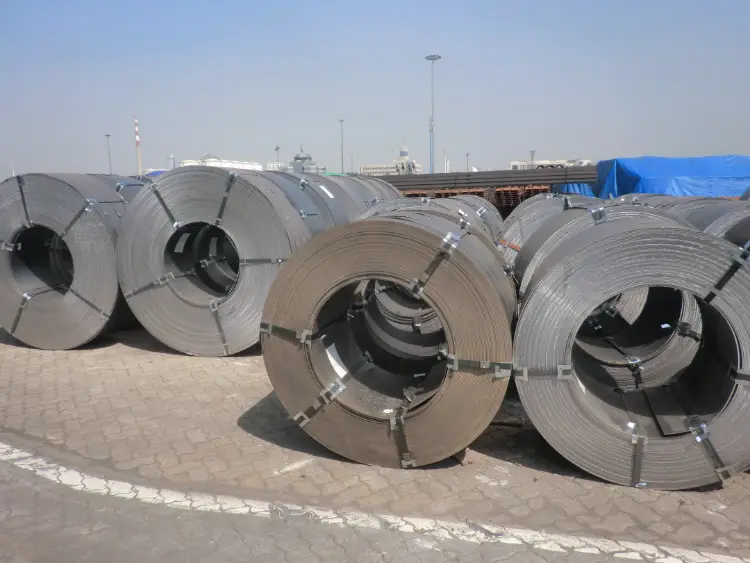
ABS Grade DQ56 Shipbuilding Steel Coil
ABS Grade DQ56 Shipbuilding Steel Coil: High-Strength Quenched & Tempered Steel for Marine Structures
Comprehensive material data for ABS Grade DQ56 shipbuilding steel coil, including chemical composition, mechanical properties, physical properties, international equivalents, and application guidelines.
Hot rolling, quenching and tempering, cutting, welding, cold forming, machining
- Phone : +8618037372205
- Email : [email protected]
- WhatsApp: Contact via Whtsapp
- WeChat: +8618037372205
ABS Grade DQ56 Shipbuilding Steel Coil Introduction
ABS DQ56 is a high-strength quenched and tempered steel grade certified by the American Bureau of Shipping for shipbuilding and offshore constructions. It features a minimum yield strength of 560 MPa and is designed for critical structural components operating in low-temperature marine environments. The steel exhibits excellent toughness, weldability, and resistance to brittle fracture. The grade designation includes:
- D – indicates Charpy impact test temperature of -20°C
- Q – denotes quenched and tempered heat treatment condition
- 56 – minimum yield strength of 560 MPa
Supplied as hot-rolled coil or plates, ABS DQ56 meets stringent requirements of the ABS Rules for Materials and Welding, Part 2. Typical applications encompass hull structures, deck components, and offshore platform members subjected to high stress and dynamic loading.
ABS Grade DQ56 Shipbuilding Steel Coil Chemical Composition of ABS DQ56
Chemical requirements according to ABS Rules for Materials and Welding, Part 2. The steel is microalloyed for grain refinement and strength. CEV (carbon equivalent) is limited to ensure good weldability. Values are maximum unless a range is specified.
| Element | Specified Value (max, % unless range) | Remarks |
|---|---|---|
| Carbon, C | 0.21 | Max |
| Manganese, Mn | 0.80 – 1.70 | Range |
| Silicon, Si | 0.10 – 0.55 | Range |
| Phosphorus, P | 0.030 | Max |
| Sulfur, S | 0.030 | Max |
| Aluminum, Al (total / acid soluble) | ≥0.020 / ≥0.015 | Grain refining element |
| Niobium, Nb | 0.02 – 0.05 | Typical, optional microalloy |
| Vanadium, V | 0.05 – 0.10 | Typical, optional microalloy |
| Titanium, Ti | ≤0.02 | If added for grain refinement |
| Chromium, Cr | ≤0.30 | Residual / optional addition |
| Nickel, Ni | ≤0.40 | Residual / optional addition |
| Molybdenum, Mo | ≤0.08 | Residual / optional addition |
| Copper, Cu | ≤0.35 | Residual / optional addition |
| Carbon Equivalent, CEV | ≤0.53 (typically ≤0.45 for thickness ≤50 mm) | CEV = C+Mn/6+(Cr+Mo+V)/5+(Ni+Cu)/15; lower CEV improves weldability |
ABS Grade DQ56 Shipbuilding Steel Coil Physical Properties of ABS DQ56
The following data represent typical values for quenched and tempered high-strength steel of this grade, used for design and simulation. They are not mandatory acceptance criteria. Properties may vary slightly with actual tempering practice.
| Property | Typical Value | Unit | Test Conditions / Remarks |
|---|---|---|---|
| Density (ρ) | 7.85 | g/cm³ | At 20°C |
| Elastic modulus (E) | 205 – 210 | GPa | At 20°C, tension |
| Shear modulus (G) | 80 – 82 | GPa | At 20°C, calculated |
| Poisson's ratio (ν) | 0.28 – 0.30 | – | Elastic range |
| Thermal expansion coefficient (α) | 11.5 – 12.5 | 10⁻⁶/K | 20 – 100°C |
| Thermal expansion coefficient (α) | 12.5 – 13.5 | 10⁻⁶/K | 20 – 200°C |
| Thermal expansion coefficient (α) | 13.0 – 14.0 | 10⁻⁶/K | 20 – 400°C |
| Thermal conductivity (λ) | 40 – 45 | W/(m·K) | At 20°C |
| Thermal conductivity (λ) | 38 – 42 | W/(m·K) | At 200°C |
| Thermal conductivity (λ) | 35 – 39 | W/(m·K) | At 400°C |
| Specific heat capacity (cₚ) | 460 – 500 | J/(kg·K) | At 20°C |
| Specific heat capacity (cₚ) | 520 – 560 | J/(kg·K) | At 200°C |
| Specific heat capacity (cₚ) | 580 – 630 | J/(kg·K) | At 400°C |
| Electrical resistivity (ρₑ) | 0.20 – 0.25 | Ω·mm²/m | At 20°C |
ABS Grade DQ56 Shipbuilding Steel Coil Mechanical Properties of ABS DQ56
Tensile and impact properties are determined on test pieces taken in the transverse direction unless otherwise agreed. Values refer to quenched and tempered condition. Requirements vary with plate/coil thickness. Impact tests are performed on Charpy V-notch specimens at -20°C.
| Property | Required Value | Unit | Test Conditions / Remarks |
|---|---|---|---|
| Upper yield strength (ReH) | ≥560 | MPa | Thickness ≤50 mm; transverse |
| Upper yield strength (ReH) | ≥540 | MPa | Thickness >50 to 70 mm; transverse |
| Upper yield strength (ReH) | ≥510 | MPa | Thickness >70 to 100 mm; transverse |
| Tensile strength (Rm) | 670 – 830 | MPa | Thickness ≤100 mm; transverse |
| Elongation after fracture (A5) | ≥16 | % | Gauge length 5.65√S₀; thickness ≤50 mm; transverse |
| Elongation after fracture (A5) | ≥15 | % | Thickness >50 to 70 mm; transverse |
| Elongation after fracture (A5) | ≥14 | % | Thickness >70 to 100 mm; transverse |
| Charpy impact energy (KV₂) | ≥41 (average of 3), ≥28 (single) | J | Longitudinal, -20°C; thickness ≤50 mm |
| Charpy impact energy (KV₂) | ≥34 (average of 3), ≥24 (single) | J | Longitudinal, -20°C; thickness >50 to 70 mm |
| Charpy impact energy (KV₂) | ≥27 (average of 3), ≥19 (single) | J | Longitudinal, -20°C; thickness >70 to 100 mm |
| Bend test (mandrel diameter) | No cracks or defects | – | 180° bend; mandrel diameter = 3× thickness (t ≤25 mm), 4× thickness (t >25 mm) or as agreed |
ABS Grade DQ56 Shipbuilding Steel Coil Fully Equivalent Material Standards and Substitutable Grades
| Country / Region | Standard | Grade | Remarks |
|---|---|---|---|
| International (IACS) | IACS UR W11 | D560 | Harmonized high-strength quenched & tempered shipbuilding steel |
| Norway / Germany (DNV) | DNV Rules Pt.2 Ch.1 | D560 | Quenched and tempered, yield 560 MPa |
| France (BV) | BV Rules Part B Ch.1 | D560 | Equivalent to ABS DQ56 |
| United Kingdom (LR) | LR Rules Pt.3 Ch.1 | DH560 | Longitudinal impact -20°C |
| Japan (NK) | NK Rules Part K | KD560 | Quenched and tempered KS D560 |
| China (CCS) | CCS Rules Pt.9 Ch.1 | D560 | Same test temperature and strength level |
| Italy (RINA) | RINA Rules Pt.A Ch.1 | D560 | Fully comparable grade |
| South Korea (KR) | KR Rules Pt.2 Ch.1 | D560 | Yield ≥560 MPa, QT condition |
| India (IRS) | IRS Rules Pt.4 | D560 | As per IACS W11 |
ABS Grade DQ56 Shipbuilding Steel Coil Application Introduction
ABS DQ56 is engineered for weight-critical, high-stress ship and offshore structures operating in cold climates. The quenched and tempered microstructure provides an excellent strength-to-weight ratio while maintaining sufficient ductility for structural safety. Its good weldability and low-temperature toughness make it suitable for thick-section fabrication without excessive preheating. Typical processing includes plasma/flame cutting, submerged-arc welding (SAW), and cold or hot forming. Post-weld heat treatment is generally avoided to preserve the properties of the tempered steel. Connections must follow approved welding procedures as per ABS welding standards.
Product Applications: Main deck plating and bottom shell plating of large container ships and bulk carriers, Hull structural members such as longitudinal stiffeners, transverse frames, and web frames, Offshore platform columns, braces, and deck structures, Ice belt region plates of ice-class vessels, Crane booms and lattice structures for heavy lift cranes, Jack-up rig legs and spudcans, Welded beams and box girders in heavy structural steel works
Processed into products: Ship hull plates (keel, side shell, deck plates), Stiffeners (flat bars, bulb flats, angles), Built-up T-beams and girders, Crane boom chords and diagonal braces, Offshore jacket leg members and nodes (welded tubular joints), Transition pieces for monopole wind turbine foundations, Pressure vessel shells subject to dynamic loads, Padeyes and heavily loaded connection plates
Application industries: Shipbuilding (commercial and naval vessels, polar-class ships, icebreakers), Offshore oil and gas (jack-up rigs, semi-submersibles, platform legs), Renewable energy (offshore wind turbine foundations, transition pieces), Heavy construction and lifting equipment (crane booms, jibs, heavy-duty chassis), Port and harbor machinery (container cranes, ship unloaders), Pressure vessels and storage tanks (low-temperature applications where toughness matters)
ABS Grade DQ56 Shipbuilding Steel Coil Similar or Closely Related Substitute Materials
| Country / Region | Standard | Grade | Remarks |
|---|---|---|---|
| ABS | ABS Rules | DQ63 (or DQ620) | Higher yield (620 MPa), similar toughness and weldability |
| ABS | ABS Rules | DQ55 (or DQ550) | Slightly lower yield (550 MPa), same delivery condition |
| ABS | ABS Rules | EQ56 | Lower impact test temperature (-40°C), similar strength |
| ABS | ABS Rules | DH36 | Normalized high-strength steel (355 MPa), different heat treatment |
| DNV | DNV Rules | D620 / D550 | Alternative strength levels with equivalent toughness |
| EN | EN 10025-6 | S690QL / S690QL1 | Higher strength QT steel, adjust design for equivalent toughness, CVN at -20°C required |
| API | API 2W / 2Y | Grade 60 (min 550 MPa) or higher | For offshore structures; need to verify toughness requirement at -20°C |
Notes:
Certification: ABS surveyor inspection and stamping are required. Material shall be produced at an ABS-approved mill. NDT: Ultrasonic testing per ABS requirements is mandatory for thicker plates. Welding: Preheating temperature typically 100–150°C depending on thickness and hydrogen control. Use low-hydrogen consumables. Maximum interpass temperature should be monitored. The quenched and tempered condition limits hot work; hot forming must be followed by a new heat treatment if allowed.
- Share



