
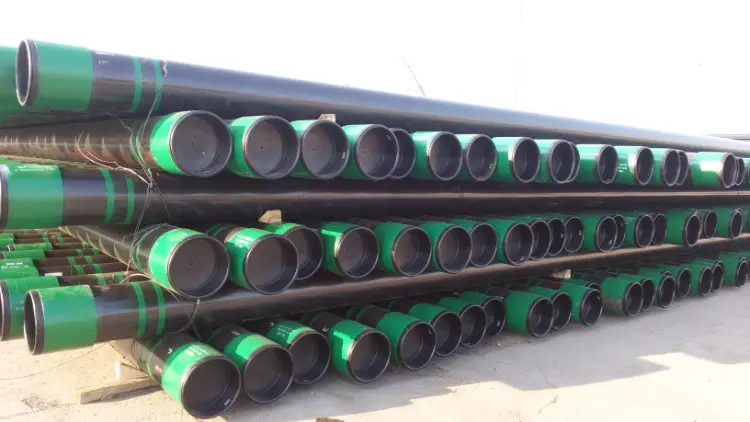
GB/T 1591 Q460E Low Alloy High Strength Structural Steel for LSAW Pipe
Q460E Low Alloy High Strength Structural Steel for LSAW Pipe per GB/T 1591
Comprehensive material data for Q460E low alloy structural steel used in longitudinal submerged arc welded pipes, including chemical composition, mechanical properties, physical properties, equivalent grades, applications and processing guidance.
Hot rolling, controlled rolling, thermomechanical controlled processing (TMCP), normalizing, welding, cold forming, cutting, bending
- Phone : +8618037372205
- Email : [email protected]
- WhatsApp: Contact via Whtsapp
- WeChat: +8618037372205
GB/T 1591 Q460E Low Alloy High Strength Structural Steel for LSAW Pipe Introduction
Q460E is a low alloy high-strength structural steel grade specified in GB/T 1591-2018. It offers a minimum yield strength of 460 MPa under normal thickness conditions and is designated with quality grade E, which guarantees excellent low-temperature impact toughness down to -40 °C. The steel is typically supplied in a thermomechanical rolled (TMCP) or normalized condition and exhibits good weldability, forming and cold bending properties. It is widely used for heavy-duty structures, bridges, pressure vessels, offshore platforms and particularly for manufacturing LSAW (Longitudinal Submerged Arc Welded) pipes. The controlled fine-grain structure ensures high strength combined with adequate ductility and toughness, making it suitable for demanding engineering applications in construction and energy sectors.
GB/T 1591 Q460E Low Alloy High Strength Structural Steel for LSAW Pipe Chemical Composition
Chemical composition as per GB/T 1591-2018 for grade Q460E. Maximum values apply unless a range is shown. Elements not listed are limited by the required mechanical properties but are allowed in residual amounts only. Fine grain elements such as Al, Nb, V, Ti may be added singly or in combination.
| Element | Specified Value | Remarks |
|---|---|---|
| Carbon (C) | ≤ 0.20 | Ladle analysis |
| Silicon (Si) | ≤ 0.60 | Ladle analysis |
| Manganese (Mn) | ≤ 1.80 | Ladle analysis |
| Phosphorus (P) | ≤ 0.020 | Ladle analysis |
| Sulfur (S) | ≤ 0.010 | Ladle analysis |
| Niobium (Nb) | ≤ 0.11 | Single or in combination with V, Ti |
| Vanadium (V) | ≤ 0.20 | Single or in combination with Nb, Ti |
| Titanium (Ti) | ≤ 0.20 | Single or in combination with Nb, V |
| Chromium (Cr) | ≤ 0.30 | Residual element, not purposely added |
| Nickel (Ni) | ≤ 0.80 | Residual element, not purposely added |
| Copper (Cu) | ≤ 0.55 | Residual element, not purposely added |
| Molybdenum (Mo) | ≤ 0.10 | Residual element, not purposely added |
| Nitrogen (N) | ≤ 0.015 | Ladle analysis |
| Aluminum (Alt) | ≥ 0.015 | Total aluminum, acid-soluble Al is often specified ≥ 0.015% |
GB/T 1591 Q460E Low Alloy High Strength Structural Steel for LSAW Pipe Thermal and Electrical Physical Properties
The following properties are typical for low alloy structural steels and are provided for engineering design guidance only. Actual values may vary slightly with manufacturing process and test conditions. These are not specified in GB/T 1591 but are based on general material behavior.
| Property | Typical Value | Unit | Test Condition |
|---|---|---|---|
| Density (ρ) | 7.85 | g/cm³ | at 20 °C |
| Elastic Modulus (E) | 205 – 210 | GPa | at 20 °C, tensile |
| Shear Modulus (G) | 80 – 82 | GPa | at 20 °C, calculated from E and ν |
| Poisson's Ratio (ν) | 0.28 – 0.30 | — | room temperature, elastic range |
| Thermal Expansion Coefficient (α) | 11.8 – 12.5 | ×10⁻⁶/K | 20–100 °C average |
| Thermal Conductivity (λ) | 38 – 45 | W/(m·K) | at 20 °C |
| Specific Heat Capacity | 450 – 480 | J/(kg·K) | at 20–100 °C |
| Electrical Resistivity (ρ_e) | 0.20 – 0.25 | ×10⁻⁶ Ω·m | at 20 °C |
GB/T 1591 Q460E Low Alloy High Strength Structural Steel for LSAW Pipe Mechanical Properties
Mechanical properties according to GB/T 1591-2018, tested on transverse specimens. The yield strength decreases with increasing thickness. Impact test performed at -40 °C with minimum absorbed energy of 34 J. Bend test required with specified mandrel diameter.
| Property | Specified Value | Unit | Test Condition |
|---|---|---|---|
| Yield Strength (ReH) | ≥ 460 | MPa | Thickness ≤ 16 mm |
| Yield Strength (ReH) | ≥ 440 | MPa | Thickness > 16 mm ≤ 40 mm |
| Yield Strength (ReH) | ≥ 420 | MPa | Thickness > 40 mm ≤ 63 mm |
| Yield Strength (ReH) | ≥ 400 | MPa | Thickness > 63 mm ≤ 80 mm |
| Yield Strength (ReH) | ≥ 390 | MPa | Thickness > 80 mm ≤ 100 mm |
| Tensile Strength (Rm) | 550 – 720 | MPa | Thickness ≤ 100 mm (all ranges) |
| Elongation (A) | ≥ 17 | % | Thickness ≤ 16 mm (gauge length 5.65√So) |
| Elongation (A) | ≥ 17 | % | Thickness > 16 mm ≤ 100 mm |
| Impact Energy (KV2) | ≥ 34 | J (longitudinal) | -40 °C, Charpy V-notch |
| Bend Test (d = mandrel diameter; a = thickness) | d = 3a | — | Thickness ≤ 16 mm, 180° bend |
| Bend Test | d = 4a | — | Thickness > 16 mm ≤ 100 mm, 180° bend |
GB/T 1591 Q460E Low Alloy High Strength Structural Steel for LSAW Pipe Direct Equivalent Material Standards and Substitute Grades
| Country/Region | Standard | Grade | Remarks |
|---|---|---|---|
| European Union | EN 10025-4:2019 | S460ML (1.8838) | Thermomechanical rolled structural steel; -50 °C impact energy requirement ≥27 J, fully satisfies low-temperature toughness comparable to Q460E. Chemical composition slightly different but interchangeable for structural design. |
GB/T 1591 Q460E Low Alloy High Strength Structural Steel for LSAW Pipe Application Introduction
Application Guide for Q460E LSAW Pipe
Due to its high strength, excellent toughness, and good weldability, Q460E steel is widely used to manufacture LSAW (Longitudinal Submerged Arc Welded) pipes for structural and line pipe applications. The material can be processed through hot forming, cold bending, and welding using conventional techniques, provided appropriate preheating and interpass temperature control is observed. It is suitable for components that bear high static and dynamic loads, operate in aggressive environments, and must withstand low temperatures without brittle fracture.
Product Applications: LSAW steel pipes (API 5L X65M/X70M equivalent level, sour service optional), Spiral welded pipes (SSAW) where flat-rolled plates are used, Welded H-beams and box columns for structural frames, Heavy plates cut to shape for offshore node construction, Bend pipes and induction bends for pipeline routing, Cold-formed hollow sections (square, rectangular) for structural support
Processed into products: Main line pipe segments for oil/gas transmission pipelines, Offshore platform legs and brace members, Wind turbine tower shells and foundation transition pieces, Bridge girders and arch ribs, Pressure vessel shells and heat exchanger tubes (under certain conditions), Pipe piling for marine and foundation works, Heavy-duty crane booms and lattice structures, Hydraulic cylinder barrels and thick-walled machinery parts
Application industries: Oil and gas transportation (onshore and offshore pipelines), Construction and civil engineering (bridges, high-rise buildings, stadiums), Offshore engineering (jackets, topsides, risers, platform legs), Wind power generation (tower tubes, transition pieces, foundation piles), Shipbuilding and marine structures (hull reinforcements, heavy-lift crane booms), Mining and heavy machinery (booms, structural frames), Water supply and sewage systems (large-diameter transmission pipes)
GB/T 1591 Q460E Low Alloy High Strength Structural Steel for LSAW Pipe Similar or Alternative Material Recommendations
| Country/Region | Standard | Grade | Remarks |
|---|---|---|---|
| European Union | EN 10025-3:2019 | S460N / S460NL | Normalized/normalized rolled fine-grain steel; impact test down to -20 °C (S460N) or -50 °C (S460NL). Chemical composition differs; suitable for welded structures where TMCP is not possible. |
| Japan | JIS G 3106:2015 | SM570 | Structural steel for welded structures; typical yield ≥ 460 MPa, tensile 570–720 MPa, impact test optionally at -5 °C or -40 °C (grade with suffix -E). Not fully aligned in low-temperature toughness. |
| USA | ASTM A913/A913M | Grade 65 (450 MPa) | High-strength low-alloy structural steel; yield 450 MPa min, tensile 550 MPa min, impact test at -50 °C available. Slightly lower yield but can be used as a substitute in many applications. |
| International | ISO 4950-2:1995 | E460DD | High yield strength flat steel products; thermomechanical rolled; impact test at -20 °C or -50 °C depending on quality; chemistry not identical but strength and toughness comparable. |
| China | GB/T 1591-2018 | Q460D | Same strength level but with impact test at -20 °C; can be used if the service temperature is less demanding. |
Notes:
- For LSAW pipe production, the base metal is usually processed from hot-rolled wide plates produced by TMCP to ensure uniform mechanical properties through the thickness.
- Welding consumables must be selected to match the strength and toughness of the base metal (e.g., AWS A5.18 ER70S-6 or ER80S-G for GMAW).
- Post-weld heat treatment (PWHT) is generally not required for thicknesses below 30 mm; for higher thicknesses, stress relieving may be applied but must consider the potential reduction in strength if normalization is performed.
- Preheating to 100–150 °C is recommended for welding in low-ambient-temperature conditions or when the carbon equivalent (CEV) exceeds 0.45.
- All above data are based on the official standard GB/T 1591-2018 and typical physical properties; for exact values on a specific product, the mill test certificate must be consulted.
- Share



