
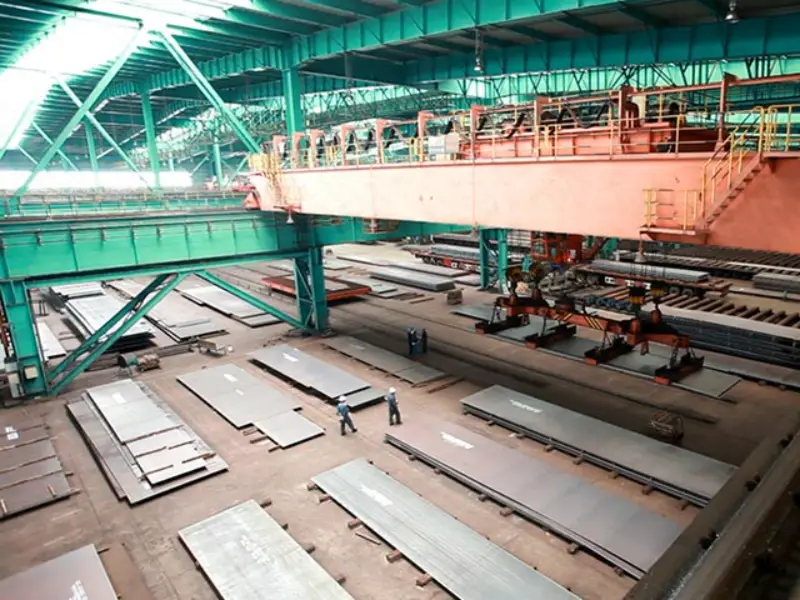
ABS Grade FH32 Shipbuilding Steel
ABS Grade FH32 Shipbuilding Steel: High-Strength, Low-Temperature Toughness for Marine Environments
Explore ABS Grade FH32 shipbuilding steel coil – a normalized high-strength structural steel with minimum yield 315 MPa and guaranteed impact properties at -60°C, certified by ABS for critical marine applications.
Hot rolling, cold forming, gas/plasma/laser cutting, arc welding, bending, punching, and stamping
- Phone : +8618037372205
- Email : [email protected]
- WhatsApp: Contact via Whtsapp
- WeChat: +8618037372205
ABS Grade FH32 Shipbuilding Steel Introduction
ABS Grade FH32 is a high-strength hull structural steel defined by the American Bureau of Shipping (ABS) for use in shipbuilding and offshore structures. It belongs to the normalized, fine grain-treated category with minimum yield strength of 315 MPa.
- Low-temperature toughness: Guaranteed Charpy V-notch impact energy at -60°C (longitudinal ≥31 J, transverse ≥22 J), making it suitable for ice-class vessels and arctic service.
- Good weldability: Low carbon content and microalloying (Nb, V, Ti) provide excellent weldability with proper preheating.
- Through-thickness properties: Offers uniform strength and ductility in thicknesses up to 50 mm, commonly used in ship hulls, decks, and structural members.
- Normalized delivery: Typically supplied in normalized condition (or TMCP upon agreement) ensuring consistent mechanical properties and fine grain structure.
ABS Grade FH32 Shipbuilding Steel Chemical Composition – Grade FH32 per ABS Rule 2023
The ladle analysis limits for ABS Grade FH32 ensure balanced strength, toughness and weldability. Carbon is restricted to ≤0.18%, manganese is optimized between 0.90% and 1.60%, and microalloying elements (Nb, V, Ti, Al) are controlled for fine grain refinement. Phosphorus and sulfur are kept low to enhance ductility and impact resistance.
- Carbon equivalent (CEV) is typically limited to ≤0.38% for good weldability.
- Acid soluble aluminum (Alsol) ≥0.015% is required for full killing and grain refinement.
| Chemical Element | Specified Value (max %) | Remarks |
|---|---|---|
| Carbon (C) | ≤0.18 | Ladle analysis |
| Silicon (Si) | 0.10–0.50 | Ladle analysis |
| Manganese (Mn) | 0.90–1.60 | Ladle analysis |
| Phosphorus (P) | ≤0.035 | Ladle analysis |
| Sulfur (S) | ≤0.035 | Ladle analysis |
| Chromium (Cr) | ≤0.20 | Ladle analysis; permitted residual |
| Nickel (Ni) | ≤0.40 | Ladle analysis; permitted residual |
| Molybdenum (Mo) | ≤0.08 | Ladle analysis; permitted residual |
| Copper (Cu) | ≤0.35 | Ladle analysis; permitted residual |
| Aluminum (Alsol) | ≥0.015 | Acid soluble; required for grain refinement |
| Niobium (Nb) | 0.02–0.05 | Microalloy; for strength and toughness |
| Vanadium (V) | 0.05–0.10 | Microalloy; for strength and toughness |
| Titanium (Ti) | ≤0.02 | Microalloy; for grain refinement; optional |
| Nb+V+Ti | ≤0.12 | Combined sum if all microalloys are used |
| Carbon Equivalent (CEV) | ≤0.38 | Calculated as C + Mn/6 + (Cr+Mo+V)/5 + (Ni+Cu)/15 |
ABS Grade FH32 Shipbuilding Steel Thermal and Electrical Physical Properties – Typical Reference Values for FH32
Physical properties are derived from standard values for low-carbon high-strength structural steels. Variations within normal compositional range are negligible for engineering design.
- Density is used for weight calculations.
- Thermal conductivity and expansion are essential for weld preheating and distortion control.
- Electrical resistivity is typical for structural steels.
| Property | Typical Value | Unit | Test Condition / Remarks |
|---|---|---|---|
| Density (ρ) | 7850 | kg/m³ | Room temperature |
| Modulus of Elasticity (E) | 210 | GPa | Room temperature |
| Shear Modulus (G) | 81 | GPa | Calculated from E and ν |
| Poisson's Ratio (ν) | 0.3 | – | Room temperature |
| Thermal Expansion Coefficient (α) | 12.0 | 10⁻⁶/K | 20–100°C; average value |
| Thermal Conductivity (λ) | 50 | W/(m·K) | 20°C; typical for normalized HSLA steel |
| Specific Heat Capacity | 460 | J/(kg·K) | 20°C; typical |
| Electrical Resistivity (ρ_e) | 0.20 | μΩ·m | Room temperature |
ABS Grade FH32 Shipbuilding Steel Mechanical Properties – Typical Reference Values for FH32
Mechanical properties are determined on normalized or TMCP material in accordance with ABS testing requirements. Tensile testing is performed in transverse direction. Impact testing (Charpy V-notch) is mandatory at -60°C.
- For thicknesses 50–70 mm, slight reductions in elongation and yield may apply; consult ABS tables.
- Bend test: 180° over a diameter of 3t, no cracks or defects permitted.
| Property | Standard Required Value | Unit | Test Condition / Remarks |
|---|---|---|---|
| Yield Strength (ReH) | ≥315 | MPa | Transverse, 0.2% offset, for t ≤50 mm |
| Tensile Strength (Rm) | 440–570 | MPa | Transverse, for t ≤50 mm |
| Elongation (A) | ≥22 | % | Transverse, gauge length 5.65√So, t ≤50 mm |
| Charpy Impact Energy (KV), Longitudinal | ≥31 | J | At -60°C, V-notch, average of 3 tests; min single value 22 J |
| Charpy Impact Energy (KV), Transverse | ≥22 | J | At -60°C, V-notch, average of 3 tests; min single value 16 J |
| Bend Test (180°) | D=3t, no cracks | – | t=specimen thickness; for t ≤50 mm |
ABS Grade FH32 Shipbuilding Steel Completely Equivalent Grades – ABS FH32 Recognized by Other Classification Societies
| Country / Region | Standard / Rule | Equivalent Grade | Remarks |
|---|---|---|---|
| International | DNV Rules | DNV FH32 | Identical chemical and mechanical requirements; -60°C impact |
| International | BV Rules | BV FH32 | Bureau Veritas high-strength hull steel |
| International | LR Rules | LR FH32 | Lloyd's Register equivalent; same toughness class |
| International | CCS Rules | CCS FH32 | China Classification Society; recognized equivalent |
| International | NK Rules | NK FH32 | ClassNK equivalent for marine constructions |
| International | RINA Rules | RINA FH32 | Italian classification society equivalent |
| International | KR Rules | KR FH32 | Korean Register; technically identical |
ABS Grade FH32 Shipbuilding Steel Application Introduction
ABS FH32 is specifically designed for welded structures in ships and offshore units operating at low temperatures. Its guaranteed toughness at -60°C makes it ideal for ice-going vessels and arctic environments.
- Typical service temperature: down to -60°C.
- Excellent deformation capacity under dynamic loading.
- Suitable for all conventional welding methods (SAW, SMAW, FCAW, GMAW).
Product Applications: Ship hull plates and stiffeners, Deck plating and longitudinal girders, Bulkhead panels and web frames, Offshore module structural members, Wind turbine installation vessel hulls
Processed into products: Keel plates and bottom shell plates, Side shell plates in ice belt area, Watertight bulkheads and collision bulkheads, Hatch coamings and corner reinforcements, Brackets and gusset plates for critical joints, Welded beams and columns for topside modules
Application industries: Shipbuilding (tankers, bulk carriers, container ships, icebreakers), Offshore oil & gas (jack-up legs, platform decks, flare booms), Arctic engineering (ice-breaking structures, polar supply vessels), Heavy lifting and port equipment (crane booms, heavy-duty structural frames), Defense/naval (hull of patrol vessels, frigates)
ABS Grade FH32 Shipbuilding Steel Similar/Alternative Materials – Grades with Comparable Strength or Toughness
| Country / Region | Standard / Rule | Alternative Grade | Remarks |
|---|---|---|---|
| International | ABS Rules | ABS Grade FH36 | Higher strength (yield 355 MPa), same -60°C toughness; direct upgrade |
| International | ABS Rules | ABS Grade EH32 | Same strength (315 MPa) but lower toughness: -40°C; possible substitute in less severe cold |
| Europe | EN 10025-4 | S355ML | Thermo-mechanically rolled, yield 355 MPa, similar -50°C toughness but lacks -60°C guarantee; may need qualification |
| Japan | JIS G 3106 | SM490A | Tensile 490–610 MPa, 0°C impact; used in general structures, not a direct FH32 substitute |
| China | GB 712 | F32 | Same strength and -60°C toughness; Chinese ship steel equivalent |
Notes:
Additional technical notes:
- Ultrasonic testing (UT) per ASTM A578 Level II or equivalent is commonly required for thicknesses ≥ 20 mm in critical areas.
- Welding consumables must be selected to match the -60°C toughness (e.g., E7018-A1 with CVN at -60°C). Preheat and interpass temperatures should be controlled to avoid cold cracking; typical preheat ~100°C for plates >30 mm.
- Post-weld heat treatment (PWHT) is generally not required for thicknesses up to 50 mm when using low-hydrogen processes.
- Corrosion protection in marine environment is achieved by coating systems combined with cathodic protection.
- Share



