
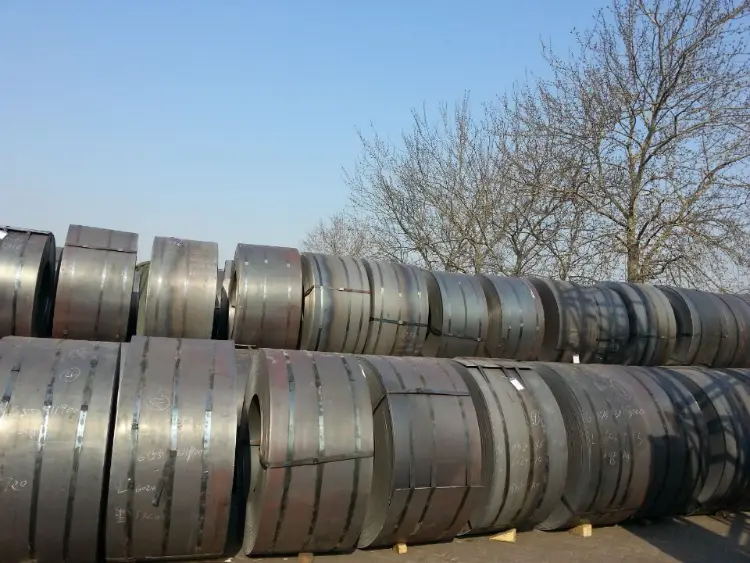
ABS Grade EH32 Shipbuilding Steel Coil
ABS Grade EH32 Shipbuilding Steel Coil: High-Strength, Low-Temperature Toughness for Marine Structures
Explore detailed data on ABS Grade EH32 shipbuilding steel coil: chemical composition, mechanical and thermal properties, international equivalents, and application guidelines for ship and offshore structures.
Hot rolling, thermomechanical controlled rolling (TMCP), normalizing, shot blasting, cutting, welding
- Phone : +8618037372205
- Email : [email protected]
- WhatsApp: Contact via Whtsapp
- WeChat: +8618037372205
ABS Grade EH32 Shipbuilding Steel Coil Introduction
ABS Grade EH32 is a high-strength, normalized or controlled-rolled shipbuilding structural steel as per the American Bureau of Shipping (ABS) Rules. It is designed for critical marine and offshore applications where a minimum yield strength of 315 MPa (approx. 32 kg/mm²) and excellent notch toughness at -40°C are required. The 'E' designation indicates that the steel passes Charpy V‑notch impact testing at -40°C, making it suitable for cold-environment service. The grade offers good weldability, formability, and corrosion resistance in marine atmospheres. EH32 is typically supplied as as-rolled, thermomechanically controlled processed (TMCP), or normalized steel plates and coils.
ABS Grade EH32 Shipbuilding Steel Coil Chemical Composition
The ladle analysis limits for ABS EH32 are specified to ensure adequate strength, toughness, and weldability. Typical microalloying with Nb, V, or Ti may be applied to refine grain size.
- Ceq (IIW) is usually restricted to improve weldability.
- Aluminum is added as a grain refiner and deoxidizer.
| Element | Standard Value (max. unless range given) | Remarks |
|---|---|---|
| Carbon (C) | ≤ 0.18% | Controlled for weldability |
| Manganese (Mn) | 0.90 – 1.60% | Contributes to strength and toughness |
| Silicon (Si) | 0.10 – 0.50% | Deoxidizer |
| Phosphorus (P) | ≤ 0.035% | Detrimental to toughness |
| Sulfur (S) | ≤ 0.035% | Improves machinability but kept low for toughness |
| Aluminum (Al, acid soluble) | ≥ 0.015% | Grain refinement |
| Niobium (Nb) | ≤ 0.05% | Optional grain refiner |
| Vanadium (V) | ≤ 0.10% | Optional precipitation hardening |
| Titanium (Ti) | ≤ 0.02% | Optional grain refinement |
| Nitrogen (N) | ≤ 0.009% (if present) | May be controlled to avoid strain aging |
| Copper (Cu) | ≤ 0.35% | Residual; can enhance corrosion resistance |
| Chromium (Cr) | ≤ 0.20% | Residual |
| Nickel (Ni) | ≤ 0.40% | Residual |
| Molybdenum (Mo) | ≤ 0.08% | Residual |
ABS Grade EH32 Shipbuilding Steel Coil Physical Properties
Physical properties are not specified in ABS rules but are typical for structural steel grades similar to EH32. Values are approximate and may vary slightly with manufacturing process and temperature. They are provided for design and simulation purposes.
| Property | Typical Value | Unit | Test Condition |
|---|---|---|---|
| Density (ρ) | 7.85 | g/cm³ | At room temperature |
| Modulus of Elasticity (E) | 205 | GPa | At room temperature |
| Shear Modulus (G) | 80 | GPa | At room temperature |
| Poisson's Ratio (ν) | 0.30 | - | Elastic domain, room temperature |
| Thermal Expansion Coefficient (α) | 11.5 × 10⁻⁶ | K⁻¹ | 20 – 100 °C |
| Thermal Expansion Coefficient (α) | 12.5 × 10⁻⁶ | K⁻¹ | 20 – 200 °C |
| Thermal Expansion Coefficient (α) | 13.5 × 10⁻⁶ | K⁻¹ | 20 – 400 °C |
| Thermal Conductivity (λ) | 52 | W/(m·K) | At room temperature |
| Thermal Conductivity (λ) | 48 | W/(m·K) | At 200 °C |
| Specific Heat Capacity (cp) | 460 | J/(kg·K) | At room temperature |
| Electrical Resistivity (ρₑ) | 0.21 | μΩ·m | At room temperature |
ABS Grade EH32 Shipbuilding Steel Coil Mechanical Properties
Mechanical properties are tested on normalized, TMCP, or as-rolled condition flat samples. Impact test is performed at -40°C on Charpy V‑notch specimens. Elongation is measured on a proportional gauge length (L₀ = 5.65√S₀). Bend test ensures cold formability without cracking.
| Property | Standard Requirement | Unit | Test Condition |
|---|---|---|---|
| Yield Strength (ReH) | ≥ 315 | MPa | t ≤ 50 mm |
| Yield Strength (ReH) | ≥ 295 | MPa | 50 < t ≤ 70 mm |
| Yield Strength (ReH) | ≥ 285 | MPa | 70 < t ≤ 100 mm |
| Tensile Strength (Rm) | 440 – 590 | MPa | t ≤ 100 mm |
| Elongation (A) | ≥ 21 | % | L₀ = 5.65√S₀, longitudinal |
| Elongation (A) | ≥ 19 | % | L₀ = 5.65√S₀, transverse |
| Bend Test (Diameter) | No crack | - | 180° bend, D = 2a (a = thickness), t ≤ 25 mm; D = 3a, t > 25 mm |
| Charpy V‑notch Impact (KV2) | ≥ 31 (average), ≥ 22 (individual) | J | -40°C, longitudinal |
| Charpy V‑notch Impact (KV2) | ≥ 24 (average), ≥ 17 (individual) | J | -40°C, transverse |
ABS Grade EH32 Shipbuilding Steel Coil Fully Equivalent Standards and Replaceable Grade Recommendations
| Country/Region | Standard | Grade | Remarks |
|---|---|---|---|
| International | IACS (Unified Requirement UR W11) | EH32 | IACS unified grade for high-strength ship steels |
| Norway/Germany | DNV GL Rules | EH32 | DNV and GL merged; identical requirements |
| United Kingdom | Lloyd's Register (LR) Rules | EH32 | Directly equivalent |
| France | Bureau Veritas (BV) Rules | EH32 | Same designation |
| China | China Classification Society (CCS) Rules | EH32 | CCS EH32 matches ABS EH32 |
| Japan | Nippon Kaiji Kyokai (ClassNK) | EH32 | NK KE32 or EH32 (identical) |
| South Korea | Korean Register (KR) Rules | EH32 | Same mechanical and chemical limits |
| Italy | RINA Rules | EH32 | Direct substitute |
ABS Grade EH32 Shipbuilding Steel Coil Application Introduction
ABS Grade EH32 is extensively used in the marine and offshore industry due to its balanced combination of strength, low‑temperature toughness, and weldability.
- Shipbuilding: Hull outer plates, keel, deck plating, web frames, and longitudinal stiffeners.
- Offshore Engineering: Jacket legs, braces, deck modules, helidecks, and living quarters on offshore platforms.
- Port & Coastal Structures: Sheet piling, lock gates, and mooring dolphins.
Product Applications: Hot-rolled steel coils and plates, Cut-to-length sheets, Fabricated sections (T‑beams, angles, channels), Welded sub-assemblies and modules, Prefabricated ship blocks
Processed into products: Hull shell plates (bottom, side, and bilge), Strength deck plating, Bulkheads and internal structural members, Stiffeners, girders, and frames, Offshore platform tubular joints, Bracket and stiffener plates, Hatch coamings and foundations
Application industries: Shipbuilding and Marine Engineering, Offshore Oil & Gas, Renewable Offshore Energy (Wind, Wave), Port Infrastructure, Heavy Civil Engineering near marine environment
ABS Grade EH32 Shipbuilding Steel Coil Similar and Closely Related Material Recommendations
| Country/Region | Standard | Grade | Remarks |
|---|---|---|---|
| International | ABS Rules | EH36 | Higher strength (min. yield 355 MPa) with same -40°C toughness; otherwise similar chemistry |
| International | ABS Rules | DH32 | Lower toughness temperature (-20°C) but same strength; may substitute if service temperature permits |
| International | ABS Rules | FH32 | Higher toughness (-60°C); useful for very low temperature applications |
| International | EN 10025 | S355ML/S355NL | Structural steel with impact at -50°C (ML) or -50°C (NL) and 355 MPa yield; not class-approved but mechanically close |
| International | ASTM A131 | EH32 | ASTM spec for shipbuilding steel, directly equivalent to ABS EH32 |
Notes:
Welding: EH32 has excellent weldability with low carbon equivalent (typically Ceq ≤ 0.40%). Preheating is generally not required for plate thicknesses up to 30–50 mm, but it is recommended to follow approved welding procedures. Corrosion: As a structural steel, it requires protective coating or cathodic protection in marine immersion. Certification: All coils are normally supplied with ABS surveyor certification (3.2 certificate) and full traceability.
- Share



