
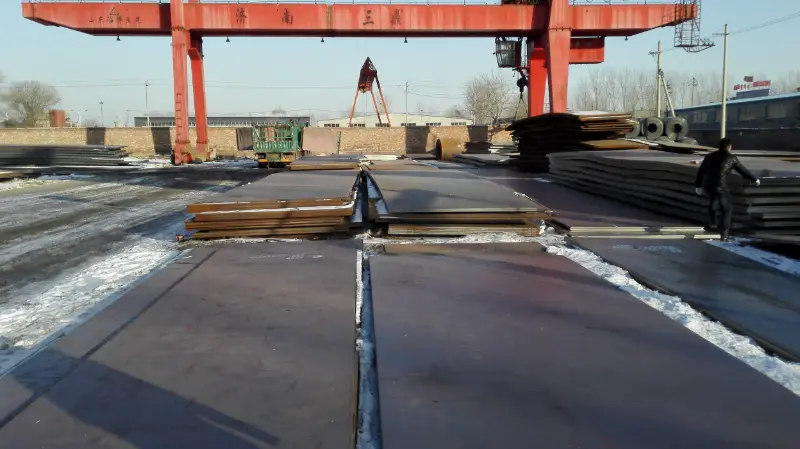
ABS Grade DH32 Shipbuilding Steel
ABS Grade DH32 Shipbuilding Steel: Composition, Properties & Equivalent Grades
Complete datasheet of ABS Grade DH32 high-strength hull structural steel including chemical composition, tensile and impact properties, bend test requirements, physical constants, and a list of fully equivalent DNV, LR, BV, GL, NK, CCS, RINA, KR grades.
Hot rolling, controlled rolling, normalizing, TMCP, welding, forming, flame/plasma cutting
- Phone : +8618037372205
- Email : [email protected]
- WhatsApp: Contact via Whtsapp
- WeChat: +8618037372205
ABS Grade DH32 Shipbuilding Steel Introduction
The American Bureau of Shipping (ABS) Grade DH32 is a high-strength structural steel designed for shipbuilding and offshore construction. Supplied in coil, plate or sheet form, it is produced via thermo-mechanical controlled rolling (TMCP) or normalizing and offers a minimum yield strength of 315 MPa with guaranteed impact toughness at -20°C.
- Excellent weldability and formability
- Good low-temperature notch toughness
- Widely recognized by all major classification societies under equivalent designations
- Suitable for critical hull and structural components in cold environments
ABS Grade DH32 Shipbuilding Steel Chemical Composition
The chemical composition specified by ABS for Grade DH32 ensures balanced strength, toughness, and weldability. Microalloying elements such as niobium, vanadium, and titanium are used for grain refinement and precipitation strengthening. Limits apply to both ladle and product analyses, with slight tolerances allowed in the finished product.
| Element | Content (max %) | Remarks |
|---|---|---|
| C | 0.18 | For thickness ≤ 50 mm; can be raised to 0.20 for thicker plates |
| Mn | 0.90–1.60 | |
| Si | 0.10–0.50 | |
| P | 0.035 | |
| S | 0.035 | |
| Cu | 0.35 | Residual element |
| Ni | 0.40 | Residual element |
| Cr | 0.20 | Residual element |
| Mo | 0.08 | Residual element |
| Al (total) | ≥ 0.015 | Required for fine grain practice |
| Nb | 0.02–0.05 | If added singly or in combination |
| V | 0.05–0.10 | If added |
| Ti | 0.007–0.05 | If added |
| Nb+V+Ti | ≤ 0.12 | Combined limit for microalloys |
ABS Grade DH32 Shipbuilding Steel Physical Properties
These physical constants are typical for DH32 steel and may vary slightly with temperature and processing conditions. The data are useful for design calculations and thermal analysis. Density, modulus, and thermal properties are consistent with standard structural steels of this strength class.
| Property | Typical Value | Unit | Conditions |
|---|---|---|---|
| Density (ρ) | 7.85 | g/cm³ | Room temperature |
| Modulus of elasticity (E) | 205 | GPa | Room temperature |
| Shear modulus (G) | ~79 | GPa | Calculated from E and ν |
| Poisson's ratio (ν) | 0.29 | – | |
| Thermal expansion coefficient (α) | 12.1 | ×10⁻⁶ /K | 20–100 °C |
| Thermal expansion coefficient (α) | 13.8 | ×10⁻⁶ /K | 20–600 °C |
| Thermal conductivity (λ) | 51 | W/(m·K) | 100 °C |
| Specific heat capacity (c) | 460 | J/(kg·K) | Room temperature |
| Electrical resistivity (ρe) | 0.18 | μΩ·m | Room temperature |
ABS Grade DH32 Shipbuilding Steel Mechanical Properties
Tensile, impact and bend properties as required by ABS Rules. Test specimens are taken in the longitudinal direction from plate products. Charpy V-notch impact values represent the minimum average of three specimens, with individual minimums not less than 70% of the specified average. Bend tests are performed through 180° with mandrel diameters varying by plate thickness.
| Property | Value | Unit | Test Conditions |
|---|---|---|---|
| Yield strength (ReH) | ≥ 315 | MPa | Room temperature, longitudinal |
| Tensile strength (Rm) | 440 – 590 | MPa | Room temperature, longitudinal |
| Elongation (A5.65√So) | ≥ 22 | % | Gauge length 5.65√So |
| Charpy impact energy (KV2) – average | ≥ 34 | J | -20 °C, longitudinal, 10×10 mm |
| Charpy impact energy (KV2) – single | ≥ 24 | J | -20 °C, longitudinal, 10×10 mm |
| Bend test (180°) – t ≤ 12 mm | d = 2t | – | No cracks after bending |
| Bend test (180°) – 12 mm < t ≤ 25 mm | d = 3t | – | |
| Bend test (180°) – 25 mm < t ≤ 50 mm | d = 4t | – | |
| Bend test (180°) – t > 50 mm | d = 5t | – |
ABS Grade DH32 Shipbuilding Steel Fully Equivalent Material Standards & Designations
| Region / Classification Society | Standard | Grade | Remarks |
|---|---|---|---|
| International (IACS) | UR W11 | DH32 | Unified Requirement; applied by all member societies |
| American Bureau of Shipping (USA) | ABS Rules | DH32 | Original designation |
| DNV (Norway) | DNV Rules | DH32 | Fully interchangeable |
| Lloyd's Register (UK) | LR Rules | DH32 | Fully interchangeable |
| Bureau Veritas (France) | BV Rules | DH32 | Fully interchangeable |
| Germanischer Lloyd (Germany) | GL Rules | DH32 | Now merged into DNV, but still recognized |
| Registro Italiano Navale (Italy) | RINA Rules | DH32 | |
| ClassNK (Japan) | NK Rules | DH32 | |
| China Classification Society | CCS Rules | DH32 | |
| Korean Register | KR Rules | DH32 |
ABS Grade DH32 Shipbuilding Steel Application Introduction
ABS Grade DH32 steel is extensively utilized in the maritime sector where a combination of high strength, excellent weldability, and guaranteed low-temperature impact properties is essential. It can be processed into a variety of shapes and components using standard metal fabrication methods.
Product Applications: Ocean-going vessels (e.g., bulk carriers, container ships, tankers), Inland and coastal ships, Offshore platform decks, legs, and jacket structures, Hull plates, shell plating, and decks, Structural modules and outfitting items
Processed into products: Longitudinal stiffeners and frames, Transverse web frames and girders, Bulkhead plates and stiffeners, Hatch coamings and covers, Main deck beams, Bottom and side shell plates, Foundations for heavy equipment, Wind turbine tower sections (offshore)
Application industries: Shipbuilding and marine engineering, Offshore oil & gas platforms, Port and harbor equipment, Bridge and infrastructure construction, Heavy machinery subjected to dynamic loading
ABS Grade DH32 Shipbuilding Steel Similar Substitute Materials
| Region / Standard Body | Standard | Grade | Remarks |
|---|---|---|---|
| ABS (USA) | ABS Rules | AH32 | Impact test at 0 °C; suitable for less severe service conditions |
| ABS (USA) | ABS Rules | EH32 | Higher toughness at -40 °C; for very cold environments |
| ABS (USA) | ABS Rules | DH36 | Higher strength (yield ≥355 MPa); same -20 °C toughness |
| ABS (USA) | ABS Rules | DH40 | Even higher strength (yield ≥390 MPa); same toughness class |
| EN 10025-2 (Europe) | EN 10025-2 | S355J2+N | Structural steel with similar strength; not certified for shipbuilding unless additionally approved |
Notes:
- Produced under ABS survey and certification; material is supplied with ABS test certificates.
- Welding procedures must be in accordance with ABS Rules and approved consumables; preheat may be required for carbon equivalent above 0.41%.
- Surface condition: Mill finish, optionally blasted and primed for corrosion protection.
- Dimensional tolerances comply with the applicable ABS or ASTM/EN standards as agreed.
- Share



