
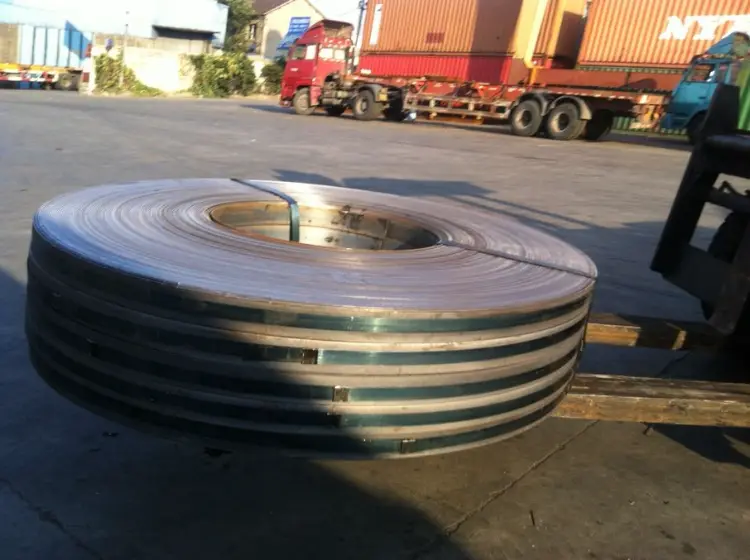
ABS Grade AH32 Shipbuilding Steel Coil
ABS Grade AH32 Shipbuilding Steel Coil: High Strength, Excellent Weldability & Low-Temperature Toughness
Detailed data sheet for ABS Grade AH32 shipbuilding steel, including chemical composition, mechanical properties, physical properties, international equivalents, and applications.
Hot rolling, controlled rolling, normalizing, TMCP, welding, forming
- Phone : +8618037372205
- Email : [email protected]
- WhatsApp: Contact via Whtsapp
- WeChat: +8618037372205
ABS Grade AH32 Shipbuilding Steel Coil Introduction
ABS Grade AH32 is a high-strength hull structural steel standardized by the American Bureau of Shipping (ABS) for shipbuilding and offshore engineering. It belongs to the AH32 category, where 'A' indicates impact testing at 0 °C, 'H' denotes higher strength, and '32' refers to a minimum yield strength of 315 MPa. This steel is widely adopted in the construction of large vessels, offshore platforms, and marine structures due to its excellent combination of strength, weldability, and low-temperature toughness.
AH32 is produced through controlled rolling, normalizing, or thermomechanical controlled processing (TMCP), resulting in a fine-grained ferrite-pearlite microstructure. It exhibits good ductility and reliable notch toughness at service temperatures down to 0 °C, meeting stringent safety requirements. The steel can be readily welded using standard shipbuilding practices without significant preheating, and it offers good corrosion resistance in marine environments.
Key characteristics include:
- Minimum yield strength of 315 MPa for thicknesses up to 100 mm
- Tensile strength in the range of 440–590 MPa
- Guaranteed Charpy impact energy at 0 °C (≥27 J longitudinal)
- Excellent weldability with low carbon equivalent (CE ≤ 0.38%)
- Availability in coils, plates, and wide flats
ABS Grade AH32 Shipbuilding Steel Coil Chemical Composition
The chemical composition of ABS Grade AH32 is designed to achieve high strength while maintaining good toughness and weldability. Microalloying elements such as Nb, V, Ti, and Al are used to refine grain size and provide precipitation strengthening. The carbon equivalent (CE) is controlled to ≤0.38% to ensure excellent weldability without the need for excessive preheating. All values are based on heat analysis as per ABS rules.
| Element | Typical Value / Range (max unless specified) | Remarks |
|---|---|---|
| C | ≤ 0.18 | Carbon content controlled for strength and weldability |
| Mn | 0.90 – 1.60 | Manganese contributes to strength and deoxidation |
| Si | 0.10 – 0.50 | Silicon for deoxidation and strength |
| P | ≤ 0.035 | Phosphorus restricted for toughness |
| S | ≤ 0.035 | Sulfur restricted for ductility and cleanliness |
| Al (acid soluble) | ≥ 0.015 | Grain refinement (fine grain practice) |
| Nb | ≤ 0.05 | Niobium microalloying for strength and grain refinement |
| V | ≤ 0.10 | Vanadium microalloying for precipitation strengthening |
| Ti | ≤ 0.02 | Titanium for grain refinement and nitrogen fixing |
| Cu | ≤ 0.35 | Copper may be present; limited for surface quality |
| Cr | ≤ 0.20 | Chromium residual; not intentionally added |
| Ni | ≤ 0.40 | Nickel residual; beneficial for toughness |
| Mo | ≤ 0.08 | Molybdenum residual |
| N | ≤ 0.012 | Nitrogen limited to avoid aging effects |
| Ceq (IIW) | ≤ 0.38 | Carbon equivalent = C+Mn/6+(Cr+Mo+V)/5+(Ni+Cu)/15 |
ABS Grade AH32 Shipbuilding Steel Coil Thermal and Electrical Physical Properties
The physical properties of AH32 are representative of low-alloy structural steels. Actual values may vary slightly depending on heat treatment and exact composition. The data provided here are typical for normalized or TMCP condition at room temperature unless otherwise noted.
| Property | Typical Value | Unit | Test Condition / Remarks |
|---|---|---|---|
| Density (ρ) | 7.85 | g/cm³ | At 20 °C |
| Modulus of Elasticity (E) | 205 | GPa | At 20 °C |
| Shear Modulus (G) | 79.3 | GPa | Estimated from E and Poisson's ratio |
| Poisson's Ratio (ν) | 0.29 – 0.30 | — | At 20 °C |
| Thermal Expansion Coefficient (α) | 11.5 | 10⁻⁶/K | Between 20 °C and 100 °C |
| Thermal Expansion Coefficient (α) | 12.3 | 10⁻⁶/K | Between 20 °C and 200 °C |
| Thermal Expansion Coefficient (α) | 13.0 | 10⁻⁶/K | Between 20 °C and 300 °C |
| Thermal Conductivity (λ) | 51.9 | W/(m·K) | At 20 °C |
| Specific Heat Capacity (cp) | 486 | J/(kg·K) | At 20 °C |
| Electrical Resistivity (ρₑ) | 0.22 | Ω·mm²/m | At 20 °C |
ABS Grade AH32 Shipbuilding Steel Coil Mechanical Properties
The mechanical properties of ABS AH32 comply with ABS Rules for thicknesses up to 100 mm. The yield strength is determined using 0.2% offset method, and tensile testing is performed on transverse specimens. Impact toughness is verified using standard Charpy V-notch specimens at 0 °C. The actual values depend on the thickness and test direction; longitudinal impact values are shown. Bending tests are performed to confirm formability.
| Property | Standard Requirement | Unit | Test Condition / Remarks |
|---|---|---|---|
| Yield Strength (ReH) | ≥ 315 | MPa | Thickness ≤ 50 mm; transverse specimen |
| Yield Strength (ReH) | ≥ 305 | MPa | Thickness > 50 mm to 70 mm |
| Yield Strength (ReH) | ≥ 295 | MPa | Thickness > 70 mm to 100 mm |
| Tensile Strength (Rm) | 440 – 590 | MPa | All thickness grades; transverse specimen |
| Elongation (A) | ≥ 22 | % | Gauge length 5.65√S0; thickness ≤ 50 mm |
| Elongation (A) | ≥ 21 | % | Thickness > 50 mm to 70 mm |
| Elongation (A) | ≥ 20 | % | Thickness > 70 mm to 100 mm |
| Charpy Impact Energy (KV2) | ≥ 27 | J | At 0 °C; longitudinal specimen; thickness ≤ 50 mm |
| Charpy Impact Energy (KV2) | ≥ 24 | J | At 0 °C; longitudinal; thickness > 50 mm to 70 mm |
| Charpy Impact Energy (KV2) | ≥ 21 | J | At 0 °C; longitudinal; thickness > 70 mm to 100 mm |
| Bend Test (Mandrel Diameter) | 3t (t = specimen thickness) | — | 180° bend, no cracks; for plate thickness ≤ 35 mm |
ABS Grade AH32 Shipbuilding Steel Coil Fully Equivalent International Standards and Substitutable Grades
| Country / Region | Standard | Grade | Remarks |
|---|---|---|---|
| International | ABS | AH32 | Original specification |
| Norway / Germany | DNV | AH32 | Det Norske Veritas; equivalent requirements |
| United Kingdom | LR | AH32 | Lloyd's Register; identical mechanical/chemical limits |
| France | BV | AH32 | Bureau Veritas; same yield and impact criteria |
| China | CCS | AH32 | China Classification Society; fully compatible |
| Germany | GL | AH32 | Germanischer Lloyd (now part of DNV GL); identical |
| Japan | NK | AH32 | Nippon Kaiji Kyokai; equivalent high-strength grade |
| Italy | RINA | AH32 | Registro Italiano Navale; corresponding specification |
| South Korea | KR | AH32 | Korean Register; matched properties |
| International | IACS UR W11 | AH32 | International Association of Classification Societies unified requirement |
ABS Grade AH32 Shipbuilding Steel Coil Application Introduction
ABS AH32 is a versatile high-strength steel for marine and offshore applications. It can be formed, welded, and machined using standard techniques. The delivery condition (normalized, TMCP, etc.) should be selected based on component thickness and required toughness.
Product Applications: Ship hull plates and stiffeners (bottom, side, deck), Web frames and longitudinal girders, Bulkhead plates, Offshore platform legs and braces, Wind turbine monopiles and transition pieces, Marine pressure vessel shells (LNG tank outer hulls)
Processed into products: Cut panels (welded assemblies), Rolled and bent profiles (frames), Flame-cut structural blanks, Welded built-up sections (T-bars, bulb profiles), Machined base plates and connectors, Forged fittings (after transformation from plate/coil)
Application industries: Shipbuilding (commercial vessels: bulk carriers, tankers, container ships; naval ships), Offshore oil and gas (jacket structures, topsides, drilling platforms), Renewable energy (offshore wind turbine foundations, transition pieces), Marine engineering (barges, dredgers, floating cranes), Port and harbor construction (dock gates, caissons)
ABS Grade AH32 Shipbuilding Steel Coil Similar and Alternative Grades for Consideration
| Country / Region | Standard | Grade | Remarks |
|---|---|---|---|
| International | ABS | AH36 | Higher strength (ReH ≥355 MPa); also suitable for shipbuilding, often interchangeable in design if strength is needed |
| International | ABS | DH32 | Similar strength but impact tested at -20 °C; better for colder environments |
| International | ABS | AH32 (Z35) | Through-thickness properties (Z-quality); required for highly restrained joints |
| Europe | EN 10025-4 | S355ML | Thermomechanically rolled weldable fine-grain steel; comparable yield strength, used in offshore structures |
| Europe | EN 10225 | S355G7+N | Offshore structural steel; similar mechanical properties with normalizing delivery |
| Japan | JIS G 3106 | SM490A/B/C | Welded structural steel; similar tensile/yield range but different impact temperature classification |
Notes:
Additional requirements:
- Z-direction testing (through-thickness tensile) may be required for thick plates subjected to high restraint; specify AH32-Z25 or -Z35 accordingly.
- Ultrasonic testing per ASTM A578 Level I or II is common for critical applications.
- Surface quality and dimensional tolerances shall comply with ABS rules or ISO 901.
- Welding consumables should match AH32 strength and low-temperature toughness; preheat may be required for thick sections (>50 mm) to prevent hydrogen cracking.
- For coil material, additional flattening or leveling may be needed; verify coil break free condition if used for plate replacement.
- Share



