
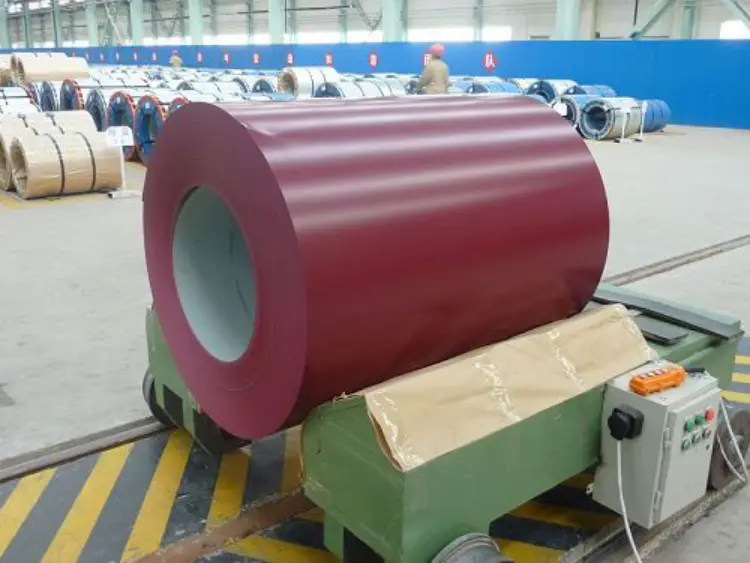
ABS Grade E Shipbuilding Steel Coil
ABS Grade E Shipbuilding Steel Coil - Low-Temperature Toughness Marine Steel
Comprehensive material data for ABS Grade E shipbuilding steel coil: chemical composition, mechanical & thermal properties, international equivalents, and application guidance.
Hot rolling, normalizing, controlled rolling, thermo-mechanical control process (TMCP), quenching & tempering (optional), cutting, forming, and welding
- Phone : +8618037372205
- Email : [email protected]
- WhatsApp: Contact via Whtsapp
- WeChat: +8618037372205
ABS Grade E Shipbuilding Steel Coil Introduction
ABS Grade E is an ordinary-strength hull structural steel regulated by the American Bureau of Shipping (ABS). It is designed for welded ship structures requiring high notch toughness at low temperatures. The grade is fully killed and produced with fine-grain practice, ensuring excellent weldability and resistance to brittle fracture. Typical minimum yield strength is 235 MPa, with tensile strength ranging from 400 to 520 MPa. Charpy V-notch impact testing is performed at -40°C, providing reliable performance in cold-climate marine environments. Delivered as coils, plates, or sections, this steel is widely used in shipbuilding and offshore engineering for critical structural components.
ABS Grade E Shipbuilding Steel Coil Chemical Composition per ABS Rules
Typical ladle analysis limits for ABS Grade E ordinary-strength steel. Elements are controlled to ensure weldability, strength, and low‑temperature toughness. Grade E must be fully killed and fine‑grain practice is mandatory. Residual elements are kept within specified limits.
| Element | Standard Value | Remarks |
|---|---|---|
| Carbon (C) | ≤ 0.18% | Maximum; lower carbon improves weldability and toughness |
| Manganese (Mn) | 0.70 – 1.35% | Minimum 0.70% for all thicknesses; upper limit for strength and formability |
| Silicon (Si) | ≤ 0.50% | If silicon‑killed; typical range 0.15–0.40%; contributes to deoxidation |
| Phosphorus (P) | ≤ 0.035% | Maximum; restricted to avoid embrittlement |
| Sulfur (S) | ≤ 0.035% | Maximum; low sulfur improves through‑thickness properties |
| Aluminum (Al)acid sol. | ≥ 0.015% | Acid‑soluble aluminum; ensures fine‑grain structure |
| Total Aluminum (Altotal) | 0.020 – 0.070% | Often specified for fully killed fine‑grain practice |
| Niobium (Nb) | Optional, ≤ 0.05% | May be added as grain refiner; combined Nb+V+Ti ≤ 0.12% |
| Vanadium (V) | Optional, ≤ 0.10% | May be added; combined Nb+V+Ti ≤ 0.12% |
| Titanium (Ti) | Optional, ≤ 0.02% | May be added; combined Nb+V+Ti ≤ 0.12% |
| Copper (Cu) | ≤ 0.35% | Residual if not specified; higher levels may require special precautions |
| Chromium (Cr) | ≤ 0.20% | Residual; not normally added |
| Nickel (Ni) | ≤ 0.40% | Residual; can improve toughness |
| Molybdenum (Mo) | ≤ 0.08% | Residual |
| Carbon Equivalent (CEV) | Typically ≤ 0.40% | Not mandatory but controlled for weldability |
ABS Grade E Shipbuilding Steel Coil Thermal & Electrical Physical Properties
Representative physical properties for carbon‑manganese structural steel similar to ABS Grade E. Values may vary slightly with composition and heat treatment. Density, elastic moduli, and thermal expansion are standard for mild steel. Electrical resistivity is given for comparative purposes only.
| Property | Typical Value | Unit | Test Conditions |
|---|---|---|---|
| Density (ρ) | 7.85 | g/cm³ | 20°C |
| Elastic Modulus (E) | 205 – 210 | GPa | Room temperature, static tensile test |
| Shear Modulus (G) | 79 – 81 | GPa | Calculated from E and Poisson's ratio |
| Poisson's Ratio (ν) | 0.29 – 0.30 | – | Elastic range, room temperature |
| Thermal Expansion Coefficient (α) | 11.5 – 13.5 | 10⁻⁶/K | 20–200°C average |
| Thermal Conductivity (λ) | 43 – 52 | W/(m·K) | At 100°C; decreases with temperature |
| Specific Heat Capacity (cₚ) | 460 – 485 | J/(kg·K) | 20–200°C |
| Electrical Resistivity (ρₑ) | 0.15 – 0.20 | µΩ·m | 20°C, typical for carbon steel |
ABS Grade E Shipbuilding Steel Coil Mechanical Properties
Tensile and impact properties for ABS Grade E in normalized or TMCP condition, tested in accordance with ABS Rules. Charpy V‑notch tests are performed at −40°C. Elongation is measured on gauge length 5.65√S₀. Values apply to thicknesses up to 50 mm unless otherwise noted.
| Property | Required Value | Unit | Test Conditions |
|---|---|---|---|
| Yield Strength (ReH) | ≥ 235 | MPa | Room temperature, transverse or longitudinal specimen |
| Tensile Strength (Rm) | 400 – 520 | MPa | Room temperature, transverse or longitudinal specimen |
| Elongation (A5) | ≥ 22 | % | Gauge length 5.65√S₀, t ≤ 50 mm, transverse/longitudinal |
| Elongation (A5) | ≥ 20 | % | Thickness > 50 mm, per ABS reduction schedule |
| Charpy V‑notch Impact Energy | ≥ 27 (avg) / ≥ 20 (single) | J | Longitudinal, −40°C; sub‑size specimens adjusted |
| Charpy V‑notch Impact Energy | ≥ 20 (avg) / ≥ 14 (single) | J | Transverse, −40°C; sub‑size specimens adjusted |
| Bend Test (180°) | No cracks | – | Mandrel diameter 3× thickness (t ≤ 25 mm) or as specified |
ABS Grade E Shipbuilding Steel Coil Fully Equivalent Standards & Substitution Grades
| Country/Region | Standard | Grade | Remarks |
|---|---|---|---|
| International | ISO 630-3 | HSA/HSB/E | Ordinary‑strength hull structural steel; Grade E corresponds to toughness level |
| United Kingdom | Lloyd's Register (LR) | Grade E | Equivalent to ABS Grade E in all respects |
| Norway/Germany | DNV GL (now DNV) | NV E (VL E) | Identical shipbuilding steel specifications |
| France | Bureau Veritas (BV) | Grade E | Full equivalence for marine construction |
| China | CCS (China Classification Society) | Grade E | Same chemical and mechanical requirements |
| Japan | Nippon Kaiji Kyokai (NK) | Grade E | Identical toughness class |
| South Korea | Korean Register (KR) | Grade E | Full parity |
| Italy | RINA | Grade E | Equivalent hull structural steel |
| Russia | Russian Maritime Register (RS) | Grade E | Same specification |
| Germany | Germanischer Lloyd (GL) legacy | GL–E | Historical equivalence; now part of DNV |
ABS Grade E Shipbuilding Steel Coil Application Introduction
ABS Grade E steel coil is optimized for welded structures in shipbuilding and offshore engineering where low‑temperature toughness is critical. It can be processed into plates, profiles, and sections using standard metalworking techniques. Key attributes:
- Excellent notch toughness at −40°C
- Good weldability with low carbon equivalent
- Homogeneous fine‑grain microstructure
- Formable for cold bending and rolling
- Compliance with all major classification societies
Product Applications: Hull plates and shell plating, Main deck and internal deck panels, Bulkheads, web frames, and stiffeners, Offshore platform topside modules, Ice‑breaker hulls and polar supply vessels, LNG carrier containment structures, Barges, tugs, and workboats
Processed into products: Longitudinal and transverse frames, Keel and stern frame segments, Rudder horns and skegs, Hatch coamings and covers, Deck plates and floor plates, Watertight bulkheads and tank boundaries, Foundation plates for machinery, Brackets, gussets, and doublers
Application industries: Shipbuilding and repair, Offshore oil & gas platforms, Marine and coastal structures, Arctic engineering and ice‑class vessels, Pressure vessel manufacturing (non‑lethal service), Bridge and heavy infrastructure construction
ABS Grade E Shipbuilding Steel Coil Similar / Alternative Materials
| Country/Region | Standard | Grade | Remarks |
|---|---|---|---|
| Europe (EN) | EN 10025-2 | S235J2 | Similar yield strength (235 MPa), impact at −20°C (KV 27J); not fully equivalent for −40°C service |
| Europe (EN) | EN 10025-2 | S235J0 | Impact at 0°C; lower toughness, for less demanding marine applications |
| USA (ASTM) | ASTM A131 | Grade E | Ordinary strength, same toughness level; equivalent to ABS Grade E in IACS context |
| USA (ASTM) | ASTM A36/A36M | A36 | Common structural steel, yield 250 MPa, but lack of guaranteed low‑temperature toughness |
| Russia | GOST 5521 | D | Similar hull steel, but often tested at −40°C with minor compositional differences |
| China | GB/T 712 | Grade E | Chinese standard for shipbuilding steel; practically identical to ABS Grade E |
Notes:
Welding precautions: Low‑hydrogen processes (SMAW, SAW, GMAW) are recommended to prevent cold cracking. Preheating is generally not required for thicknesses below 25 mm, but may be necessary for higher restraint joints. Heat treatment: Normalizing or stress‑relieving may be applied after forming to restore toughness. Certification: Material must be supplied with ABS 3.2 inspection certificate including chemical analysis, tensile, and impact test reports. The steel is fully compliant with IACS Unified Requirements W11 and W13.
- Share



