
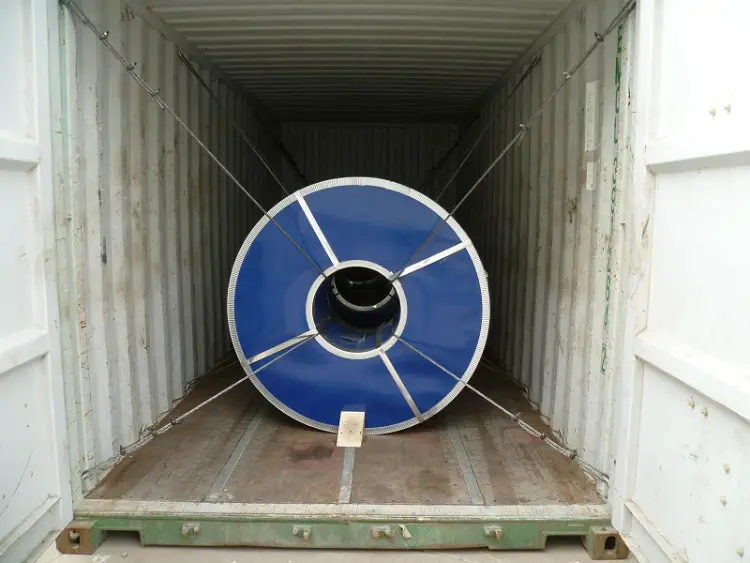
ABS Grade D Shipbuilding Steel Coil
ABS Grade D Shipbuilding Steel Coil - Normal Strength Hull Structural Steel for Marine Applications
Comprehensive data sheet for ABS Grade D shipbuilding steel coil: chemical composition, mechanical properties, physical properties, international equivalents, and application guidance for marine structures.
Hot rolling, controlled rolling, normalizing (as required by thickness), cutting, bending, welding, and machining
- Phone : +8618037372205
- Email : [email protected]
- WhatsApp: Contact via Whtsapp
- WeChat: +8618037372205
ABS Grade D Shipbuilding Steel Coil Introduction
ABS Grade D is a normal strength hull structural steel specified by the American Bureau of Shipping (ABS) for use in shipbuilding and marine construction. It belongs to the group of ordinary strength ship steels and is widely applied in the construction of ship hulls, decks, bulkheads, and offshore structures. Grade D is a fully killed, fine grain steel with improved notch toughness at sub-zero temperatures, guaranteed by impact testing at -20°C. It offers good weldability, formability, and reliable strength, with a minimum yield strength of 235 MPa and tensile strength in the range of 400–520 MPa. The steel is typically delivered in normalized or controlled rolling condition. This grade is recognized internationally and has equivalent designations in all major classification societies, making it a standardized choice for global shipbuilding projects.
ABS Grade D Shipbuilding Steel Coil Chemical Composition of ABS Grade D
The chemical composition conforms to ABS Rules for ordinary strength hull structural steel. Grade D requires fully killed practice and fine grain treatment. Carbon equivalent (Ceq) may be limited by additional requirements. Ranges and limits are typical for thickness ≤ 50 mm.
| Chemical Element | Standard Value (max, %) | Remarks |
|---|---|---|
| Carbon (C) | ≤ 0.21 | Typical for Grade D; lower carbon improves weldability |
| Silicon (Si) | ≤ 0.50 | Deoxidizer; typical range 0.15–0.50% |
| Manganese (Mn) | ≥ 2.5 × C (min) | Minimum linked to carbon content; typical range 0.80–1.50% |
| Phosphorus (P) | ≤ 0.035 | Upper limit for toughness |
| Sulfur (S) | ≤ 0.035 | Upper limit for ductility |
| Aluminum (Al) total | ≥ 0.015 (if Al is used as grain refiner) | Required for fine grain practice; other grain refiners may be used |
| Nitrogen (N) | ≤ 0.009 (when Al treated) | Typically controlled for fine grain steel |
| Carbon Equivalent (Ceq) | ≤ 0.40 (typical) | Ceq = C + Mn/6 + (Cr+Mo+V)/5 + (Ni+Cu)/15; applies for specified thickness range |
| Note | All values in mass percent. Copper, Chromium, Nickel, Molybdenum may be present as residuals but not intentionally added without agreement. |
ABS Grade D Shipbuilding Steel Coil Thermal and Electrical Physical Properties
These physical properties are typical for low-carbon structural steel and are provided as general guidance. They are not normalized by ABS rules but are representative of materials similar to ABS Grade D. Properties can vary slightly with manufacturing process and temperature.
| Property | Typical Value | Unit | Test Condition / Remarks |
|---|---|---|---|
| Density (ρ) | 7.85 | g/cm³ | At ambient temperature |
| Modulus of Elasticity (E) | 205 | GPa | At ambient temperature |
| Shear Modulus (G) | 80 | GPa | Calculated from E and Poisson's ratio |
| Poisson's Ratio (ν) | 0.3 | — | Typical for steel |
| Thermal Expansion Coefficient (α) | 12.0 × 10⁻⁶ | /K | Average for 20–100°C |
| Thermal Conductivity (λ) | 48 | W/(m·K) | At 20°C; decreases with increasing temperature |
| Specific Heat Capacity (cₚ) | 460 | J/(kg·K) | At 20°C |
| Electrical Resistivity (ρₑ) | 0.20 | µΩ·m | At 20°C, approximate for low carbon steel |
ABS Grade D Shipbuilding Steel Coil Mechanical Properties of ABS Grade D
Mechanical properties are determined according to ABS Rules. Values apply to flat products of thickness ≤ 50 mm. Tensile test is transverse. Impact test temperature is -20°C for Grade D. Bend test is specified with mandrel diameter depending on thickness.
| Property | Standard Requirement Value | Unit | Test Condition / Remarks |
|---|---|---|---|
| Minimum Yield Strength (ReH) | 235 | MPa | Transverse, room temperature, for all thicknesses ≤ 50 mm |
| Tensile Strength (Rm) | 400–520 | MPa | Transverse, room temperature |
| Elongation (A) | ≥ 22 | % | Gauge length 5.65√S₀ (proportional), transverse, thickness ≤ 50 mm |
| Elongation (A50) | ≥ 24 (typical derived) | % | Based on 200 mm gauge length for plate ≤ 50 mm (alternative requirement if requested) |
| Impact Energy (KV, longitudinal) | ≥ 27 (average of 3 tests); single min ≥ 20 | J | Charpy V-notch, -20°C, longitudinal specimen |
| Bend Test (Cold Bend, 180°) | No cracks (d = 2a for t ≤ 25 mm; d = 3a for t > 25 mm) | Bending mandrel diameter versus specimen thickness |
ABS Grade D Shipbuilding Steel Coil International Equivalents – Directly Replaceable Grades of ABS Grade D
| Country / Classification Society | Standard | Grade Designation | Remarks |
|---|---|---|---|
| DNV (Norway/Germany) | DNV Rules for Ships / OS | Grade D | Identical mechanical and toughness requirements; fully equivalent for thicknesses up to 50 mm |
| Lloyd's Register (UK) | LR Rules for Ships | Grade D | Direct equivalent with same yield/tensile and -20°C impact |
| Bureau Veritas (France) | BV Rules for Steel Ships | Grade D | Equivalent normal strength hull steel; same performance class |
| China Classification Society | CCS Rules for Steel Ships | Grade D | Equivalent; commonly used in Asian shipyards |
| Nippon Kaiji Kyokai (Japan) | NK Rules for Ships | Grade D | Same designation and requirements |
| Korean Register | KR Rules for Ships | Grade D | Direct equivalent |
| RINA (Italy) | RINA Rules for Ships | Grade D | Equivalent in all respects |
| ASTM (USA) | ASTM A131 / A131M | Grade D | USA standard for ship steel; identical strength and ductility, impact at -20°C |
| EN (Europe) | EN 10025-2 (structural steel) – not ship class, but comparable strength | S235J2+N (informative comparison) | S235J2 provides similar yield/tensile and -20°C impact, but not certified by classification society; for non-marine use only |
ABS Grade D Shipbuilding Steel Coil Application Introduction
ABS Grade D is primarily used in shipbuilding and marine construction where good weldability, moderate strength, and reliable low-temperature toughness are required. It is suitable for structural components subjected to dynamic loading and cold environments, especially when service temperatures may drop below 0°C. Typical applications include:
Product Applications: Ship hull plates (shell plating, deck, bottom, side shell), Longitudinal and transverse stiffeners, Bulkheads and web frames, Superstructure plates, Barge hulls and deck plates
Processed into products: Main deck and strength deck plates, Side shell plating above and below waterline, Bottom shell plating, Transverse bulkheads, Inner bottom plating, Hatch coamings and corner reinforcements, Foundation plates for heavy machinery
Application industries: Commercial shipbuilding (bulk carriers, tankers, container ships, Ro-Ro vessels), Naval shipbuilding (auxiliary vessels), Offshore oil and gas (platform decks, helidecks, accommodation modules), Barge and pontoon construction, Marine equipment and crane structures, Bridge structures (where marine environment demands class-approved steel)
ABS Grade D Shipbuilding Steel Coil Similar Steel Grades with Comparable Performance
| Country / Standard | Grade | Similarity and Notes |
|---|---|---|
| ABS | ABS Grade A | Normal strength hull steel with lower toughness requirement (impact at 0°C instead of -20°C). Suitable for less demanding applications where fracture toughness at low temperature is not critical. |
| ABS | ABS Grade B | Same strength level; impact tested at 0°C. Often substituted for Grade D if service temperature allows. |
| ABS | ABS Grade E | Higher toughness class (impact at -40°C). Can replace Grade D in extreme low-temperature conditions; more expensive. |
| ASTM A36 | A36 | General structural carbon steel with similar yield (≥250 MPa) but no specific low-temperature impact requirement. Used for non-marine structural applications. |
| EN 10025-2 | S235J2+N | Structural steel with guaranteed impact at -20°C; comparable strength. Not classed for shipbuilding but may be used in auxiliary structures. |
| API 2H Grade 42 | API 2H-42 | Offshore structural steel with yield ~290 MPa; higher strength but often accepted for marine structures if toughness is adequate. |
Notes:
ABS Grade D is often supplied with additional notation such as 'TM' (thermo-mechanically rolled) or 'N' (normalized) depending on delivery condition. Ultrasonic testing (Class I, II, or III) may be required as per purchaser's specification. The steel is suitable for welding with all common shipbuilding welding processes (SAW, SMAW, GMAW, FCAW) using appropriate low-hydrogen consumables and preheat for thicker sections. For thicknesses above 50 mm, supplementary requirements and restricted chemical composition may apply; refer to the latest ABS Rules.
- Share



