
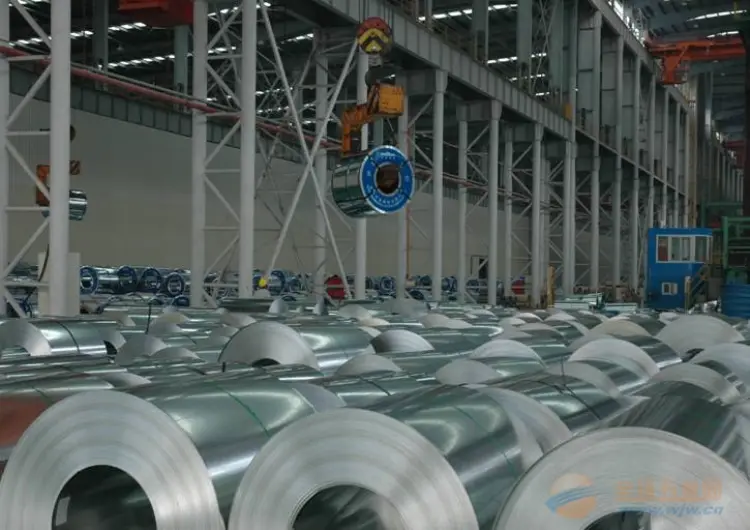
ABS Grade B Shipbuilding Steel Coil
ABS Grade B Shipbuilding Steel Coil - Properties, Equivalents & Application Data
Complete material specifications for ABS Grade B shipbuilding steel coil: chemical composition, mechanical & thermal properties, international equivalents, and industrial applications.
Hot rolling, Controlled rolling, Normalizing, Thermo-mechanical controlled processing (TMCP), Cold rolling, Cutting, Welding, Bending, Forming
- Phone : +8618037372205
- Email : [email protected]
- WhatsApp: Contact via Whtsapp
- WeChat: +8618037372205
ABS Grade B Shipbuilding Steel Coil Introduction
ABS Grade B is a normal-strength hull structural steel specified by the American Bureau of Shipping. It is widely used in shipbuilding and offshore structures. The steel is fully killed, fine-grain treated, and delivered in coil or plate form.
- Minimum yield strength: 235 MPa (34 ksi)
- Excellent weldability and formability
- Notch toughness at 0°C (Charpy V-notch test)
- Available in various thicknesses with tailored mechanical properties
ABS Grade B Shipbuilding Steel Coil Chemical Composition - Typical Ladle Analysis per ABS Rules
The chemical composition of ABS Grade B steel is designed for good weldability and notch toughness. The steel is fully killed and fine-grain treated with aluminum. Carbon equivalent (Ceq) is controlled to enhance weldability.
- Maximum limits are given for impurity elements.
- Microalloying with Nb, V, or Ti is optional for grain refinement.
| Element | Standard Value (max or range) | Remarks |
|---|---|---|
| C (Carbon) | ≤ 0.21% | Ladle analysis; may be reduced for improved toughness |
| Mn (Manganese) | 0.80 - 1.10% | For thickness ≤ 25.4 mm; minimum 0.60% for greater thicknesses |
| Si (Silicon) | 0.10 - 0.35% | Deoxidation element, fine-grain practice |
| P (Phosphorus) | ≤ 0.035% | Impurity control for ductility |
| S (Sulfur) | ≤ 0.035% | Impurity control for weldability and toughness |
| Cu (Copper) | ≤ 0.35% | Residual element; may affect hot shortness if high |
| Cr (Chromium) | ≤ 0.20% | Residual element |
| Ni (Nickel) | ≤ 0.40% | Residual element |
| Mo (Molybdenum) | ≤ 0.08% | Residual element |
| Al (Aluminum, total) | 0.020 - 0.050% | For grain refinement; acid-soluble Al ≥ 0.015% |
| Nb (Niobium) | 0.02 - 0.05% | Optional microalloying for grain refinement |
| V (Vanadium) | 0.05 - 0.10% | Optional microalloying |
| Ti (Titanium) | ≤ 0.02% | Optional for improving weldability |
| Ceq (Carbon Equivalent) | ≤ 0.40% | Typical control limit; Ceq = C + Mn/6 + (Cr+Mo+V)/5 + (Ni+Cu)/15 |
ABS Grade B Shipbuilding Steel Coil Thermal & Electrical Physical Properties
The following properties are typical for low-carbon structural steels such as ABS Grade B. Exact values may vary with composition and microstructure. These data are useful for heat transfer, thermal expansion, and electrical applications.
| Property | Typical Value | Unit | Test Condition / Remarks |
|---|---|---|---|
| Density (ρ) | 7.85 | g/cm³ | Room temperature; 7850 kg/m³ |
| Elastic Modulus (E) | 200 - 210 | GPa | Room temperature |
| Shear Modulus (G) | 75 - 80 | GPa | Room temperature, estimated from E and ν |
| Poisson's Ratio (ν) | 0.27 - 0.30 | Elastic range | |
| Thermal Expansion Coefficient (α) | 11.7 × 10⁻⁶ | 1/K (or /°C) | Mean, 20 - 100 °C |
| Thermal Expansion Coefficient (α) | 12.5 × 10⁻⁶ | 1/K | Mean, 20 - 300 °C |
| Thermal Conductivity (λ) | 50 - 60 | W/(m·K) | At 20 °C; decreases with temperature |
| Specific Heat Capacity (cp) | 460 - 500 | J/(kg·K) | At 100 °C |
| Electrical Resistivity (ρe) | 0.16 - 0.20 × 10⁻⁶ | Ω·m | At room temperature |
ABS Grade B Shipbuilding Steel Coil Mechanical Properties - Minimum / Typical Values
Mechanical properties are determined on test pieces taken in the longitudinal direction unless otherwise stated. The values below are for thickness ranges common in shipbuilding. Charpy V-notch impact tests are performed at 0°C. Elongation refers to a gauge length of 5.65√S₀ (A5).
| Property | Standard Requirement | Unit | Test Condition / Remarks |
|---|---|---|---|
| Yield Strength (ReH) | ≥ 235 | MPa | Thickness ≤ 50 mm |
| Yield Strength (ReH) | ≥ 225 | MPa | Thickness > 50 mm to 70 mm |
| Yield Strength (ReH) | ≥ 215 | MPa | Thickness > 70 mm to 100 mm |
| Tensile Strength (Rm) | 400 - 490 | MPa | All thicknesses |
| Tensile Strength (Rm) | 400 - 490 | MPa | For coils after decoiling and flattening, slightly higher values allowed |
| Elongation (A) | ≥ 22 | % | A5 (5.65√S₀) for thickness ≤ 50 mm |
| Elongation (A) | ≥ 21 | % | A5 for thickness > 50-70 mm |
| Elongation (A) | ≥ 20 | % | A5 for thickness > 70-100 mm |
| Charpy Impact (KV) | ≥ 27 (average) | J | Longitudinal specimen, 0°C; individual min. 20 J |
| Charpy Impact (KV) | ≥ 20 (average) | J | Transverse specimen, 0°C; individual min. 15 J |
| Bend Test (180°) | No cracks | Dia = 2t for thickness ≤ 25 mm; 3t for 25 < t ≤ 50 mm; longer for greater thickness |
ABS Grade B Shipbuilding Steel Coil Full Equivalents – Identical Shipbuilding Grades
These grades are fully interchangeable with ABS Grade B as they meet the common IACS (International Association of Classification Societies) standard for normal-strength hull structural steel, grade B.
| Country / Region | Standard | Grade | Remarks |
|---|---|---|---|
| USA | ASTM A131 / A131M | Grade B | Same chemistry and mechanical requirements |
| China | GB 712-2011 / CCS Rules | CCS B | Identical to IACS specification |
| UK | Lloyd's Register Rules | LR B | Same grade B |
| Norway / Germany | DNV Rules | DNV B (NV B) | Same grade B |
| France | Bureau Veritas Rules | BV B | Same grade B |
| Italy | RINA Rules | RINA B | Same grade B |
| Japan | NK Rules | NK B | Same grade B |
| Korea | KR Rules | KR B | Same grade B |
| International | IACS Recommendation No. 12 | Grade B | Unified requirement for normal strength ship steels |
ABS Grade B Shipbuilding Steel Coil Application Introduction
ABS Grade B steel is a primary material in shipbuilding and marine engineering due to its balanced strength, ductility, and notch toughness at 0°C. It is particularly suited for welded structures in medium ambient temperatures.
- Common thicknesses: 6 – 100 mm as plates or coils.
- Good formability allows cold bending and forming of hull profiles.
- Preheating is usually not required for welding thicknesses below 30 mm, but may be recommended for higher thicknesses or low temperatures.
Product Applications: Bulk carriers, tankers, container vessels, Fishing vessels and patrol boats, Barges and tugboats, Offshore platform decks and jackets, Caissons and floating docks
Processed into products: Hull plating (side, bottom, deck), Stiffeners and longitudinals, Frames and girders, Bulkheads and tank tops, Superstructure panels, Hatch covers and coamings, Rudders and stern frames
Application industries: Shipbuilding and ship repair, Offshore oil & gas structures, Marine equipment manufacturing, Barge and pontoon construction, Port and harbor infrastructure
ABS Grade B Shipbuilding Steel Coil Closely Related or Similar Steels with Partial Overlap in Properties
The following materials are chemically or mechanically comparable, but do not meet the full ship-class notched toughness requirements at 0°C unless specifically certified. They are often used in less demanding structural applications.
| Country / Region | Standard | Grade | Remarks |
|---|---|---|---|
| USA / International | ASTM A283 / A283M | Grade C | Similar strength (YS 205 MPa, TS 380-515 MPa) but no impact requirement; structural carbon steel |
| EU | EN 10025-2 | S235JR | YS 235 MPa, TS 360-510 MPa; not ship-certified for -0°C notch toughness unless special ordered |
| Japan | JIS G 3101 | SS400 | YS 245/235 MPa, TS 400-510 MPa; general structural steel, no guaranteed low-temp toughness |
| China | GB/T 700 | Q235B | YS 235 MPa, impact at 20°C; less stringent than ABS B |
| USA (Ship) | ABS Rules | Grade A | Same strength but no impact test required; lower toughness |
| USA (Ship) | ABS Rules | Grade D | Same strength but improved toughness (impact test at -20°C) |
Notes:
Welding procedures should follow ABS guidelines. For thicknesses above 50 mm, normalizing or TMCP treatment is often specified to achieve uniform properties. The steel can be coated and painted standard marine coating systems. Dimensional tolerances and surface quality are per ABS and ASTM A6/A6M. Important: Charpy impact test is mandatory for Grade B; test temperature is 0°C, and specimens are taken from a location specified by the rules. For thicknesses exceeding 25 mm, transverse impact values are commonly agreed upon between purchaser and manufacturer.
- Share



