
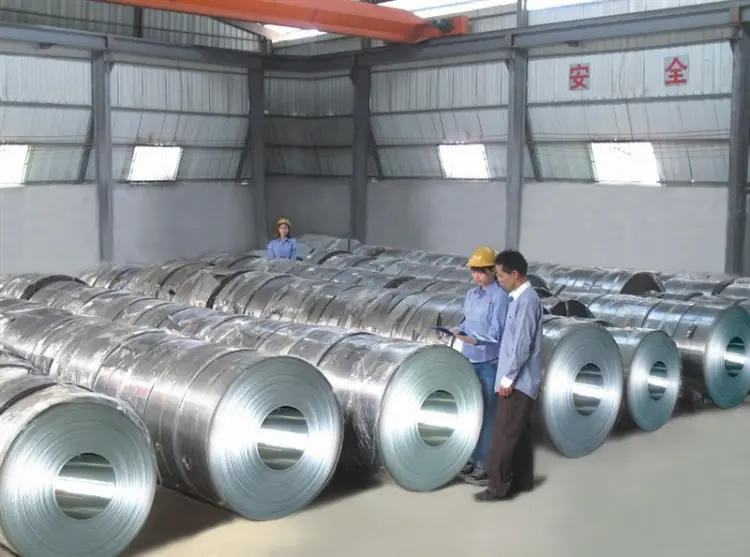
ABS Grade A Shipbuilding Steel Coil
ABS Grade A Shipbuilding Steel Coil - Marine Structural Steel for Hull Construction
Comprehensive technical data sheet of ABS Grade A shipbuilding steel, including chemical composition, mechanical properties, physical properties, international equivalent grades, and application guidance for marine and offshore engineering.
Hot rolling, controlled rolling, normalizing, cold forming, welding, cutting
- Phone : +8618037372205
- Email : [email protected]
- WhatsApp: Contact via Whtsapp
- WeChat: +8618037372205
ABS Grade A Shipbuilding Steel Coil Introduction
ABS Grade A is a normal strength hull structural steel specified by the American Bureau of Shipping (ABS) for the construction of ship structures. This steel grade is primarily used in the fabrication of hulls, decks, and other critical marine components. It is characterized by excellent weldability, good toughness, and reliable strength at ambient temperatures. The steel is typically supplied in the form of plates, coils, or sections in the hot-rolled condition, and may be normalized or controlled rolled to refine the grain structure and enhance mechanical properties. It meets strict requirements for low-temperature impact toughness (27 J at 0 °C) to ensure safety in marine environments.
ABS Grade A Shipbuilding Steel Coil Chemical Composition
The chemical composition of ABS Grade A steel is strictly controlled to achieve a balance of strength, weldability, and toughness. The maximum carbon content is limited to 0.21% to prevent hardening in the heat-affected zone after welding. Manganese is specified as a minimum of 2.5 times the carbon content to ensure adequate strength and deoxidation. Impurity elements such as phosphorus and sulfur are kept low to avoid brittleness and hot cracking. Residual elements like copper, chromium, nickel, and molybdenum are also restricted to maintain consistent properties.
| Element | Standard Value | Remarks |
|---|---|---|
| Carbon, C | ≤ 0.21% | Ladle analysis |
| Manganese, Mn | ≥ 2.5 × C | Minimum 2.5 times carbon content; typical range 0.50 - 1.00% |
| Silicon, Si | ≤ 0.50% | |
| Phosphorus, P | ≤ 0.035% | |
| Sulfur, S | ≤ 0.035% | |
| Copper, Cu | ≤ 0.35% | Residual element |
| Chromium, Cr | ≤ 0.20% | Residual element |
| Nickel, Ni | ≤ 0.40% | Residual element |
| Molybdenum, Mo | ≤ 0.08% | Residual element |
| Cu+Cr+Ni+Mo | ≤ 0.70% | Sum of residual elements |
| Nitrogen, N | ≤ 0.012% | For aluminium killed or fine grain steels |
ABS Grade A Shipbuilding Steel Coil Thermal and Electrical Physical Properties
The physical properties listed below are typical for carbon-manganese steel grades similar to ABS Grade A. These values are not directly specified by the ABS standard but are derived from reference data for comparable steels. They are valid for room temperature unless otherwise noted and may vary with heat treatment and specific composition. These properties are essential for design calculations involving heat transfer, thermal expansion, and electrical conductivity in marine structures.
| Property | Reference Value | Unit | Test Conditions / Remarks |
|---|---|---|---|
| Density (ρ) | 7.85 | g/cm³ | at 20 °C |
| Modulus of elasticity (E) | 205 | GPa | at 20 °C |
| Shear modulus (G) | 80 | GPa | at 20 °C |
| Poisson's ratio (ν) | 0.3 | - | at 20 °C |
| Thermal expansion coefficient (α) | 11.5 × 10⁻⁶ | 1/K | between 20 °C and 100 °C |
| Thermal expansion coefficient (α) | 12.0 × 10⁻⁶ | 1/K | between 20 °C and 200 °C |
| Thermal expansion coefficient (α) | 12.5 × 10⁻⁶ | 1/K | between 20 °C and 300 °C |
| Thermal conductivity (λ) | 52 | W/(m·K) | at 100 °C |
| Thermal conductivity (λ) | 47 | W/(m·K) | at 200 °C |
| Thermal conductivity (λ) | 42 | W/(m·K) | at 300 °C |
| Specific heat capacity (cp) | 465 | J/(kg·K) | at 20 °C |
| Specific heat capacity (cp) | 500 | J/(kg·K) | at 100 °C |
| Electrical resistivity (ρe) | 0.16 | μΩ·m | at 20 °C |
ABS Grade A Shipbuilding Steel Coil Mechanical Properties
Tensile testing is performed on samples taken from the material in the delivery condition. The yield strength and tensile strength values depend on the product thickness. For plates and sections up to 50 mm, the minimum yield strength is 235 MPa. For thicknesses above 50 mm, reduced minimum yield strengths apply. The impact test is conducted at 0 °C on longitudinal Charpy V-notch specimens, with a minimum average absorbed energy of 27 J. Elongation is measured on a gauge length of 5.65√S₀ (A5) or 200 mm (A200), with the requirement depending on thickness.
| Property | Required Value | Unit | Test Conditions |
|---|---|---|---|
| Yield strength (ReH) | ≥ 235 | MPa | Thickness ≤ 50 mm |
| Yield strength (ReH) | ≥ 225 | MPa | Thickness > 50 mm ≤ 70 mm |
| Yield strength (ReH) | ≥ 215 | MPa | Thickness > 70 mm ≤ 100 mm |
| Tensile strength (Rm) | 400 - 520 | MPa | All thicknesses |
| Elongation (A5) | ≥ 22 | % | Gauge length 5.65√S₀, thickness ≤ 50 mm |
| Elongation (A200) | ≥ 24 | % | Gauge length 200 mm, thickness ≤ 50 mm |
| Charpy impact energy (KV2) | ≥ 27 (average) | J | Longitudinal, 10×10 mm specimen, 0 °C |
| Charpy impact energy (KV2) | ≥ 20 (individual) | J | One value may be below 27 J, but not below 20 J |
ABS Grade A Shipbuilding Steel Coil Exact Equivalent Standards and Replaceable Grades
| Country / Region | Standard | Grade | Remarks |
|---|---|---|---|
| China | CCS Rules | CCS A | Identical normal strength hull steel |
| United Kingdom | LR Rules | LR A | Identical normal strength hull steel |
| Norway / Germany | DNV Rules | DNV A | DNV and GL merged; same specification |
| France | BV Rules | BV A | Identical normal strength hull steel |
| Germany (former) | GL Rules | GL A | Now part of DNV GL, still used as reference |
| South Korea | KR Rules | KR A | Identical normal strength hull steel |
| Japan | NK Rules | NK A | Identical normal strength hull steel |
| Italy | RINA Rules | RINA A | Identical normal strength hull steel |
| Russia | RS Rules | RS A | Identical; may have additional requirements for cold service |
ABS Grade A Shipbuilding Steel Coil Application Introduction
ABS Grade A shipbuilding steel is primarily used in marine and offshore environments where moderate strength, excellent weldability, and reliable impact toughness at 0 °C are required. It is suitable for hull plates, decks, bulkheads, and other structural members of ships and barges not exposed to extremely low temperatures. For lower service temperatures, higher toughness grades such as B, D, or E should be considered. The steel can be formed, welded, and machined using standard shipyard practices.
Product Applications: Hull plates and shell plating for ships and barges, Decks, bulkheads, and hatch covers, Stiffeners, frames, and girders, Offshore platform topsides and jackets, Pontoon and floating dock structures, Marine crane pedestals and foundations
Processed into products: Cut-to-size hull plates and stiffened panels, Longitudinal and transverse frames, stringers, Watertight and non-watertight bulkhead panels, Deck beams and deck stiffeners, Buoyancy tanks and ballast tank walls, Welded T-beams, angle bars and bulb flats for ship reinforcement, Mooring and anchoring brackets
Application industries: Shipbuilding and ship repair, Offshore oil & gas platform construction, Marine engineering and port infrastructure, Barge and dredger manufacturing, Defense and naval vessels (non-combatant, auxiliary ships), Renewable energy offshore structures (wind turbine foundations)
ABS Grade A Shipbuilding Steel Coil Similar / Alternative Materials
| Country / Region | Standard | Grade | Remarks |
|---|---|---|---|
| International | ISO 630 | E235B | Structural steel with comparable minimum yield strength; not impact tested at 0 °C unless specified |
| EU | EN 10025-2 | S235JR | General structural steel; mild strength, limited low-temperature toughness |
| EU | EN 10025-2 | S235J0 | Similar yield strength, impact tested at 0 °C (27 J); close to ABS A but different chemical requirements |
| USA | ASTM A36/A36M | A36 | Carbon structural steel; minimum yield 250 MPa, tensile 400-550 MPa; no mandatory impact test; used for general construction |
| Japan | JIS G3101 | SS400 | General structural rolled steel; mechanical properties similar but no impact test |
| China | GB/T 700 | Q235B | Carbon structural steel; 235 MPa yield, impact at 20 °C; for ambient service only, not for low temperature without verification |
Notes:
ABS Grade A steel is normally supplied with minimum Charpy V-notch impact energy of 27 J at 0 °C for thicknesses up to 50 mm; for thicker products, the requirement may be adjusted according to ABS rules. Normalizing or controlled rolling may be applied to improve toughness and refine grain structure. For welding, preheat is generally not required for moderate thicknesses when using low-hydrogen processes, but a qualified welding procedure should be used. The material is susceptible to corrosion in seawater without protection; coatings or cathodic protection are recommended. Marking includes the grade, heat number, and ABS stamp certifying compliance.
- Share



