
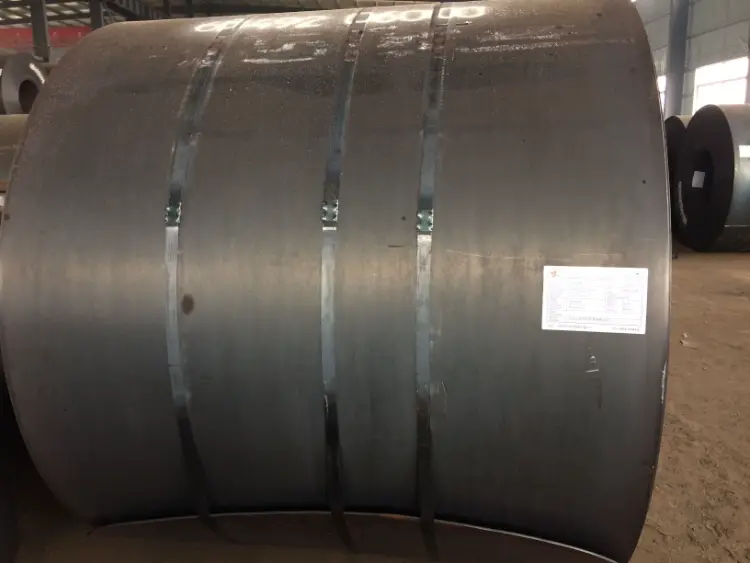
ABS Grade AH36 Shipbuilding Steel Coil
ABS Grade AH36 Shipbuilding Steel Coil: Properties, Equivalents & Applications
Comprehensive material data for ABS Grade AH36 shipbuilding steel coil, including chemical composition, mechanical and physical properties, international equivalents, and application guidance.
Hot rolling, normalizing, controlled rolling, thermo-mechanical control process (TMCP), welding, cutting, cold forming, bending
- Phone : +8618037372205
- Email : [email protected]
- WhatsApp: Contact via Whtsapp
- WeChat: +8618037372205
ABS Grade AH36 Shipbuilding Steel Coil Introduction
ABS Grade AH36 is a high-strength hull structural steel under the American Bureau of Shipping (ABS) rules, widely used in shipbuilding and offshore engineering. It offers a minimum yield strength of 355 MPa and excellent toughness at 0°C, making it suitable for critical structural components. As a normalized or controlled rolled steel, AH36 provides good weldability and formability.
- High-strength low-alloy ship plate
- Good low-temperature impact toughness (Grade A, impact tested at 0°C)
- Complies with ABS Rules and IACS UR W11
- Available in coil, plate, and cut-to-length forms
ABS Grade AH36 Shipbuilding Steel Coil Chemical Composition
The chemical composition of ABS Grade AH36 is governed by ABS Rules and IACS UR W11. The ladle analysis limits are shown below. Carbon equivalent (CEV) is typically controlled to ensure weldability (usually CEV ≤ 0.38% for thickness ≤50 mm, calculated by IIW formula). Micro-alloying elements such as Nb, V, Ti, and Al may be added singly or in combination to achieve the required strength and toughness. Full deoxidation is required, typically with aluminium.
| Element | Standard Value | Remarks |
|---|---|---|
| Carbon (C) | ≤ 0.18% | Ladle analysis |
| Manganese (Mn) | 0.90–1.60% | Depending on thickness, may be adjusted per standard |
| Silicon (Si) | ≤ 0.50% | Killed steel, Si as deoxidizer |
| Phosphorus (P) | ≤ 0.035% | Max |
| Sulfur (S) | ≤ 0.035% | Max |
| Aluminium (Al, acid-soluble) | ≥ 0.015% | Usually present for grain refinement; total Al often 0.02–0.05% |
| Niobium (Nb) | 0.02–0.05% | Optional grain refiner |
| Vanadium (V) | 0.05–0.10% | Optional micro-alloy |
| Titanium (Ti) | ≤ 0.02% | Optional for grain refinement |
| Copper (Cu) | ≤ 0.35% | Max, if specified for improved corrosion resistance |
| Chromium (Cr) | ≤ 0.20% | Residual |
| Nickel (Ni) | ≤ 0.40% | Residual |
| Molybdenum (Mo) | ≤ 0.08% | Residual |
| Nitrogen (N) | ≤ 0.012% | Usually controlled |
| Carbon Equivalent (CEV) | ≤ 0.38% | For thickness ≤50 mm, IIW formula; may be higher for thicker products with agreed measures |
ABS Grade AH36 Shipbuilding Steel Coil Thermal and Electrical Physical Properties
The physical properties listed are typical for ambient temperature conditions (20–25°C) and approximate; they may vary slightly with manufacturing process and exact composition. These values are provided for design guidance and are not mandated by the ABS specification. Thermal conductivity and specific heat capacity shown apply near room temperature; values will change with temperature.
| Property | Typical Value | Unit | Test Condition / Remarks |
|---|---|---|---|
| Density (ρ) | 7850 | kg/m³ | Approximate value at 20°C |
| Modulus of Elasticity (E) | 205 | GPa | At room temperature, typical for low-alloy steel |
| Shear Modulus (G) | 80 | GPa | Approximate value |
| Poisson's Ratio (ν) | 0.3 | - | Elastic range |
| Thermal Expansion Coefficient (α) | 12.0 × 10⁻⁶ | 1/K | Mean coefficient 20–100°C (11.7 to 12.5 × 10⁻⁶ typical range) |
| Thermal Conductivity (λ) | 52 | W/(m·K) | At 20°C; decreases with temperature (approx. 48 W/(m·K) at 100°C, 40 W/(m·K) at 400°C) |
| Specific Heat Capacity (c) | 470 | J/(kg·K) | At 20°C; rises to ~600 J/(kg·K) at 500°C |
| Electrical Resistivity (ρ_e) | 0.18 × 10⁻⁶ | Ω·m | At 20°C (0.15–0.25 µΩ·m typical) |
| Melting Point | ~1450–1520 | °C | Typical range for mild/low-alloy steel |
| Curie Temperature | ~770 | °C | Ferromagnetic loss point |
ABS Grade AH36 Shipbuilding Steel Coil Mechanical Properties
Mechanical properties per ABS Rules, typical for plate/coil thickness ≤50 mm in transverse direction (unless otherwise noted). Impact test temperature for AH36 is 0°C. The Charpy V-notch impact energy requirement is minimum 34 J individually, with an average of 3 specimens not less than 34 J. Thinner material may have slightly higher elongation and different sampling requirements. Bending test (180° bend, d = 3a for thickness ≤25 mm, d = 4a for >25–50 mm) with no cracks.
| Property | Standard Required Value | Unit | Test Condition |
|---|---|---|---|
| Yield Strength (ReH) | ≥ 355 | MPa | Tensile test, transverse, thickness ≤50 mm |
| Tensile Strength (Rm) | 490–620 | MPa | Tensile test, transverse, thickness ≤50 mm |
| Elongation after fracture (A5) | ≥ 21 | % | Gauge length 5.65√S₀, transverse, thickness ≤50 mm; for thickness ≤12.5 mm use gauge length 200 mm (min. 21%) |
| Bend Test | No cracks (d=3a) | - | Bend angle 180°, bend diameter ratio d=3a for t≤25 mm; d=4a for t=25–50 mm |
| Charpy Impact Energy (KV2, -20°C) | ≥ 34 (average), ≥ 24 (single) | J | 20°C test temperature for Grade AH; AH36 tested at 0°C. Transverse specimen, thickness ≥6 mm |
| Charpy Impact Energy (KV2, 0°C) | ≥ 34 (average), ≥ 24 (single) | J | Standard test temperature for AH36, longitudinal specimen if agreed, but transverse typical |
| Hardness | Typically ≤ 200 HB | HBW | Not a mandatory requirement, for reference |
ABS Grade AH36 Shipbuilding Steel Coil Full Equivalent Material Standards and Replaceable Grades
| Country/Region | Standard | Grade | Remarks |
|---|---|---|---|
| USA / International | ASTM A131 / A131M | AH36 | Primary standard, fully equivalent to ABS AH36; included in IACS classification societies |
| United Kingdom | LR Rules | AH36 | Lloyd's Register, same strength and impact class |
| Norway / Germany | DNV GL Rules | AH36 | DNV (now DNV) high strength hull steel, same requirements |
| France | BV Rules | AH36 | Bureau Veritas, identical designation |
| China | CCS Rules | AH36 | China Classification Society, equivalent grade |
| Japan | NK Rules | AH36 | Nippon Kaiji Kyokai (ClassNK), equivalent |
| Korea | KR Rules | AH36 | Korean Register, equivalent |
| Italy | RINA Rules | AH36 | Registro Italiano Navale, equivalent |
| Russia | RS Rules | AH36 | Russian Maritime Register of Shipping, equivalent |
| European | EN 10025-4 | S355G7+N or S355G8+M | European naval steel standard; S355G7 is normalized, S355G8 is TMCP; not exactly identical but close when certified for offshore/marine use; check individual specification. |
| International | IACS UR W11 | High Strength Hull Structural Steel, Grade AH36 | Basis for all classification societies' AH36 |
ABS Grade AH36 Shipbuilding Steel Coil Application Introduction
ABS Grade AH36 steel coil is a versatile material for marine and offshore structures. It is readily weldable and formable, making it ideal for large-scale shipbuilding. Coil form allows continuous roll-length supply, reducing welding seams in long structural members.
- Primary use: ship hulls (outer shell, deck plating, bottom plating), bulkheads, and stiffeners.
- Secondary use: offshore platform structural components, jack-up legs, helideck structures, module support frames.
- Processing: laser cutting, plasma cutting, submerged arc welding, cold bending, and roll forming.
Product Applications: Ship hulls (container ships, bulk carriers, tankers), Deck sections, Bulkheads and web frames, Offshore platform decks and module structures, Jack-up rig legs and spudcans, Shipbuilding stiffeners (angle, bulb flats, flat bars cut from coil), Large-diameter marine piles
Processed into products: Longitudinal stringers, Transverse frames, Shell plates and strakes, Stiffened panels, Cofferdams, Hatch coamings, Wind tower base sections (with additional certification), Bollard foundations
Application industries: Shipbuilding (merchant vessels, naval ships, barges), Offshore oil & gas (platforms, FPSO modules, jackets), Marine equipment manufacturing, Port and harbor construction (sheet piling, quay walls), Wind energy (offshore wind turbine foundations, transition pieces)
ABS Grade AH36 Shipbuilding Steel Coil Similar / Alternative Materials Recommendation
| Country/Region | Standard | Grade | Remarks |
|---|---|---|---|
| European | EN 10025-2 | S355J2+N | Structural steel, minimum yield 355 MPa, impact at -20°C (J2), but not specifically certified for shipbuilding; may be used in non-critical marine structures with additional agreement. |
| European | EN 10225 | S355G3+N or S355G3+M | Weldable structural steels for fixed offshore structures; equivalent in strength and toughness, suitable for marine offhsore if ABS approval obtained. |
| USA | ASTM A572 / A572M | Grade 50 | High strength low-alloy structural steel, min yield 345 MPa (50 ksi), similar chemistry, not ship-certified; can be considered for land-based port equipment. |
| USA | ASTM A709 / A709M | Grade 50 | Bridge steel with comparable strength, requires separate ABS qualification for marine use. |
Notes:
Important: The steel must be fully deoxidized (killed, with aluminum). Mill certificate to be endorsed by ABS surveyor or approved manufacturer. For plate thickness >50 mm, mechanical properties may need separate agreement. Carbon equivalent limits are strictly required for weldability; crack tip opening displacement (CTOD) testing may be specified for critical offshore structural applications. Coil form may be subject to maximum thickness and width limits depending on the producing mill. All values are based on ABS Rules 2024 edition; consult latest rule set for any updates.
- Share



