
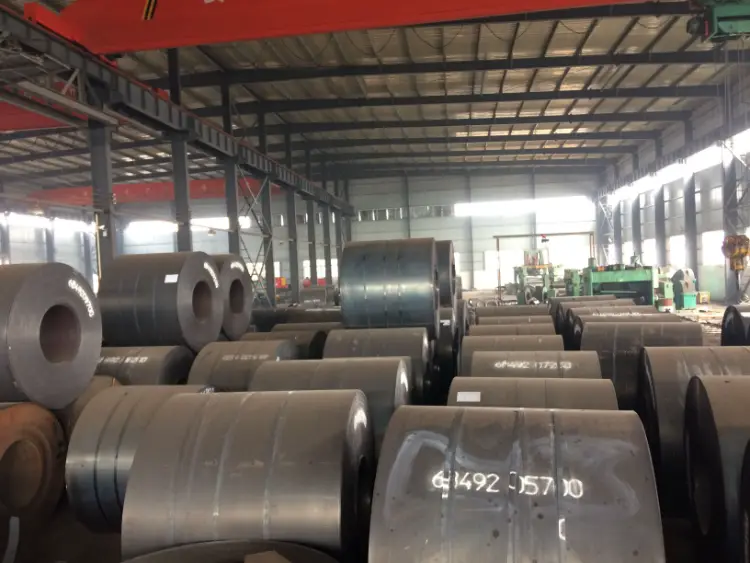
ABS Grade DH36 Shipbuilding Steel Coil
ABS Grade DH36 Shipbuilding Steel Coil: High Strength & Superior Low-Temperature Toughness
Complete technical data for ABS Grade DH36 shipbuilding steel coil including chemical composition, mechanical and physical properties, international equivalents, and applications in shipbuilding and offshore engineering, delivered in accordance with ABS Rules.
Hot rolling, controlled rolling (TMCP), normalizing, cold forming, cutting, machining, welding (all conventional methods: SAW, SMAW, GMAW, FCAW)
- Phone : +8618037372205
- Email : [email protected]
- WhatsApp: Contact via Whtsapp
- WeChat: +8618037372205
ABS Grade DH36 Shipbuilding Steel Coil Introduction
ABS Grade DH36 is a high-strength, low-alloy structural steel specifically designed for marine and offshore applications, certified by the American Bureau of Shipping (ABS). It offers a minimum yield strength of 355 MPa (51 ksi) and is characterized by excellent weldability, good corrosion resistance, and guaranteed impact toughness at sub-zero temperatures down to -20°C (D class). The 'H' designates higher strength, and '36' refers to the minimum yield strength in ksi units. Typical delivery condition is normalized or thermo-mechanically controlled rolled (TMCP). The steel is primarily supplied as coils, plates, and sections, and is widely used in the construction of ship hulls, offshore platforms, and marine structures where a combination of high strength and reliable low-temperature performance is essential. Its chemistry is designed with microalloying elements such as niobium and vanadium to refine grain structure and enhance toughness without compromising formability.
ABS Grade DH36 Shipbuilding Steel Coil Chemical Composition
The ladle analysis conforms to ABS Rules, Part 2, Chapter 1, Section 1, Table 1 for Grade DH36. Microalloying elements (Nb, V, Ti) are added singly or in combination to achieve the required strength and toughness. Aluminum is used as a grain refiner and deoxidizer. The carbon equivalent (CEV) is typically controlled to ensure good weldability, with CEV = C + Mn/6 + (Cr + Mo + V)/5 + (Ni + Cu)/15 generally ≤ 0.40% for thicknesses ≤ 50 mm.
| Element | Standard Value (max unless range given) | Remarks |
|---|---|---|
| Carbon (C) | ≤0.18 | Deoxidized or grain refined |
| Manganese (Mn) | 0.90–1.60 | Depending on thickness |
| Silicon (Si) | 0.10–0.50 | Deoxidizer |
| Phosphorus (P) | ≤0.035 | Controlled for toughness |
| Sulfur (S) | ≤0.035 | Controlled for toughness and weldability |
| Aluminum (Al) | ≥0.015 (acid soluble) | For grain refinement |
| Niobium (Nb) | 0.02–0.05 | Microalloying element |
| Vanadium (V) | 0.05–0.10 | Microalloying element |
| Titanium (Ti) | ≤0.02 | Optional; if added, typical range 0.007–0.020 |
| Copper (Cu) | ≤0.35 | Residual or intentional |
| Chromium (Cr) | ≤0.20 | Residual |
| Nickel (Ni) | ≤0.40 | Residual; may be added for thicker gauges |
| Molybdenum (Mo) | ≤0.08 | Residual |
| Nitrogen (N) | ≤0.009 | Fine grain control; if Ti or Al is used |
| Boron (B) | ≤0.0005 | Not intentionally added |
ABS Grade DH36 Shipbuilding Steel Coil Thermal and Electrical Physical Properties
Physical properties are representative for low-alloy structural steels similar to DH36. They are not part of the material certification but are essential for design calculations involving thermal and electrical loads. Values may vary slightly depending on exact chemical composition and heat treatment. The coefficient of thermal expansion is valid for the temperature range 20–100°C. Thermal conductivity and resistivity are typical for a nominal composition.
| Property | Typical Value | Unit | Condition / Temperature |
|---|---|---|---|
| Density (ρ) | 7.85 | g/cm³ | Room temperature |
| Elastic modulus (E) | 200–210 | GPa | Room temperature; average 205 GPa |
| Shear modulus (G) | 79–81 | GPa | Room temperature; calculated from E and Poisson ratio |
| Poisson's ratio (ν) | 0.28–0.30 | – | Room temperature; typical 0.29 |
| Thermal expansion coefficient (α) | 11.5–12.5 | 10⁻⁶/K | 20–100°C; typical 12.0 × 10⁻⁶/K |
| Thermal conductivity (λ) | 48–56 | W/(m·K) | At 20°C; typical 52 |
| Specific heat capacity | 450–490 | J/(kg·K) | 20–100°C; typical 470 |
| Electrical resistivity (ρₑ) | 0.18–0.24 | µΩ·m | At 20°C; typical 0.20 |
ABS Grade DH36 Shipbuilding Steel Coil Mechanical Properties
Mechanical properties are determined on test specimens taken from finished products in delivery condition. Requirements apply to thicknesses up to 100 mm. For thickness >100 mm, properties are subject to agreement. Impact test is mandatory for DH36: Charpy V-notch longitudinal specimens at -20°C, minimum 34 J average (27 J single). Transverse tests if specified require minimum 24 J average.
| Property | Standard Required Value | Unit | Test Condition / Remarks |
|---|---|---|---|
| Yield strength (ReH) | ≥355 | MPa | Thickness ≤ 100 mm; thickness range may influence minimum |
| Tensile strength (Rm) | 490–620 | MPa | All thicknesses |
| Elongation (A) | ≥21 | % | Gauge length 50 mm (2 in) or 5.65√So, typically for thickness ≤ 50 mm |
| Bend test (180°) | No cracks | – | Mandrel diameter 3t (t = specimen thickness); applicable for thickness ≤ 25 mm |
| Charpy V-notch impact energy (KV₂) longitudinal | ≥34 (average), ≥27 (single) | J | At -20 °C, standard specimen 10×10 mm; sub-size specimens proportional |
| Charpy V-notch impact energy (KV₂) transverse | ≥24 (average), ≥17 (single) | J | At -20 °C, if specified by purchaser |
ABS Grade DH36 Shipbuilding Steel Coil Fully Equivalent International Standards and Substitute Grades
| Country/Region | Standard | Grade | Remarks |
|---|---|---|---|
| International Association of Classification Societies (IACS) | IACS UR W11 | DH36 | Common basis for all IACS member societies |
| USA | ASTM A131 / A131M | DH36 | Identical designation; structural steel for ships |
| China | CCS Rules for Materials and Welding | DH36 | China Classification Society, same requirement |
| Norway/Germany | DNV Rules (Det Norske Veritas) | DH36 | DNV grade DH36, fully interchangeable |
| United Kingdom | LR Rules (Lloyd's Register) | DH36 | LR grade DH36, same mechanical and impact requirements |
| France | BV Rules (Bureau Veritas) | DH36 | BV DH36, fully equivalent |
| Italy | RINA Rules | DH36 | RINA DH36, interchangeable for construction |
| Japan | NK Rules (Nippon Kaiji Kyokai) | DH36 | NK DH36, same specification |
| South Korea | KR Rules (Korean Register) | DH36 | KR DH36, equivalent material |
| Russia | RS Rules (Russian Maritime Register) | DH36 | RS DH36, accepted substitute |
ABS Grade DH36 Shipbuilding Steel Coil Application Introduction
ABS DH36 steel coil is a versatile material designed for structural components requiring high strength and guaranteed notch toughness at cold temperatures. Its excellent weldability and formability make it suitable for a wide range of heavy fabrication processes. When processed correctly, it delivers long service life in harsh marine environments.
- Typical delivery as hot-rolled coil, often in thicknesses from 6 mm to 50 mm, widths up to 2500 mm.
- Can be cut, formed, and welded to produce components such as ship hull plates, transverse bulkheads, stiffeners, and offshore platform beams.
Product Applications: Ship hull plates and keel plates, Stiffened panels and girders, Bulkheads and watertight doors, Offshore platform beams and columns, Wind turbine monopiles and jacket transition pieces, Dock levellers and lock gates, Pressure hulls for submarines (with additional testing)
Processed into products: Longitudinal and transverse stiffeners, Bracket plates, Deck stringer plates, Bilge plates, Rudder horns, Mooring cleats and bollard casings, Jack-up rig leg chords, Caisson and suction piles
Application industries: Shipbuilding (commercial vessels, naval ships, bulk carriers, tankers, container ships), Offshore oil & gas (jacket structures, topsides, decks, flare booms), Renewable energy (offshore wind turbine towers, transition pieces, foundations), Port and harbor construction (sheet piling, dock gates, crane structures), Bridge engineering (marine bridges, movable bridges), Heavy machinery (crane booms, heavy vehicles frames when corrosion resistance is needed)
ABS Grade DH36 Shipbuilding Steel Coil Similar or Alternative Materials with Comparable Properties
| Country/Region | Standard | Grade | Remarks |
|---|---|---|---|
| USA/International | ABS Rules | AH36 | Higher impact test temperature (0°C); otherwise identical strength; use where low-temperature toughness is less critical. |
| USA/International | ABS Rules | EH36 | Higher toughness requirement (-40°C); suitable for colder environments. |
| USA/International | ABS Rules | FH36 | Even lower temperature toughness (-60°C); premium option for cryogenic service. |
| European Union | EN 10025-3 | S355NL | Normalized structural steel with minimum yield 355 MPa and -50°C impact; not certified by classification societies but often used for non-ship structural applications. Note different impact temperature. |
| European Union | EN 10025-4 | S355ML | Thermo-mechanically rolled structural steel with similar strength and -50°C impact; alternative for offshore structures where maritime class certification is not required. |
| China | GB/T 712 | DH36 | Chinese national standard for shipbuilding steel; equivalent to CCS DH36, similar to ABS DH36. |
Notes:
Welding Guidelines: Use low-hydrogen electrodes and preheat when plate thickness exceeds 30 mm or ambient temperature is below 5°C. Typical preheat temperature: 75–150°C. Interpass temperature should not exceed 250°C. Post-weld heat treatment (PWHT) is not mandatory but may be applied for stress relief at 580–620°C for 1 hour per 25mm thickness. Corrosion Protection: In marine environments, painting, cathodic protection, or sacrificial anodes are required. Certification: Material is supplied with ABS 3.2 or 3.1 certification as per EN 10204, stamped with grade, heat number, and inspector marks.
- Share



