
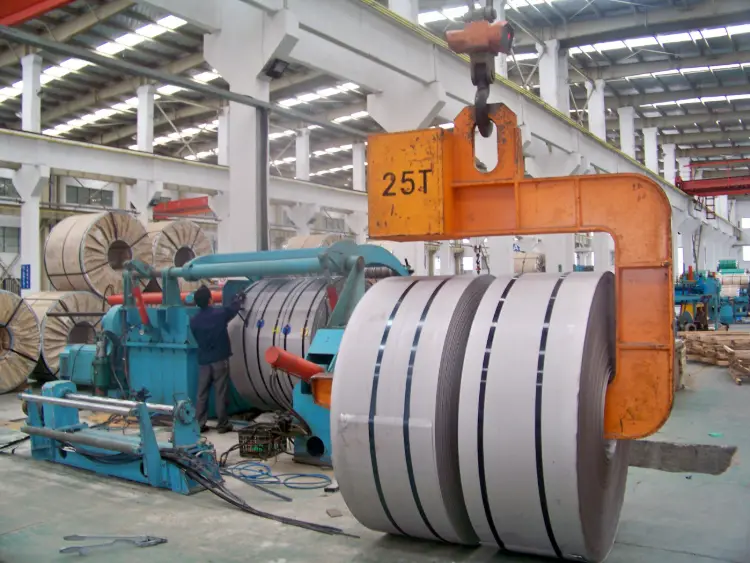
ABS Grade EH36 Shipbuilding Steel Coil
ABS Grade EH36 Shipbuilding Steel Coil: High-Strength Low-Alloy Steel for Marine & Offshore Structures
Complete material data for ABS Grade EH36 shipbuilding steel coil, including chemical composition, mechanical properties, thermal and electrical physical properties, international equivalents, and application guidance for marine and offshore engineering.
Hot rolling, normalizing, thermomechanical controlled processing (TMCP), welding, cutting, forming, and machining
- Phone : +8618037372205
- Email : [email protected]
- WhatsApp: Contact via Whtsapp
- WeChat: +8618037372205
ABS Grade EH36 Shipbuilding Steel Coil Introduction
ABS Grade EH36 is a high-strength, normalized or thermomechanically rolled low-alloy shipbuilding steel with a minimum yield strength of 355 MPa (51 ksi). It is certified by the American Bureau of Shipping for structural applications in ships and offshore units operating at very low temperatures. The 'E' designation indicates impact toughness tested at -40°C, ensuring reliable performance in Arctic and extreme marine environments.
Key features:
- Excellent notch toughness at sub-zero temperatures
- Good weldability with standard shipbuilding techniques
- High strength-to-weight ratio for lightweight structural designs
- Available in coil form for continuous processing and fabrication efficiency
ABS Grade EH36 Shipbuilding Steel Coil Chemical Composition
The chemical composition of ABS Grade EH36 steel is defined by ABS Rules for Materials and Welding. Limits are for ladle analysis. The steel is fully killed with fine-grain practice. Micro-alloying elements such as Nb, V, Ti, and Al are commonly added for strengthening and toughness improvement. Note: Carbon equivalent (CEV) may be limited based on thickness to ensure weldability, typically CEV ≤0.38% for thickness ≤50 mm.
| Chemical Element | Standard Value (max unless range given) | Remarks |
|---|---|---|
| Carbon (C) | ≤0.18% | For thickness ≤25 mm; may be reduced for thicker products |
| Manganese (Mn) | 0.90–1.60% | Adjustable for strength and toughness balance |
| Silicon (Si) | ≤0.50% | Deoxidation and strength element |
| Phosphorus (P) | ≤0.035% | Residual, controlled to ensure toughness |
| Sulfur (S) | ≤0.035% | Residual, minimized for ductility and weldability |
| Aluminum (Al) total | ≥0.020% | Fine-grain practice when Al is used as grain refiner |
| Niobium (Nb) | 0.02–0.05% | Optional micro-alloying; typical for EH36 |
| Vanadium (V) | 0.05–0.10% | Optional; often combined with Nb or Ti |
| Titanium (Ti) | ≤0.02% | Optional; grain refinement and nitrogen fixation |
| Nitrogen (N) | ≤0.009% | When Al or Ti is added for grain refinement |
| Copper (Cu) | ≤0.35% | Residual; may be specified for corrosion resistance |
| Chromium (Cr) | ≤0.25% | Residual; intentionally limited |
| Nickel (Ni) | ≤0.40% | Residual; does not appear for intentional addition |
| Molybdenum (Mo) | ≤0.08% | Residual |
| Carbon Equivalent (CEV) | ≤0.38% (typical agreement) | For thickness ≤50 mm; often specified as supplementary requirement |
ABS Grade EH36 Shipbuilding Steel Coil Thermal and Electrical Physical Properties
The following physical properties are typical for EH36 steel (low-alloy structural steel) at room temperature unless specified. These values are not mandatory by ABS but are derived from standard engineering references for similar carbon-manganese steel grades. Variations may occur depending on specific chemical composition and heat treatment condition.
| Property | Standard Reference Value | Unit | Test Condition / Remarks |
|---|---|---|---|
| Density (ρ) | 7.85 | g/cm³ | At 20°C |
| Elastic Modulus (E) | 205 | GPa | At room temperature; decreases with increasing temperature |
| Shear Modulus (G) | 80 | GPa | Calculated from E and ν |
| Poisson's Ratio (ν) | 0.30 | — | Within elastic range |
| Thermal Expansion Coefficient (α) | 12.0 × 10⁻⁶ | /K | Average from 20°C to 100°C |
| Thermal Expansion Coefficient (α) | 13.0 × 10⁻⁶ | /K | Average from 20°C to 200°C |
| Thermal Expansion Coefficient (α) | 14.0 × 10⁻⁶ | /K | Average from 20°C to 400°C |
| Thermal Conductivity (λ) | 51.9 | W/(m·K) | At 20°C |
| Thermal Conductivity (λ) | 49.8 | W/(m·K) | At 100°C |
| Thermal Conductivity (λ) | 41.0 | W/(m·K) | At 300°C |
| Specific Heat Capacity (cp) | 460–480 | J/(kg·K) | At 20°C; varies slightly with temperature |
| Electrical Resistivity (ρe) | 0.16–0.20 | μΩ·m | At 20°C; typical for low-alloy steel |
ABS Grade EH36 Shipbuilding Steel Coil Mechanical Properties
Mechanical properties are tested on samples taken transverse to the rolling direction. All values are minimum unless ranges are given. Impact testing is conducted on Charpy V-notch specimens at -40°C for thickness ≥5 mm. For coil products, testing is performed after flattening. Thickness ranges are as defined in ABS Rules.
Note: Tensile test results may vary slightly depending on rolling condition and final thickness.
| Property | Standard Requirement Value | Unit | Test Condition / Remarks |
|---|---|---|---|
| Yield Strength (ReH) | ≥355 | MPa | For thickness ≤50 mm; for thickness >50–70 mm, ≥355 MPa; >70–100 mm, ≥355 MPa |
| Tensile Strength (Rm) | 490–620 | MPa | Applies to all thicknesses |
| Elongation (A5) | ≥21% | % | Gauge length 50 mm, transverse, thickness ≤50 mm |
| Elongation (A4) | ≥19% | % | Gauge length 25 mm, transverse, thickness ≤50 mm (some cases) |
| Charpy Impact (KV2 at -40°C) | ≥34 (longitudinal); ≥24 (transverse) | J | Average of three specimens; single value ≥70% of average. For thickness ≤50 mm |
| Charpy Impact (KV2 at -40°C) | ≥41 (longitudinal); ≥27 (transverse) | J | For thickness >50–70 mm |
| Charpy Impact (KV2 at -40°C) | ≥50 (longitudinal); ≥34 (transverse) | J | For thickness >70–100 mm |
| Bend Test (180°) | D = 3a (for t ≤25 mm); D = 4a (for t >25 mm) | — | Mandrel diameter D, specimen thickness a. No cracks |
ABS Grade EH36 Shipbuilding Steel Coil Fully Equivalent Material Standards and Substitutable Grades
The following grades are recognized as direct equivalents to ABS EH36 under their respective classification society rules or international standards. They meet the same minimum mechanical and toughness requirements for high-strength ship structural steel with impact testing at -40°C.
| Country/Region | Standard/Classification Society | Equivalent Grade | Notes |
|---|---|---|---|
| International | DNV (Det Norske Veritas) Rules | DNV EH36 | Identical requirements; often interchangeable |
| International | Lloyd's Register (LR) Rules | LR EH36 | Technical equivalence accepted |
| International | Bureau Veritas (BV) Rules | BV EH36 | Same strength and impact class |
| China | China Classification Society (CCS) Rules | CCS EH36 | Fully aligned with ABS |
| International | ClassNK (NK) Rules | NK EH36 | Mutually recognized for marine use |
| South Korea | Korean Register (KR) Rules | KR EH36 | Equivalent in all essential aspects |
| International | RINA (Registro Italiano Navale) Rules | RINA EH36 | Direct substitute |
| Russia | Russian Maritime Register of Shipping (RS) Rules | RS EH36 | Allows substitution where ABS EH36 is specified |
| European / UK | EN 10225-1:2019 | S355G10+N (thickness ≤150 mm) | Steel for offshore structures, requires CEV agreement and -40°C impact |
| USA / International | ASTM A131/A131M | Grade EH36 | ASTM standard for shipbuilding steel, identical to ABS EH36 |
ABS Grade EH36 Shipbuilding Steel Coil Application Introduction
ABS Grade EH36 steel coil is engineered for critical load-bearing structures where high strength, excellent weldability, and superior low-temperature toughness are required. Its availability in coil form enables efficient automated production of ship panels, stiffeners, and long structural members through uncoiling, leveling, and cutting lines. The material is suitable for both new construction and repair projects in the maritime and offshore energy sectors.
Product Applications: Ship hull plates and panels (longitudinal and transverse framing), Deck stringers and sheer strakes, Hatch coamings and container cell guides, Offshore module beams and columns, Jack-up rig leg chords and bracings, Caisson and conductor support structures, Wind turbine tower shells (lower sections), Heavy-lift crane booms and pedestals
Processed into products: Flat stiffened panels (shell plating, bulkheads) produced by laser or plasma cutting followed by roll forming, Tee profiles and angle stiffeners fabricated by splitting coil strip and continuous welding, Cold-formed L, C, Z sections for light structural applications, Pipe piles and casing fabricated by spiral or longitudinal welding of coil, Built-up box girders for crane runways, Transition ring forgings (after hot rolling and forming from plate cut from coil), Blast-resistant panels for offshore accommodations
Application industries: Commercial and naval shipbuilding (container ships, bulk carriers, tankers, LNG carriers, icebreakers), Offshore oil & gas platforms (jackets, topsides, living quarters), Renewable offshore wind energy (transition pieces, foundation structures), Heavy machinery and earthmoving equipment (booms, arms, chassis), Bridge and infrastructure construction (structural girders requiring notch toughness), Polar and Arctic engineering
ABS Grade EH36 Shipbuilding Steel Coil Similar / Closely Comparable Substitution Materials
The following materials have comparable chemical composition and mechanical properties, but may differ in specific toughness class or delivery condition. They can be considered when EH36 is not available, subject to re-certification or supplementary testing at -40°C.
| Country/Region | Standard/Grade | Closest Similar Grade | Comparison & Limitations |
|---|---|---|---|
| International | ABS Rules | ABS AH36 | Same strength (≥355 MPa), but impact tested at 0°C only; not suitable for low-temperature service without additional testing. |
| International | ABS Rules | ABS DH36 | Same strength, impact tested at -20°C; closer to EH36 but may not meet -40°C requirements. |
| European | EN 10025-4:2019 | S355M/ML | Thermomechanically rolled fine-grain steel; ML grade has impact at -50°C, comparable toughness; may require additional through-thickness testing for marine use. |
| USA | ASTM A572/A572M | Grade 50 [345] Type 1 | Yield 345 MPa, lower than EH36; not certified for shipbuilding; may be used in structural non-marine applications with reduced thickness. |
| Japan | JIS G 3106 | SM490YA/B/C | Higher tensile range but impact properties and certification differ; typically used in construction, not directly marine-certified. |
| China | GB/T 712-2011 | AH36, DH36 | National shipbuilding standard equivalents with different impact test temperatures; EH36 not always listed as GB grade but can be produced per agreement. |
Notes:
All technical data comply with ABS Rules 2024 Part 2, Chapter 1, and relevant international references. Physical property values are typical for low-alloy steel and may vary slightly with actual chemistry.
Welding: Preheat and interpass temperature control may be applied based on thickness and CEV. Approved consumables for EH36 grade should match base metal strength and toughness.
Corrosion Resistance: EH36 is a plain carbon-manganese steel without significant corrosion-resisting alloy; protective coatings or cathodic protection are required for marine exposure.
Certification: Each coil is inspected and stamped with the ABS certification mark and heat number, accompanied by 3.2 certification per EN 10204 or equivalent.
- Share



