
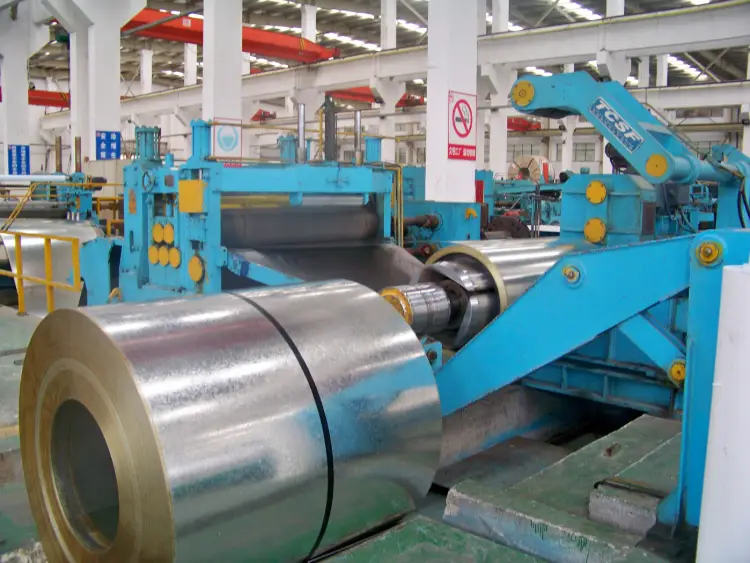
ABS Grade FH36 Shipbuilding Steel Coil
ABS Grade FH36 Shipbuilding Steel Coil - Data Sheet, Properties & International Equivalents
Complete material data for ABS Grade FH36 shipbuilding steel coil: chemical composition, mechanical and thermophysical properties, international equivalent grades, and application guidance for extreme low-temperature marine structures.
Suitable for cold forming, hot forming, welding, machining, and surface treatment
- Phone : +8618037372205
- Email : [email protected]
- WhatsApp: Contact via Whtsapp
- WeChat: +8618037372205
ABS Grade FH36 Shipbuilding Steel Coil Introduction
ABS Grade FH36 is a high-strength hull structural steel certified by the American Bureau of Shipping (ABS). It is designed for critical shipbuilding applications requiring a minimum yield strength of 355 MPa and excellent low-temperature notch toughness at -60°C. The steel is produced in coil form and subsequently processed into plates, profiles, or welded structures. Key features:
- Fine-grain, normalized or thermomechanically controlled rolled (TMCP) supply condition
- Excellent weldability due to controlled carbon equivalent
- Outstanding impact toughness at arctic service temperatures
- Complies with ABS Rules for Materials and Welding, Part 2
ABS Grade FH36 Shipbuilding Steel Coil Chemical Composition
The composition limits comply with ABS Rules Part 2, Chapter 1, Table 8 for FH36. Microalloying elements such as Nb, V, Ti are used to achieve fine grain size and high strength. Notes:
- Al content represents total or acid-soluble aluminum as agreed.
- The sum of Nb + V + Ti is typically restricted to ≤0.12%.
- Carbon equivalent (CEV) is controlled to ensure weldability; maximum CEV is usually ≤0.38%.
| Element | Specified Value (max unless range) | Remarks |
|---|---|---|
| Carbon (C) | ≤0.16% | Heat analysis |
| Manganese (Mn) | 0.90–1.60% | Can be adjusted for thickness |
| Silicon (Si) | ≤0.50% | Killed steel practice |
| Phosphorus (P) | ≤0.025% | |
| Sulfur (S) | ≤0.025% | |
| Aluminum (Al) | ≥0.015% (acid soluble) | Minimum for fine grain practice |
| Niobium (Nb) | 0.02–0.05% | Typical range; may be combined with V or Ti |
| Vanadium (V) | 0.05–0.10% | |
| Titanium (Ti) | ≤0.02% | Used for grain refinement |
| Nitrogen (N) | ≤0.009% (if applicable) | For Al-killed steels |
| Copper (Cu) | ≤0.35% | If specified for atmospheric corrosion resistance |
| Chromium (Cr) | ≤0.20% | |
| Nickel (Ni) | ≤0.40% | |
| Molybdenum (Mo) | ≤0.08% |
ABS Grade FH36 Shipbuilding Steel Coil Thermophysical Properties
The following data represent typical values for high-strength normalized structural steel with similar chemical composition. Actual values may vary slightly depending on the exact processing and testing conditions. Sources: Engineering material handbooks and published data for fine-grain C-Mn steels.
| Property | Typical Value | Unit | Condition / Temperature |
|---|---|---|---|
| Density (ρ) | 7850 | kg/m³ | Room temperature |
| Elastic Modulus (E) | 205 | GPa | Room temperature |
| Shear Modulus (G) | 79 | GPa | Calculated from E and ν |
| Poisson's Ratio (ν) | 0.29 | Elastic range | |
| Thermal Expansion Coefficient (α) | 12.0 | 10⁻⁶/K | 20–100°C; typical range 11–13 within 20–300°C |
| Thermal Conductivity (λ) | 50 | W/(m·K) | Room temperature |
| Specific Heat Capacity | 460 | J/(kg·K) | Room temperature |
| Electrical Resistivity (ρe) | 0.20 | 10⁻⁶ Ω·m | Room temperature |
ABS Grade FH36 Shipbuilding Steel Coil Mechanical Properties
The steel demonstrates high strength and excellent toughness at -60°C. Properties are for normalized or TMCP condition and represent the minimum requirements unless a range is indicated. Test conditions:
- Tensile testing at room temperature, transverse specimens for plates ≥6 mm.
- Charpy V-notch impact tests at -60°C, longitudinal direction for thickness ≤50 mm.
- Bend tests: 180° with mandrel diameter 3×thickness for t≤25 mm, 4×thickness for t>25 mm.
| Property | Specified Value | Unit | Test Conditions |
|---|---|---|---|
| Yield Strength (ReH) | ≥355 | MPa | Upper yield point; thickness ≤100 mm |
| Tensile Strength (Rm) | 490–620 | MPa | Room temperature; gauge length 5.65√So |
| Elongation (A5) | ≥21 | % | For thickness ≤50 mm; 5.65√So |
| Bend Test (180°) | d=3a (t≤25 mm); d=4a (t>25 mm) | No cracks on outside of bent portion | |
| Charpy Impact Energy (KV, -60°C) | ≥34 (longitudinal); ≥24 (transverse) | J | Average of three specimens; single min 70% of average |
ABS Grade FH36 Shipbuilding Steel Coil Exact Equivalent Materials – International Classification Society Grades
| Country/Region | Standard / Society | Grade | Remarks |
|---|---|---|---|
| United Kingdom | Lloyd's Register (LR) | LR FH36 | Identical minimum requirements for ReH, Rm, and -60°C impact |
| Norway/Germany | DNV | NV F36 | DNV equivalent; -60°C Charpy V-notch requirement |
| France | Bureau Veritas (BV) | BV F36 | Same classification society notation |
| China | China Classification Society (CCS) | CCS FH36 | Equivalent under CCS Rules for Hull Structural Steel |
| Japan | ClassNK (Nippon Kaiji Kyokai) | NK F36 | FH36 under ClassNK rules |
| Italy | RINA | RINA F36 | Equivalent high-strength low-temperature steel |
| Russia | Russian Maritime Register of Shipping (RS) | RS F36 | RS grade F36 with same specifications |
| South Korea | Korean Register (KR) | KR F36 | Equivalent FH36 class |
ABS Grade FH36 Shipbuilding Steel Coil Application Introduction
ABS FH36 is used when both high strength and guaranteed toughness at -60°C are mandatory. It is the steel of choice for structures exposed to extreme cold and dynamic loading, such as arctic navigation or sub-zero offshore environments. Design guidance:
- Always verify that the supplied coil and subsequent processing maintain the certified properties.
- Preheating and interpass temperature control are recommended for thick sections to avoid cold cracking.
- Full traceability and certification (ABS 3.2 or similar) is standard.
Product Applications: Icebreaker hull plates and frames, Deck plating and longitudinal stiffeners, Bulkheads and watertight compartments, Offshore structure primary nodes and braces, Tanks for liquefied gas storage (outer shell)
Processed into products: Hull shell plates and bilge strakes, Longitudinal and transverse stiffeners, Decks and deck girders, Web frames and floor plates, Corrugated bulkheads and panels, Support brackets and base plates, Weld-on attachments and lifting lugs
Application industries: Shipbuilding (ice-class vessels, LNG carriers, naval auxiliaries), Offshore and marine engineering (arctic platforms, FPSO modules), Polar logistics and infrastructure (icebreaker hulls, barge coatings), Renewable energy (offshore wind turbine transition pieces in cold seas), Pressure vessel and storage tank fabrication for cryogenic environments
ABS Grade FH36 Shipbuilding Steel Coil Similar or Alternative Materials with Close Performance
| Country/Region | Standard / Grade | Designation | Remarks |
|---|---|---|---|
| USA/International | ABS EH36 | EH36 | Same strength level but impact test at -40°C; suitable for less severe low-temperature applications |
| USA/International | ABS DH36 | DH36 | Impact test at -20°C; lower toughness, not for arctic use |
| USA/International | ASTM A131 FH36 | ASTM A131 FH36 | ASTM specification for shipbuilding steel, equivalent to ABS FH36 |
| Europe | EN 10025-4 S420ML/S460ML | S420ML / S460ML | Higher strength thermomechanical rolled structural steels with good low-temperature toughness (e.g., -50°C), but different delivery conditions and exact match requires engineering assessment |
| USA | API 2H Grade 50 | API 2H Grade 50 | For offshore structures, similar strength but impact temperature typically higher unless specifically tested |
Notes:
- Certification: Material should be supplied with ABS certificate attesting compliance with FH36 grade.
- Welding: Low-hydrogen welding consumables and procedures are essential. The steel is compatible with SMAW, SAW, FCAW, and GMAW processes.
- Forming: The fine grain structure allows cold bending to moderate radii; hot forming should be followed by normalizing if required by classification society.
- Impact tests: The -60°C Charpy requirement is for longitudinal specimens; transverse values are reduced. Verify requirements based on structural orientation.
- Data provided is for reference; always consult the latest ABS Rules and project-specific specifications.
- Share



