
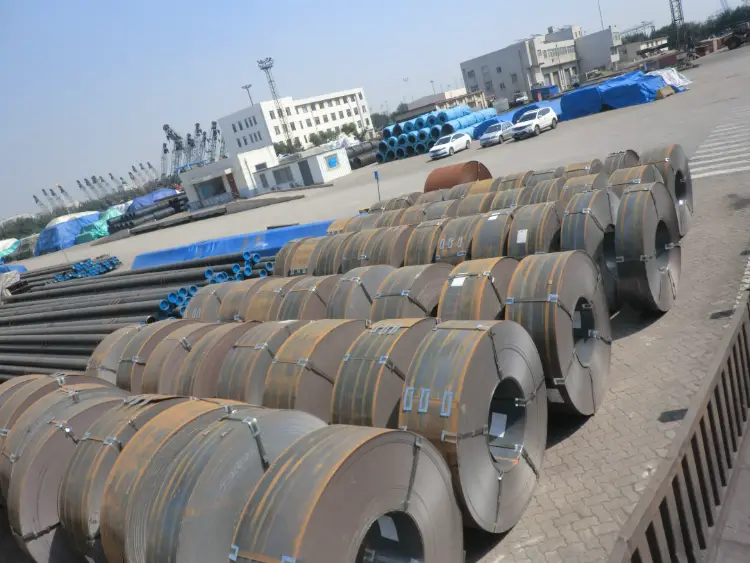
ABS Grade EQ70 Shipbuilding Steel Coil
ABS Grade EQ70 Shipbuilding Steel Coil - High Strength Quenched & Tempered Marine Steel
Comprehensive data on ABS Grade EQ70 shipbuilding steel coil including chemical composition, mechanical properties, physical properties, international equivalents, and applications.
Hot rolling, quenching and tempering, welding, cutting, cold forming (with limitations), machining
- Phone : +8618037372205
- Email : [email protected]
- WhatsApp: Contact via Whtsapp
- WeChat: +8618037372205
ABS Grade EQ70 Shipbuilding Steel Coil Introduction
ABS Grade EQ70 is a high-strength, quenched and tempered (Q&T) shipbuilding steel certified by the American Bureau of Shipping. It is specifically designed for critical structural components in ships, offshore platforms, and marine engineering applications requiring a minimum yield strength of 690 MPa combined with excellent low-temperature toughness. The material is supplied in coil form, allowing efficient processing into plates, profiles, and fabricated parts. Its fine-grained microstructure provides superior weldability, fatigue resistance, and consistent mechanical behavior under dynamic loading conditions typical of marine environments.
- Yield strength ≥ 690 MPa
- Tensile strength 770–940 MPa
- Good impact toughness at -40°C
- Weldable with low-alloy design
ABS Grade EQ70 Shipbuilding Steel Coil Chemical Composition
The chemical composition limits are specified by ABS Rules for Materials and Welding Part 2. The values below represent ladle analysis maximum or range as per the standard to achieve the required strength and toughness. Microalloying elements such as Nb, V, Ti, and Al are used for grain refinement and precipitation strengthening. Carbon equivalent (CEV) is typically controlled below 0.50% to ensure good weldability.
| Element | Standard Value (wt%) | Remarks |
|---|---|---|
| Carbon (C) | ≤ 0.20 | Ladle analysis max |
| Silicon (Si) | 0.10 – 0.55 | Ladle analysis range |
| Manganese (Mn) | 0.70 – 1.70 | Ladle analysis range |
| Phosphorus (P) | ≤ 0.025 | Ladle analysis max |
| Sulfur (S) | ≤ 0.025 | Ladle analysis max |
| Chromium (Cr) | ≤ 0.30 | Ladle analysis max |
| Nickel (Ni) | ≤ 1.00 | Ladle analysis max |
| Molybdenum (Mo) | ≤ 0.50 | Ladle analysis max |
| Copper (Cu) | ≤ 0.35 | Ladle analysis max |
| Aluminum (Al, acid sol.) | ≥ 0.015 | Grain refining element |
| Niobium (Nb) | ≤ 0.06 | Ladle analysis max |
| Vanadium (V) | ≤ 0.10 | Ladle analysis max |
| Titanium (Ti) | ≤ 0.02 | Ladle analysis max |
| Nitrogen (N) | ≤ 0.012 | Ladle analysis max |
| Boron (B) | ≤ 0.005 | Optional; if added for hardenability |
ABS Grade EQ70 Shipbuilding Steel Coil Thermal & Electrical Physical Properties
Physical properties are typical values for high-strength low-alloy quenched and tempered steel. They are provided for engineering design purposes and may show minor variations depending on the exact composition and heat treatment condition. Thermal expansion and thermal conductivity values are essential for welding and fire-engineering calculations.
| Property | Typical Value | Unit | Test Condition |
|---|---|---|---|
| Density (ρ) | 7.85 | g/cm³ | 20°C |
| Elastic modulus (E) | 205 | GPa | 20°C |
| Shear modulus (G) | 80 | GPa | 20°C |
| Poisson's ratio (ν) | 0.30 | – | 20°C |
| Thermal expansion coefficient (α) | 11.5 × 10⁻⁶ | /K | 20–100°C |
| Thermal conductivity (λ) | 35 | W/(m·K) | 100°C |
| Specific heat capacity | 460 | J/(kg·K) | 20°C |
| Electrical resistivity (ρ_e) | 0.23 × 10⁻⁶ | Ω·m | 20°C |
ABS Grade EQ70 Shipbuilding Steel Coil Mechanical Properties
Mechanical properties are determined on test pieces taken in the longitudinal direction from quenched and tempered material. The values correspond to the requirements of ABS Rules. Impact tests are performed at -40°C. Actual properties may vary with plate thickness and production route. The steel exhibits a good combination of strength and ductility for heavy-duty structural designs.
| Property | Standard Requirement | Unit | Test Condition |
|---|---|---|---|
| Yield strength (ReH) | ≥ 690 | MPa | Room temperature; thickness ≤ 50 mm (t) |
| Yield strength (ReH) | ≥ 690 | MPa | Room temperature; thickness > 50 mm ≤ 100 mm |
| Tensile strength (Rm) | 770 – 940 | MPa | Room temperature; all thickness |
| Elongation (A, 5.65√S0) | ≥ 14 | % | Room temperature; longitudinal, thickness ≤ 50 mm |
| Elongation (A, 5.65√S0) | ≥ 14 | % | Room temperature; longitudinal, thickness > 50 mm |
| Bending test (180°) | d = 3a (no cracks) | – | Bend diameter d, specimen thickness a |
| Impact energy (KV2) | ≥ 27 (longitudinal) / ≥ 20 (transverse) | J | -40°C; full-size specimen 10×10 mm |
ABS Grade EQ70 Shipbuilding Steel Coil Completely Equivalent Material Standards & Replaceable Grades
| Country/Region | Standard | Grade | Remarks |
|---|---|---|---|
| International (DNV) | DNV Rules (DNVGL) | DNV E690 | Same strength class, similar toughness |
| International (Lloyd's Register) | LR Rules | LR E690 | Same strength class, similar toughness |
| International (Bureau Veritas) | BV Rules | BV E690 | Same strength class, similar toughness |
| China | CCS Rules | CCS E690 | Same strength class, similar toughness |
| International (Nippon Kaiji Kyokai) | NK Rules | NK E690 | Same strength class, similar toughness |
| Korea | KR Rules | KR E690 | Same strength class, similar toughness |
| International (RINA) | RINA Rules | RINA E690 | Same strength class, similar toughness |
| Russia | RS Rules | RS E690 | Same strength class, similar toughness |
ABS Grade EQ70 Shipbuilding Steel Coil Application Introduction
ABS EQ70 steel is widely used where high strength and low-temperature toughness are critical. Its excellent weldability and fatigue resistance make it ideal for large-scale marine and offshore constructions. The material is usually supplied as coil and can be cut, formed, and welded into complex structural assemblies. Typical processing includes
- Plasma or laser cutting
- Cold or warm forming (controlled bend radius due to high strength)
- Submerged arc welding (SAW), gas metal arc welding (GMAW), and flux-cored arc welding (FCAW) with low-hydrogen consumables
Product Applications: Ship hull plates and stiffened panels, Deck plates and hatch covers, Offshore platform topside structures, Jack-up rig leg and spudcan components, Crane booms and lifting equipment, Wind turbine foundation transition pieces
Processed into products: Rack bars and pinions for jacking systems, Longitudinal and transverse stiffeners, Gusset plates and brackets, Bearing supports and heavy-duty nodes, Welded I-beams and box girders, Reinforcement plates for highly loaded connections
Application industries: Shipbuilding (hull, deck, bulkheads), Offshore engineering (jack-up rigs, semi-submersibles, platform legs), Heavy machinery (cranes, earthmoving equipment), Mining equipment (dump truck bodies, excavator arms), Bridge construction (high-strength girder plates)
ABS Grade EQ70 Shipbuilding Steel Coil Similar/Alternative Material Grades
| Country/Region | Standard | Grade | Remarks |
|---|---|---|---|
| European Union | EN 10025-6 | S690Q / S690QL | Similar strength (ReH ≥690 MPa, Rm 770–940 MPa); EN 10025-6, Q&T structural steel. Impact temperature class may differ (QL: -40°C). Suitable for general engineering, but check ship classification rules. |
| USA | ASTM A514 / A517 | A514 Grade S | Yield ≥690 MPa, tensile 760–895 MPa (Grade S). Quenched and tempered alloy steel plate for structural use. Not directly covered by ABS; supplementary certification required. |
| USA | ASTM A514 / A517 | A514 Grade Q | Similar yield and tensile range, but impact properties may differ. Pre-approved qualification for marine use is necessary. |
Notes:
Welding: Preheat typically 100–150°C depending on thickness; low-hydrogen practices mandatory. Post-weld heat treatment may be applied for thick sections to relieve stress but must not degrade temper condition. Carbon equivalent (CEV) is kept ≤ 0.50% (typically 0.43–0.50) to ensure weldability. Corrosion protection: Paint systems or cathodic protection as per marine standards. Forming: Minimum bending radius ~3t; springback compensation required. Ordering: Specify ABS Grade EQ70 with required thickness, width, and condition (Q&T). Supplementary requirements such as through-thickness properties (Z35) can be ordered for special structural details.
- Share



