
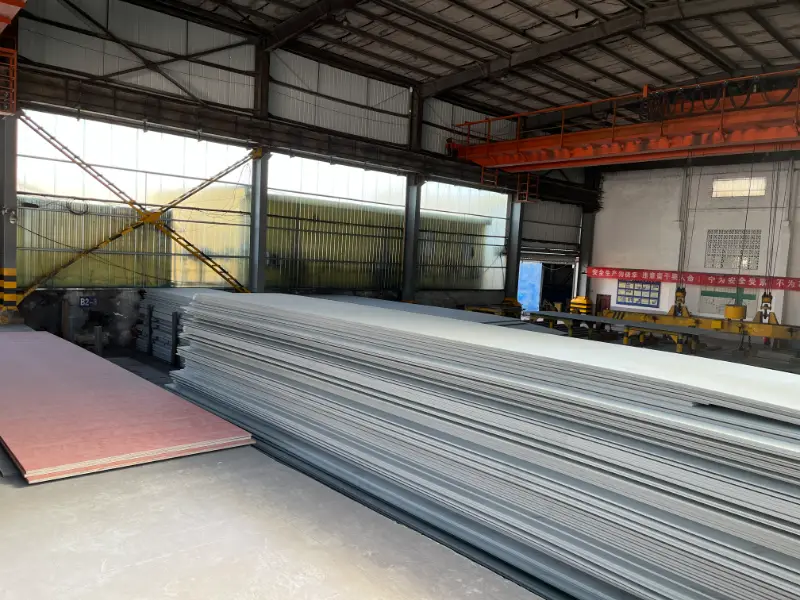
ABS Grade DQ70 Offshore & Marine Steel Plate Coil
ABS Grade DQ70 Shipbuilding Steel Coil: High-Strength Quenched & Tempered Plate for Offshore Structures
Explore the chemical composition, mechanical properties, and application of ABS Grade DQ70 shipbuilding steel coil. This high-strength quenched and tempered steel offers minimum yield strength of 690 MPa with excellent low-temperature toughness for marine and offshore engineering.
Hot rolling, quenching and tempering, stress relieving, welding, cold forming (limited), thermal cutting
- Phone : +8618037372205
- Email : [email protected]
- WhatsApp: Contact via Whtsapp
- WeChat: +8618037372205
ABS Grade DQ70 Offshore & Marine Steel Plate Coil Introduction
ABS Grade DQ70 is a high-strength, quenched and tempered structural steel governed by the American Bureau of Shipping (ABS) rules for marine and offshore applications. With a minimum yield strength of 690 MPa, it belongs to the ultra-high-strength category and is designed for critical load-bearing components in ships, offshore platforms, and other marine structures. Key features include:
- Excellent low-temperature toughness, typically down to -40°C
- High strength-to-weight ratio for weight reduction in large structures
- Good weldability with controlled carbon equivalent (Ceq)
- Uniform mechanical properties through the thickness due to the quenching and tempering process
The DQ70 designation indicates that the steel meets ABS requirements for Grade D (normal strength) notch toughness but with a yield strength of 70 ksi (690 MPa). It is supplied in plate, coil, or cut-to-length forms, and can be delivered in the quenched and tempered condition as per ABS specifications.
ABS Grade DQ70 Offshore & Marine Steel Plate Coil Chemical Composition
The chemical composition specified by ABS for Grade DQ70 is designed to achieve high strength and low-temperature toughness after quenching and tempering. Key elements include:
- Controlled carbon and manganese to provide base strength
- Microalloying elements like Nb, V, and Ti for grain refinement and precipitation strengthening
- Sufficient aluminum for deoxidation and fine grain practice
- The carbon equivalent (Ceq) is restricted to ensure good weldability
Residual elements such as Cu, Ni, Cr, and Mo are added intentionally or allowed within limits to enhance hardenability and toughness. All values are maximum unless a range is given.
| Element | Standard Value (max %) | Remarks |
|---|---|---|
| Carbon (C) | 0.20 | Ladle analysis |
| Manganese (Mn) | 1.00 - 1.60 | Depending on thickness |
| Silicon (Si) | 0.10 - 0.55 | Killed steel practice |
| Phosphorus (P) | 0.025 | Strict control for toughness |
| Sulfur (S) | 0.025 | Strict control for toughness |
| Copper (Cu) | 0.35 | Residual element |
| Nickel (Ni) | 1.50 | Improves low-temperature toughness |
| Chromium (Cr) | 0.80 | Hardenability element |
| Molybdenum (Mo) | 0.50 | Hardenability element |
| Vanadium (V) | 0.10 | Microalloy; grain refinement |
| Titanium (Ti) | 0.02 | Microalloy; grain refinement |
| Aluminum (Al) | 0.015 min (acid soluble) | Grain refinement |
| Nitrogen (N) | 0.012 | Controlled for toughness |
| Niobium (Nb) | 0.050 | Microalloy; grain refinement |
| Carbon Equivalent (Ceq) | 0.55 (typical limit) | Based on IIW formula, thickness dependent |
ABS Grade DQ70 Offshore & Marine Steel Plate Coil Thermal and Electrical Physical Properties
The following values are typical for quenched and tempered high-strength low-alloy steels and can be used for design calculations. They are not mandatory requirements in ABS specifications but are representative of Grade DQ70 at room temperature unless otherwise noted.
- Density is constant; variations are negligible
- Elastic properties decrease slightly with temperature
- Thermal conductivity and expansion are similar to other carbon-manganese steels
Data sourced from industry handbooks and typical material datasheets for S690QL class steels.
| Property | Typical Value | Unit | Test Condition |
|---|---|---|---|
| Density (ρ) | 7850 | kg/m³ | 20°C |
| Elastic Modulus (E) | 205 | GPa | 20°C, static tensile |
| Shear Modulus (G) | 80 | GPa | Calculated from E and ν |
| Poisson's Ratio (ν) | 0.3 | dimensionless | 20°C, elastic range |
| Thermal Expansion Coefficient (α) | 12.0 | 10⁻⁶/K | 20-100°C |
| Thermal Expansion Coefficient (α) | 12.5 | 10⁻⁶/K | 20-200°C |
| Thermal Expansion Coefficient (α) | 13.0 | 10⁻⁶/K | 20-300°C |
| Thermal Conductivity (λ) | 42 | W/(m·K) | 20°C |
| Thermal Conductivity (λ) | 37 | W/(m·K) | 200°C |
| Specific Heat Capacity | 460 | J/(kg·K) | 20°C |
| Electrical Resistivity (ρ_e) | 0.25 | μΩ·m | 20°C |
ABS Grade DQ70 Offshore & Marine Steel Plate Coil Mechanical Properties
The mechanical properties are tested on specimens taken from the quenched and tempered product (normally plate or coil). Transverse or longitudinal test pieces may be specified.
- Yield strength and tensile strength are the primary design parameters
- Elongation reflects ductility requirements
- Charpy V-notch impact energy is specified at -40°C to ensure brittle fracture resistance
- Bend test verifies formability and soundness
Values below are the minimum required by ABS unless a range is indicated. Product thickness influences some requirements.
| Property | Required Value | Unit | Test Condition |
|---|---|---|---|
| Yield Strength (ReH) | ≥ 690 | MPa | t ≤ 150 mm, transverse or longitudinal |
| Tensile Strength (Rm) | 770 - 940 | MPa | t ≤ 150 mm |
| Elongation (A) | ≥ 14 | % | Gauge length 5.65√So (A5), longitudinal, t ≤ 50 mm |
| Elongation (A) | ≥ 14 | % | Gauge length 5.65√So (A5), transverse, t ≤ 50 mm |
| Elongation (A) | ≥ 13 | % | Gauge length 5.65√So (A5), longitudinal, 50 < t ≤ 70 mm |
| Elongation (A) | ≥ 13 | % | Gauge length 5.65√So (A5), transverse, 50 < t ≤ 70 mm |
| Elongation (A) | ≥ 12 | % | Gauge length 5.65√So (A5), longitudinal, 70 < t ≤ 100 mm |
| Elongation (A) | ≥ 12 | % | Gauge length 5.65√So (A5), transverse, 70 < t ≤ 100 mm |
| Elongation (A) | ≥ 11 | % | Gauge length 5.65√So (A5), longitudinal, 100 < t ≤ 150 mm |
| Elongation (A) | ≥ 11 | % | Gauge length 5.65√So (A5), transverse, 100 < t ≤ 150 mm |
| Bend Test (Bend Angle 180°) | d = 3a | a = specimen thickness; no cracks | |
| Charpy V-Notch Impact (KV₂) | ≥ 69 (average), ≥ 52 (single) | J | Longitudinal, -40°C, 10x10 mm specimen |
| Charpy V-Notch Impact (KV₂) | ≥ 46 (average), ≥ 35 (single) | J | Transverse, -40°C, 10x10 mm specimen |
ABS Grade DQ70 Offshore & Marine Steel Plate Coil Completely Equivalent Material Standards and Replaceable Grades
| Country/Region | Standard | Grade | Remarks |
|---|---|---|---|
| European Union | EN 10025-6 | S690QL (1.8928) | Direct equivalence in yield strength, quenched and tempered condition, similar low-temperature toughness |
| United States | ASTM A514/A517 | Grade S | Minimum yield 690 MPa, similar alloy design, Q&T, used in structural and marine applications |
| Japan | JIS G 3128 | SHY685 | High yield strength steel for welded structures, similar composition and properties |
| International | API 2W | Grade 60 | Steel plates for offshore structures produced by thermo-mechanical control process (TMCP) or Q&T, comparable strength |
ABS Grade DQ70 Offshore & Marine Steel Plate Coil Application Introduction
ABS DQ70 is utilized in heavily loaded structures where weight savings and high strength are critical. Its combination of 690 MPa yield strength and reliable -40°C toughness makes it ideal for dynamically stressed components in harsh marine environments. Typical processing includes plasma cutting, welding with low-hydrogen consumables (preheat may be required depending on thickness), and limited cold forming. Post-weld heat treatment is not generally required but may be applied to relieve stress.
- Always follow ABS Rules for welding procedure qualification
- Design should account for the possible reduction of toughness in the heat-affected zone (HAZ)
Product Applications: Jack-up rig leg chords and racks, Ship hull stiffeners and frames, Deck plating for heavy load areas, Submarine pressure hull sections, Crane booms for heavy lift vessels
Processed into products: Welded tubular joints (nodes), Through-thickness loaded T-connections, Heavy-section stiffened panels, Pin-jointed truss members of offshore structures, Transverse and longitudinal stiffeners in ice-strengthened hulls
Application industries: Offshore oil and gas (jack-up rigs, fixed platform legs and bracings), Shipbuilding (navy vessels, icebreakers, heavy deck carriers), Marine engineering (heavy lift crane pedestals, mooring equipment), Renewable energy (offshore wind turbine jacket foundations)
ABS Grade DQ70 Offshore & Marine Steel Plate Coil Similar and Alternative Grades for Reference
| Country/Region | Standard | Grade | Remarks |
|---|---|---|---|
| European Union | EN 10025-6 | S690Q (1.8931) | Slightly lower toughness, otherwise similar; may require additional testing for ABS approval |
| United States | ASTM A514/A517 | Grade Q | Higher carbon equivalent possible; check weldability and toughness at -40°C |
| Norway | DNV GL (now DNV) | VL D690 | Very similar requirements within classification society rules; often interchangeable with ABS DQ70 |
| United Kingdom | LR (Lloyd's Register) | Grade D690 | Classification society grade with equivalent mechanical and toughness criteria |
| China | GB/T 712 | Q690CFC | Quenched and tempered high strength hull structural steel, similar to DQ70, low temperature toughness class C |
Notes:
Special considerations:
- The product must be certified by an ABS surveyor. Mill certificates must show ladle analysis and product mechanical tests as required by ABS Rules.
- For thicknesses over 50 mm, through-thickness properties (Z-direction) may be specified (Z35 steel) to avoid lamellar tearing.
- Preheating before welding is recommended for thicknesses above 20 mm to avoid hydrogen cracking; typical preheat temperature 100-150°C.
- The steel can be ordered with an optional copper addition (up to 0.50%) for improved atmospheric corrosion resistance, but this is not part of standard DQ70.
- Share



