
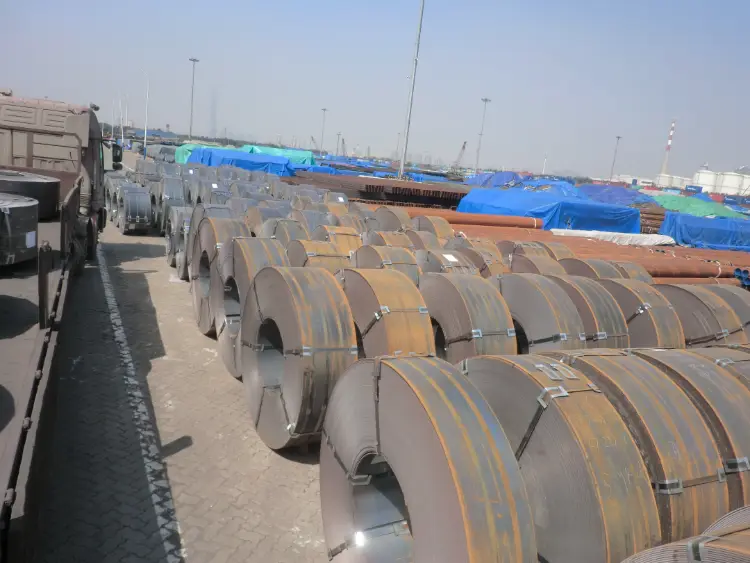
ABS Grade AQ70 Shipbuilding Steel Coil
ABS Grade AQ70 Shipbuilding Steel Coil: High-Strength Quenched & Tempered Plate for Marine Structures
In-depth data sheet of ABS Grade AQ70 shipbuilding steel coil including chemical composition, mechanical properties, thermal & electrical performance, international equivalents, and application guidelines.
Hot rolling, quenching, tempering, cutting, welding, bending
- Phone : +8618037372205
- Email : [email protected]
- WhatsApp: Contact via Whtsapp
- WeChat: +8618037372205
ABS Grade AQ70 Shipbuilding Steel Coil Introduction
ABS Grade AQ70 is a high-strength quenched and tempered structural steel primarily used in shipbuilding and offshore constructions. As per the ABS Rules for Building and Classing Steel Vessels, this grade belongs to the 690 MPa yield strength category, ensuring superior weldability, toughness, and resistance to brittle fracture. The 'A' designation indicates a minimum Charpy V-notch impact energy of 31 J at 0°C in the longitudinal direction. Typical applications include critical hull members, deck plating, and offshore platform components subject to severe loading and low-temperature environments. The material is supplied in normalized or quenched and tempered condition, often in the form of hot-rolled coils subsequently processed to plates or cut sheets.
ABS Grade AQ70 Shipbuilding Steel Coil Chemical Composition
The ladle analysis of ABS AQ70 steel follows the limits given in ABS Rules. Minor alloying elements such as Cr, Ni, Mo, V, Nb, Ti may be added individually or in combination to achieve the required mechanical properties. The carbon equivalent (CEV) is often controlled to ensure good weldability, typically CEV ≤ 0.52% for thicknesses up to 50 mm.
| Element | Standard Value (max, unless range given) | Remarks |
|---|---|---|
| C | ≤ 0.20 | For plate thickness t ≤ 50 mm; may be lower for thicker sections |
| Mn | 0.70 - 1.70 | May be adjusted based on plate thickness |
| Si | ≤ 0.55 | Killed fine grain practice required |
| P | ≤ 0.030 | Maximum |
| S | ≤ 0.030 | Maximum |
| Cu | ≤ 0.35 | |
| Cr | ≤ 1.50 | May be added for strength |
| Ni | ≤ 2.50 | May be added for toughness |
| Mo | ≤ 0.70 | May be added for hardenability |
| V | ≤ 0.12 | May be present as microalloy |
| Nb | ≤ 0.06 | May be present as microalloy |
| Ti | ≤ 0.05 | May be present as microalloy |
| Al (acid soluble) | ≥ 0.015 | Grain refining, fully killed |
| N | ≤ 0.012 | Typical control |
| CEV | ≤ 0.52 (t ≤ 50 mm) | Carbon equivalent based on IIW formula |
ABS Grade AQ70 Shipbuilding Steel Coil Thermal and Electrical Physical Properties
The physical properties provided are representative for high-strength quenched and tempered steels similar to ABS AQ70. Actual values may vary slightly depending on the exact chemical composition and heat treatment. These data are essential for structural design, thermal stress analysis, and electrical applications.
| Property | Typical Value | Unit | Test Condition / Remarks |
|---|---|---|---|
| Density (ρ) | 7.85 | g/cm³ | At 20°C |
| Modulus of Elasticity (E) | 205 - 210 | GPa | At room temperature |
| Shear Modulus (G) | ≈ 80 | GPa | Calculated from E and ν |
| Poisson's Ratio (ν) | 0.29 - 0.30 | — | Elastic range |
| Coefficient of Thermal Expansion (α) | 11.5 - 12.5 (20-100°C); 13.0 - 13.5 (20-400°C) | 10⁻⁶/K | Average over temperature range |
| Thermal Conductivity (λ) | 35 - 45 at 20°C; 30 - 35 at 400°C | W/(m·K) | Decreases with temperature |
| Specific Heat Capacity | 450 - 500 at 20°C; 550 - 600 at 400°C | J/(kg·K) | Increases with temperature |
| Electrical Resistivity (ρe) | 0.20 - 0.25 at 20°C | µΩ·m |
ABS Grade AQ70 Shipbuilding Steel Coil Mechanical Properties
Mechanical tests are carried out on specimens taken in the transverse direction unless otherwise agreed. Charpy V-notch tests are performed at 0°C for Grade AQ70. The minimum impact energy is 31 J for longitudinal specimens and reduced values for transverse orientation. Tensile testing follows the standard bar methods. Bend tests are performed on full-thickness specimens with a mandrel diameter at least 3 times the plate thickness.
| Property | Required Value | Unit | Test Condition |
|---|---|---|---|
| Yield Strength (ReH) | ≥ 690 | MPa | Ambient temperature, transverse |
| Tensile Strength (Rm) | 770 - 940 | MPa | Ambient temperature, transverse |
| Elongation (A) | ≥ 14 (gauge 200 mm) / ≥ 16 (gauge 50 mm) | % | Ambient temperature, transverse |
| Bend Test | No cracks; mandrel diameter = 3t | - | 180° bend, ambient temperature; t = specimen thickness |
| Charpy V-Notch Impact (KV) | ≥ 31 (longitudinal) | J | 0°C, specimen 10×10 mm² |
| Charpy V-Notch Impact (KV) | ≥ 22 (transverse) | J | 0°C, specimen 10×10 mm² |
| Hardness (HBW) | Typically 235 - 330 | HBW | Quenched and tempered condition; not mandatory in ABS rules |
ABS Grade AQ70 Shipbuilding Steel Coil Fully Equivalent Material Standards and Substitute Grades
| Country/Region | Standard | Grade | Remarks |
|---|---|---|---|
| International (ABS) | ABS Rules, Part 2 Ch 1 S 2 | AQ70 | Base grade, 0°C impact |
| European Union | EN 10025-6 | S690QL | Same yield class; Q+T condition; minimum impact 27J at -20°C (L) → close equivalent |
| USA | ASTM A514 / A517 | Grade S, Grade Q | A514 is plate; A517 is for pressure vessels; yield ≥ 690 MPa; Q+T |
| China | GB/T 712 | E690 (with F, E, D, A impact classes) | CCS/GB standard; A690 has 0°C impact; full equivalency needs confirmation of deoxidation practice |
| Norway/Germany (DNV) | DNVGL VL E690 | VL E690 | DNV equivalent of 690 MPa YP steel; E class is for 0°C impact |
| Bureau Veritas | BV Rules | E690 | Impact at 0°C |
| Lloyd's Register | LR Rules | EH69 | EH69 has 0°C impact |
| ClassNK | NK Rules | KE690 | K is for 0°C; AQ70 corresponds to A class |
| RINA | RINA Rules | E690 | Same strength class |
ABS Grade AQ70 Shipbuilding Steel Coil Application Introduction
ABS AQ70 steel coil, after conversion to plate or profile, is widely utilized in naval and commercial shipbuilding as well as in fixed and floating offshore structures. Thanks to its high strength-to-weight ratio and excellent low-temperature toughness, it enables weight reduction and enhances service life in harsh marine environments. Industries served:
- Shipbuilding (hulls, superstructures)
- Offshore oil & gas platforms (jackets, decks)
- Renewable energy (offshore wind turbine foundations)
- Heavy machinery and crane manufacturing
- Pressure vessels and storage tanks
Product Applications: Hull plating for large container ships and tankers, Deck plating for drillships and semi-submersibles, Leg racks and chords of jack-up rigs, Tubular nodes and braces for fixed offshore platforms, Transition pieces for monopile wind-turbine foundations, Crane booms and jibs built to ABS lifting appliance rules
Processed into products: Web frames and stringers in ship structures, Transverse bulkheads, Heavy-duty bearing supports, Welded beams and columns for platform decks, Eye pads and padeyes for lifting lugs, Shackles and hooks (after forging from plate/coil), Pressure-retaining parts of subsea modules, Cut-to-length parts for stiffeners, brackets, and chocks
Application industries: Shipbuilding and ship repair, Offshore engineering (oil & gas platforms, FPSOs), Offshore wind energy structures, Port and crane equipment, Mining and heavy machinery, Pressure vessel fabrication
ABS Grade AQ70 Shipbuilding Steel Coil Similar / Alternative Material Recommendations
| Country/Region | Standard | Grade | Remarks |
|---|---|---|---|
| European Union | EN 10025-6 | S690Q | Slightly lower notched impact energy requirement than S690QL; check toughness |
| USA | ASTM A709 | Grade HPS 100W | Higher strength (690 MPa) but different chemistry; may require re-qualification |
| Japan | JIS G 3128 | SHY685 | High yield point steel for welded structures; yield ≥ 685 MPa; often used in bridges |
| China | GB/T 1591 | Q690D/E | Q690D has -20°C impact, Q690E -40°C; may substitute AQ70 if low-temperature toughness is adequate |
| ISO | ISO 4950-2/3 | S690QL | Similar to EN 10025-6 |
Notes:
- When ordering ABS AQ70 steel coil, the specification must clearly indicate the required thickness, width, impact orientation, and any supplementary testing (e.g., through-thickness tensile, ultrasonic, NACE MR0175 compliance).
- Welding must follow approved procedures using low-hydrogen electrodes and preheat/interpass temperature control to prevent cold cracking. Post-weld heat treatment (PWHT) is generally not required but may be applied for heavy sections.
- The coil product is intended for direct use in coil form only after agreement with the classification society; otherwise it is normally processed into cut-to-length plates or strip before fabrication.
- This data sheet is for informational purposes only. For design purposes, refer to the latest edition of the ABS Rules and the material manufacturer's test certificates.
- Share



