
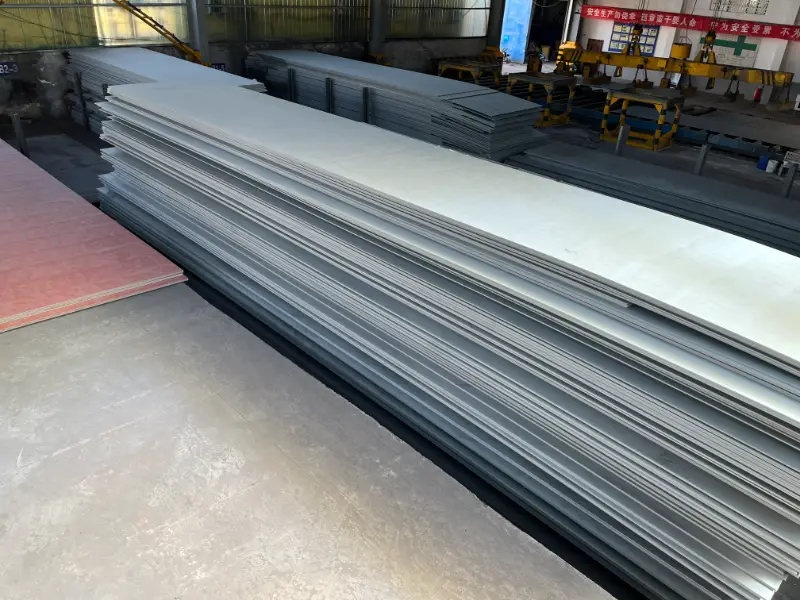
Austenitic 304H (S30409) Stainless Steel Plate/Coil
304H (UNS S30409) Austenitic Stainless Steel: High-Temperature Strength Plate & Coil
Comprehensive data on 304H (S30409) austenitic stainless steel plate/coil, including chemical composition, mechanical properties, physical properties, equivalents, and applications.
Hot rolling, cold rolling, forming, machining, welding, solution annealing
- Phone : +8618037372205
- Email : [email protected]
- WhatsApp: Contact via Whtsapp
- WeChat: +8618037372205
Austenitic 304H Stainless Steel Plate/Coil Introduction
304H (UNS S30409) is an austenitic chromium-nickel stainless steel with controlled carbon content of 0.04–0.10%, specifically designed for improved high-temperature strength and creep resistance compared to standard 304. It is widely used in elevated-temperature service up to approximately 800°C. The alloy offers good corrosion resistance in most environments and excellent formability and weldability. The H-modification provides enhanced stress-rupture properties for boiler and pressure vessel applications, making it a preferred choice for components such as superheater tubes and headers. It is typically supplied in the solution-annealed condition.
Austenitic 304H Stainless Steel Plate/Coil Chemical Composition
Chemical composition limits as per ASTM A240/A240M for 304H stainless steel. The elevated carbon content (0.04–0.10%) provides increased high-temperature strength compared to standard 304. All values are in weight percent.
| Element | Standard Value (wt%) | Remarks |
|---|---|---|
| Carbon (C) | 0.04 – 0.10 | Key element for high-temperature strength |
| Manganese (Mn) | ≤ 2.00 | |
| Phosphorus (P) | ≤ 0.045 | |
| Sulfur (S) | ≤ 0.030 | |
| Silicon (Si) | ≤ 0.75 | May also be reported as ≤ 1.00 in some specifications |
| Chromium (Cr) | 18.0 – 20.0 | |
| Nickel (Ni) | 8.0 – 10.5 | |
| Nitrogen (N) | ≤ 0.10 | |
| Iron (Fe) | Balance | Approximately 66.7 – 73.96% |
Austenitic 304H Stainless Steel Plate/Coil Physical, Thermal and Electrical Properties
These typical values are representative for 304H austenitic stainless steel. They may vary slightly depending on processing and measurement methods. All data are applicable to annealed material unless otherwise noted.
| Property | Typical Value | Unit | Test Condition / Temperature Range |
|---|---|---|---|
| Density (ρ) | 8.0 | g/cm³ (kg/dm³) | Room temperature |
| Elastic Modulus (E) | 193 | GPa | 20°C |
| Shear Modulus (G) | 78 | GPa | 20°C (estimated) |
| Poisson's Ratio (ν) | 0.28 | — | 20°C (estimated) |
| Thermal Expansion Coefficient (α) | 16.2 | µm/m·°C | 20–100°C |
| Thermal Expansion Coefficient (α) | 17.8 | µm/m·°C | 20–500°C |
| Thermal Expansion Coefficient (α) | 18.4 | µm/m·°C | 20–800°C |
| Thermal Conductivity (λ) | 16.2 | W/m·K | 100°C |
| Thermal Conductivity (λ) | 21.5 | W/m·K | 500°C |
| Specific Heat Capacity | 500 | J/kg·K | 20°C |
| Electrical Resistivity (ρ_e) | 0.72 | µΩ·m | 20°C |
Austenitic 304H Stainless Steel Plate/Coil Mechanical Properties
Minimum mechanical property requirements according to ASTM A240/A240M for plate/coil in solution-annealed condition. Testing is typically performed at ambient temperature. The alloy exhibits good ductility and toughness.
| Property | Standard Requirement (Minimum) | Unit | Test Condition |
|---|---|---|---|
| Yield Strength (0.2% offset) | 205 | MPa | Room temperature, transverse |
| Tensile Strength | 515 | MPa | Room temperature, transverse |
| Elongation (50 mm gauge) | 40 | % | Room temperature, transverse |
| Hardness | ≤ 201 HBW or ≤ 92 HRB | — | As per ASTM A370 |
| Bend Test (for plate ≤ 19 mm thick) | 180° bend, diameter = 2*thickness | — | No cracks permitted |
Austenitic 304H Stainless Steel Plate/Coil Equivalent International Standards and Grades
| Country/Region | Standard | Grade | Remarks |
|---|---|---|---|
| USA | ASTM A240/A240M | 304H (UNS S30409) | Original specification |
| Europe | EN 10028-7, EN 10088-2 | 1.4948 (X6CrNi18-11) | Chemically equivalent; high-carbon 304 |
| Japan | JIS G4304, G4305 | SUS304H | Same carbon range, similar properties |
| China | GB/T 20878, GB/T 4237 | 07Cr19Ni10 (approximate) | C ≤ 0.08%; not exactly H-grade but similar in practice |
Austenitic 304H Stainless Steel Plate/Coil Application Introduction
304H is specifically selected for applications requiring good mechanical strength at elevated temperatures, typically in the range of 500°C to 800°C, combined with corrosion resistance common to 18-8 stainless steels. Its higher carbon content provides improved creep and stress-rupture properties under sustained load at high temperatures. It is widely used in the power generation, petrochemical, and chemical processing industries for components that operate in hot gases or high-temperature steam. The alloy is readily fabricated and welded by conventional techniques.
- Key advantage: Superior high-temperature strength compared to standard 304.
- Limitations: Not recommended for applications requiring maximum intergranular corrosion resistance after welding or prolonged exposure in the sensitization range (425–815°C) without stabilization.
Product Applications: Boilers and superheaters, High-temperature heat exchangers and recuperators, Pressure vessels and tanks, Piping systems and headers for steam and hot gases, Expansion joints and bellows, Furnace components and radiant tubes
Processed into products: Superheater tubes and support plates, Boiler drums and shells, High-temperature flanges and fittings, Hot gas ducting and dampers, Reformer tubes (in modified atmospheres), Pyrolysis tubes and coils, Welded pipe and fittings for service above 500°C
Application industries: Power generation (fossil and nuclear), Petrochemical and chemical processing, Oil and gas (refineries), Pulp and paper, Heat treatment and furnace manufacturing, Automotive exhaust systems (limited)
Austenitic 304H Stainless Steel Plate/Coil Similar Materials and Near Equivalents
| Country/Region | Standard | Grade | Remarks |
|---|---|---|---|
| USA | ASTM A240 | 304 (UNS S30400) | Lower carbon (≤0.08%); reduced high-temperature strength, suitable for general corrosion resistance |
| USA | ASTM A240 | 304L (UNS S30403) | Extra-low carbon (≤0.03%); for welded structures not requiring post-weld annealing; lower hot strength |
| USA | ASTM A240 | 321 (UNS S32100) | Titanium-stabilized; excellent high-temperature strength and resistance to intergranular corrosion; often used as alternative to 304H above 800°C |
| Europe | EN 10088-2 | 1.4301 (X5CrNi18-10) | Standard 304; lower carbon, lower creep resistance |
| Europe | EN 10088-2 | 1.4541 (X6CrNiTi18-10) | Stabilized 321 equivalent; similar elevated temperature capabilities |
Notes:
The data presented are based on ASTM A240/A240M standard requirements and typical industry sources. Actual mechanical properties may vary with product form, thickness, and processing conditions. For specific high-temperature design, reference to ASME Boiler and Pressure Vessel Code Section II Part D for allowable stress values is recommended. Intergranular corrosion may occur in certain environments after exposure in the 425–815°C range; consider stabilized grades (321, 347) if post-weld annealing is not feasible. 304H should be solution-annealed at a minimum temperature of 1040°C and rapidly quenched to retain carbon in solution for optimal creep strength.
- Share



