
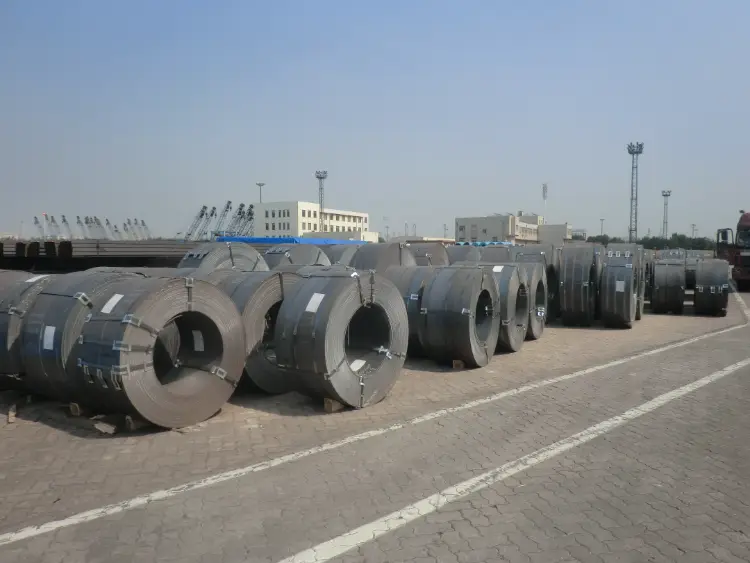
ABS Grade FQ70 Shipbuilding Steel Coil
ABS Grade FQ70 Shipbuilding Steel Coil: High-Strength Quenched & Tempered Steel for Marine Structures
ABS Grade FQ70 is an ultra-high strength quenched and tempered steel for shipbuilding and offshore structures, with minimum yield strength of 690 MPa. This coil product is designed for demanding marine applications requiring excellent toughness at low temperatures and good weldability.
Hot rolling followed by quenching and tempering; suitable for cold forming, welding (with preheat and post-weld heat treatment as required), flame and plasma cutting, machining
- Phone : +8618037372205
- Email : [email protected]
- WhatsApp: Contact via Whtsapp
- WeChat: +8618037372205
ABS Grade FQ70 Shipbuilding Steel Coil Introduction
ABS Grade FQ70 is a premium quenched and tempered structural steel governed by the American Bureau of Shipping (ABS) rules. It belongs to the FQ series of high-strength hull steels, offering a minimum yield strength of 690 MPa. The steel is processed through advanced thermo-mechanical control and quenching & tempering to achieve a fine-grained microstructure that delivers an optimal balance between high strength and excellent low‑temperature toughness.
Typical applications include:
- Legs and racks of self-elevating drilling units (jack-ups)
- Heavy-lift crane booms
- Arctic-class vessel hulls
- Pressure hulls of deep-sea submersibles
It is supplied in coil form for efficient downstream processing such as cut-to-length, roll forming, and welding. The steel meets stringent notch toughness requirements down to -40°C (longitudinal) and can be welded with appropriate low-hydrogen procedures.
ABS Grade FQ70 Shipbuilding Steel Coil Chemical Composition
The chemical composition of ABS FQ70 is tightly controlled to guarantee deep hardenability, high strength, and superior low-temperature toughness after quenching and tempering. Typical ladle analysis limits as per ABS requirements are listed below. Carbon equivalent (CEV) is normally restricted to ≤0.52–0.56% to ensure good weldability.
| Element | Standard Requirement (max, unless range given) | Remarks |
|---|---|---|
| C | ≤ 0.20 | Carbon |
| Mn | 0.70 – 1.60 | Manganese |
| Si | 0.10 – 0.55 | Silicon |
| P | ≤ 0.030 | Phosphorus |
| S | ≤ 0.030 | Sulfur |
| Cr | ≤ 1.50 | Chromium |
| Ni | ≤ 2.00 | Nickel |
| Mo | ≤ 0.70 | Molybdenum |
| Cu | ≤ 0.50 | Copper |
| V | ≤ 0.10 | Vanadium |
| Ti | ≤ 0.05 | Titanium |
| Al (total) | ≥ 0.015 | Aluminium, total |
| Nb | ≤ 0.05 | Niobium |
| N | ≤ 0.012 | Nitrogen |
ABS Grade FQ70 Shipbuilding Steel Coil Thermal and Electrical Physical Properties
The following physical properties are typical for quenched and tempered high-strength steel like FQ70 at room temperature, unless a temperature range is indicated. These values are provided as guidance for engineering calculations and may vary slightly within manufacturing tolerances.
| Property | Typical Value | Unit | Condition/Remarks |
|---|---|---|---|
| Density (ρ) | 7850 | kg/m³ | Ambient temperature |
| Modulus of Elasticity (E) | 205 | GPa | Room temperature |
| Shear Modulus (G) | 80 | GPa | Room temperature |
| Poisson's Ratio (ν) | 0.3 | — | Room temperature |
| Thermal Expansion Coefficient (α) | 11.1 × 10⁻⁶ (20–100°C); 12.3 × 10⁻⁶ (20–200°C); 13.1 × 10⁻⁶ (20–300°C) | /K | Mean coefficient |
| Thermal Conductivity (λ) | ~46 @ 20°C; ~44 @ 100°C; ~40 @ 300°C | W/(m·K) | Approximate values |
| Specific Heat Capacity | ~460 | J/(kg·K) | 20–100°C |
| Electrical Resistivity (ρe) | 0.20 – 0.25 | μΩ·m | Room temperature |
ABS Grade FQ70 Shipbuilding Steel Coil Mechanical Properties
The mechanical properties below are based on ABS Rules for Materials and Welding for FQ70 plates and coils with thickness ≤ 50 mm. Values are for transverse specimens unless otherwise noted. Impact energy requirements apply to longitudinal Charpy V-notch specimens at -40°C. Bend test should be performed to a bend diameter of 4t (t = specimen thickness) through 180° without cracking.
| Property | Required Value | Unit | Test Condition |
|---|---|---|---|
| Yield Strength (ReH) | ≥ 690 | MPa | Transverse, room temperature, t ≤ 50 mm |
| Tensile Strength (Rm) | 770 – 940 | MPa | Transverse, room temperature, t ≤ 50 mm |
| Elongation (A, 5.65√So) | ≥ 14 | % | Transverse, gauge length 5.65√So |
| Bend Test (Bend Diameter) | 4t (180°) | — | No cracks, t = thickness of test piece |
| Charpy Impact (KV, -40°C) | ≥ 50 (longitudinal) / ≥ 34 (transverse) | J | Standard Charpy V-notch, -40°C |
ABS Grade FQ70 Shipbuilding Steel Coil Exact Equivalent Material Standards and Substitutable Grades
| Country/Region | Standard | Grade | Remarks |
|---|---|---|---|
| International (ABS) | ABS Rules | FQ70 | Original specification; quenched & tempered |
| Norway/Germany (DNV) | DNV Rules | VL F690 | Same strength level, Q&T, -40°C impact |
| UK (Lloyd's Register) | LR Rules | FH69 | High strength hull steel, Q&T |
| France (Bureau Veritas) | BV Rules | EH690 | Extra-high strength structural steel |
| China (CCS) | CCS Rules | F690 | Equivalent high strength grade |
| Japan (ClassNK) | NK Rules | KF690 | High strength quenched & tempered steel |
| Italy (RINA) | RINA Rules | F690 | Matching strength and toughness |
ABS Grade FQ70 Shipbuilding Steel Coil Application Introduction
ABS FQ70 steel coil is engineered for the most demanding marine and offshore structures where weight reduction and high payload capacity are critical. Its combination of strength and toughness at low temperatures makes it the material of choice for self-elevating platform legs, racks, and pinions, as well as for heavy-lift crane booms and high-stress hull members. The product is easily formed into circular legs, boxes, and complex welded fabrications using established workshop practices. Typical processing includes plasma/oxy-fuel cutting, cold bending, and shielded metal arc or submerged arc welding with low-hydrogen electrodes and controlled heat input.
Product Applications: Legs, chords, and racks for self-elevating platforms (jack-ups), Boom and jib sections for shipboard and pedestal cranes, Hull inserts and reinforcement for ice-strengthened vessels, Deck framing and lifting padeyes on offshore units, Pressure vessels and storage spheres for cryogenic service (additional testing required)
Processed into products: Rack segments and pinions for jacking systems, Welded tubular joints and nodal cans for fixed platforms, Mega-blocks and transition pieces for offshore wind turbines, Mooring line attachments and fairlead structures, High-capacity bolted connections and splice plates
Application industries: Offshore oil & gas exploration and production, Marine/ shipbuilding (special vessels, icebreakers), Heavy civil engineering and infrastructure, Renewable energy (offshore wind turbine foundations, jack-up installation vessels), Military naval construction (e.g., submarine pressure hulls)
ABS Grade FQ70 Shipbuilding Steel Coil Similar or Equivalent Substitute Materials
| Country/Region | Standard | Grade | Remarks |
|---|---|---|---|
| Europe | EN 10025-6 | S690Q / 1.8931 (S690QL if improved toughness) | Structural steel with min. 690 MPa yield, Q&T; check CEV and thickness limitations. |
| USA | ASTM A514/A514M | Grade Q | High-yield-strength, quenched and tempered alloy steel plate; suitable for marine use under 100 mm thickness. |
| USA | API 2W | Grade 60 | Through-thickness properties for offshore platforms; similar strength level. |
| Japan | JIS G 3128 | SHY 685 | High yield strength steel plate for welded structures; close properties, verify low-temperature toughness. |
| International | ISO 4995/ISO 630 | S690 (quality dependent) | Structural steel; attainable with appropriate processing, confirm impact requirements. |
Notes:
- Welding: Preheat at least 100–150°C depending on thickness, low-hydrogen consumables mandatory. Post-weld heat treatment may be applied to reduce residual stress, but careful control is necessary to avoid over-tempering.
- Formability: Minimum bend radius of 4t is recommended for cold forming. Hot forming above 650°C requires re-quenching and tempering to restore properties.
- Inspection: Ultrasonic testing of plates/coils per ASTM A435 or ABS class rules is standard. Charpy and tensile tests are carried out on each heat treatment batch.
- Ordering: Specify ABS Grade FQ70 with thickness, width, coil inner diameter, and any supplementary requirements (e.g., Z-grade through-thickness testing, CTOD testing).
- Share



