
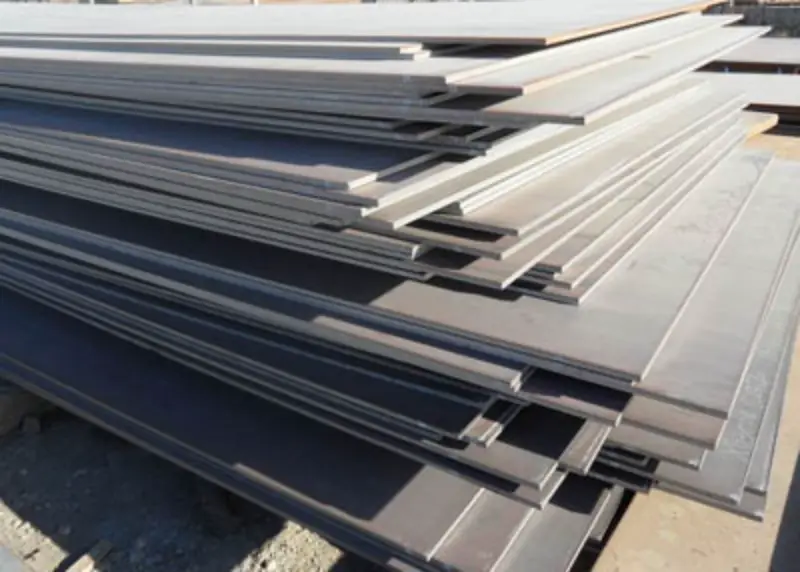
316LN (S31653) Austenitic Stainless Steel Plate/Coil
316LN (S31653) Austenitic Stainless Steel Plate/Coil: Composition, Properties & Equivalents
Detailed material data for 316LN (UNS S31653) stainless steel plate/coil, covering chemical composition per ASTM A240, mechanical properties, physical properties, international equivalents, and application guidance.
Hot rolling, cold rolling, annealing, pickling, descaling
- Phone : +8618037372205
- Email : [email protected]
- WhatsApp: Contact via Whtsapp
- WeChat: +8618037372205
316LN Austenitic Stainless Steel Plate/Coil Introduction
316LN (UNS S31653) is an austenitic stainless steel with controlled nitrogen addition (0.10–0.16%) to enhance strength without compromising the excellent corrosion resistance and ductility of standard 316L. The low carbon content (≤0.030%) ensures resistance to intergranular corrosion in the as-welded condition. This grade offers higher yield and tensile strength compared to 316L, making it suitable for demanding structural applications.
- Key Features: High strength, excellent toughness at cryogenic temperatures, good weldability, and superior resistance to pitting and crevice corrosion in chloride environments.
- Typical Forms: Hot-rolled or cold-rolled plates, coils, sheets, and strips in annealed and pickled condition.
- Industries: Chemical processing, marine, nuclear, oil & gas, and cryogenic equipment.
316LN Austenitic Stainless Steel Plate/Coil Chemical Composition
The chemistry is tightly controlled to balance corrosion resistance, weldability, and enhanced mechanical strength. Nitrogen is deliberately added within 0.10–0.16% to improve proof stress. Single values are maximum unless a range is specified. Iron is the remainder.
| Chemical Element | Standard Value (weight %) | Notes |
|---|---|---|
| Carbon (C) | ≤0.030 | Max; ensures low carbide precipitation |
| Manganese (Mn) | ≤2.00 | Max |
| Phosphorus (P) | ≤0.045 | Max |
| Sulfur (S) | ≤0.030 | Max |
| Silicon (Si) | ≤0.75 | Max |
| Chromium (Cr) | 16.0–18.0 | Key alloying element for corrosion resistance |
| Nickel (Ni) | 10.0–14.0 | Austenite stabilizer |
| Molybdenum (Mo) | 2.00–3.00 | Improves pitting resistance |
| Nitrogen (N) | 0.10–0.16 | Strengthener without compromising ductility |
| Iron (Fe) | Balance |
316LN Austenitic Stainless Steel Plate/Coil Physical and Thermal Properties
The following data are typical for solution-annealed 316LN at room temperature unless otherwise stated. These values are not specification requirements but serve as engineering references. Thermal conductivity and expansion vary with temperature; representative figures for common ranges are provided.
| Property | Typical Value | Unit | Conditions / Temperature |
|---|---|---|---|
| Density (ρ) | 8.0 | g/cm³ | At 20 °C |
| Elastic Modulus (E) | 200 | GPa | At 20 °C |
| Shear Modulus (G) | 77 | GPa | At 20 °C |
| Poisson's Ratio (ν) | 0.28 | – | At 20 °C |
| Thermal Expansion Coefficient (α), 20–100 °C | 16.5 | 10⁻⁶/°C (µm/m·°C) | Mean coefficient, 20–100 °C range |
| Thermal Conductivity (λ) | 15.0 | W/m·K | At 100 °C |
| Specific Heat Capacity (cp) | 500 | J/(kg·K) | At 20 °C |
| Electrical Resistivity (ρe) | 0.74 | µΩ·m | At 20 °C |
316LN Austenitic Stainless Steel Plate/Coil Mechanical Properties
Values represent the minimum acceptance criteria for plate, coil, sheet, and strip in the solution-annealed condition. Elongation requirements depend on the product thickness, as indicated. Yield strength is determined using the 0.2% offset method (Rp0.2). All tests are performed at ambient temperature.
| Property | Standard Requirement | Unit | Test Condition / Thickness Range |
|---|---|---|---|
| Yield Strength (Rp0.2) | ≥205 | MPa | Annealed, ambient temperature |
| Tensile Strength (Rm) | ≥515 | MPa | Annealed, ambient temperature |
| Elongation (A) in 2 in. or 50 mm gauge length | ≥40 | % | Thickness ≤ 4.76 mm (0.1875 in.) |
| Elongation (A) in 2 in. or 50 mm gauge length | ≥40 | % | Thickness 4.76–19 mm (0.1875–0.75 in.) |
| Elongation (A) in 2 in. or 50 mm gauge length | ≥35 | % | Thickness 19–38 mm (0.75–1.50 in.) |
| Elongation (A) in 2 in. or 50 mm gauge length | ≥30 | % | Thickness 38–51 mm (1.50–2.00 in.) |
| Elongation (A) in 2 in. or 50 mm gauge length | ≥25 | % | Thickness 51–63.5 mm (2.00–2.50 in.) |
316LN Austenitic Stainless Steel Plate/Coil Identical/Equivalent Material Standards and Substitutional Grades
| Country/Region | Standard | Grade/Designation | Notes |
|---|---|---|---|
| USA | ASTM A240/A240M | S31653 (316LN) | Original standard for plate, sheet, and strip |
| Europe | EN 10088-2 / EN 10088-3 | 1.4406 – X2CrNiMoN17-11-2 | Chemically identical austenitic stainless steel |
| International | ISO 15510 | X2CrNiMoN17-11-2 | Global designation matching EN 1.4406 |
| Japan | JIS G4304 / G4305 | SUS316LN | Hot-rolled / cold-rolled stainless steel plates and sheets |
| China | GB/T 3280 | 022Cr17Ni12Mo2N (S31653) | Equivalent grade with UNS S31653 |
316LN Austenitic Stainless Steel Plate/Coil Application Introduction
316LN combines the versatile corrosion resistance of the 316 family with an elevated strength level, making it a prime candidate for weight‑sensitive or high‑pressure designs. Its low carbon content and controlled nitrogen ensure good weldability and intergranular corrosion resistance in the as‑welded state. The material remains ductile down to cryogenic temperatures (−196 °C), allowing use in LNG and liquid nitrogen applications. Typical industries and component applications are listed below.
Product Applications: Pressure vessels (ASME‑compliant tanks and columns), Heat exchangers (shell‑and‑tube, plate type), Cryogenic storage tanks and transport vessels, Chemical tankers and cargo systems, Exhaust gas cleaning systems (scrubbers), Structural profiles for corrosive environments, Welded pipes and tubing (when produced to related standards)
Processed into products: Tubesheets and baffles for heat exchangers, Flanges, fittings, and valves, Pump casings and impellers, Thermowells and instrument tubing, LNG loading arms and transfer lines, Fasteners (bolts, studs) for high‑strength applications, Expansion joints and bellows, Welded structural frames and supports
Application industries: Chemical processing (reactors, columns, piping), Petrochemical and oil & gas (offshore platforms, subsea equipment), Marine engineering (desalination plants, shipbuilding), Nuclear power (reactor internals, moderator systems), Cryogenic engineering (storage tanks, piping for LNG, LIN, LOX), Pharmaceutical and food processing (hygienic equipment), Pulp & paper (digesters, bleach plants)
316LN Austenitic Stainless Steel Plate/Coil Similar/Near-Equivalent Materials and Their Relation
| Country/Region | Standard | Grade/Designation | Notes on Similarity and Differences |
|---|---|---|---|
| Global | ASTM A240 / EN 10088-2 | 316L (S31603 / 1.4404) | Same corrosion resistance but lower strength (yield ≥170 MPa) due to absence of nitrogen; excellent for general use where 316LN strength is not required. |
| Global | ASTM A240 | 317L (S31703) | Higher molybdenum (3.0–4.0%) improves pitting resistance; strength lower than 316LN (yield ≥205 MPa similar, but tensile ≥515 MPa also? Actually 317L: yield ≥205 MPa, tensile ≥515 MPa, similar but Mo higher). Often used when enhanced chloride resistance needed. |
| Global | ASTM A240 / EN 10088-2 | 316Ti (S31635 / 1.4571) | Titanium‑stabilized version of 316; good high‑temperature strength and intergranular corrosion resistance; mechanical properties comparable to 316L, not as strong as 316LN. |
| Europe | EN 10088-2 | 1.4429 – X2CrNiMoN17-13-3 | Contains ~3% Mo and nitrogen, offering strength similar to 316LN with higher pitting resistance (PREN ~32 vs. ~28); used for aggressive chloride environments. |
Notes:
Nitrogen strengthening provides a cost‑effective way to achieve higher mechanical properties compared to standard 316L, without sacrificing corrosion performance. The typical PREN (pitting resistance equivalent) value for 316LN is around 25–28, based on the formula %Cr + 3.3 × %Mo + 16 × %N. When ordering to ASTM A240, supplementary requirements (e.g., ultrasonic examination, restricted chemistry, grain size control) may be specified. The material can be readily cold‑formed, machined, and welded using standard processes for austenitic stainless steels. For heavy sections or high‑restraint joints, interpass temperature control and low heat input are recommended to preserve corrosion resistance. Cryogenic toughness is excellent; Charpy V‑notch impact values typically exceed 100 J at −196 °C for properly annealed material.
- Share



