
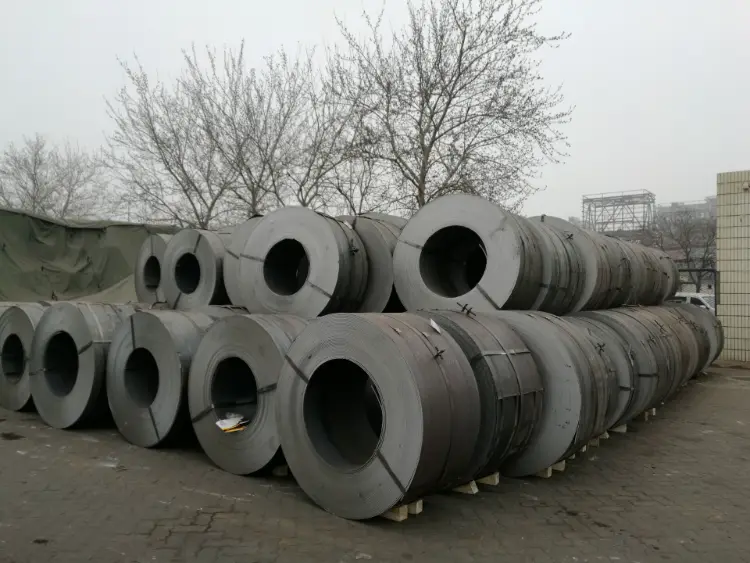
RINA Grade A Shipbuilding Steel Coil
RINA Grade A Shipbuilding Steel Coil - Properties, Standards & Equivalent Materials
Detailed material data for RINA Grade A shipbuilding steel coil, including chemical composition, mechanical and physical properties, international equivalents, and typical applications.
Hot rolling (as-rolled, AR); optional pickling and oiling; cold rolling for thin gauges; subsequent cutting, welding, bending, forming
- Phone : +8618037372205
- Email : [email protected]
- WhatsApp: Contact via Whtsapp
- WeChat: +8618037372205
RINA Grade A Shipbuilding Steel Coil Introduction
RINA Grade A is a normal strength hull structural steel certified by Registro Italiano Navale (RINA) according to its Rules for the Classification of Ships. It is intended for use in ship hulls and marine structures where moderate strength and good weldability are required. The steel is typically supplied as hot-rolled coil, plate, or sheet, and may be used in the as-rolled condition without mandatory impact testing for standard thicknesses. Its chemical composition and mechanical properties align with the IACS UR W11 unified requirement, ensuring global interchangeability with equivalent grades from other classification societies. The material offers reliable tensile properties (min. 235 MPa yield, 400–520 MPa tensile) and sufficient ductility for forming and welding, making it a cost-effective choice for primary structural components in shipbuilding and offshore engineering.
RINA Grade A Shipbuilding Steel Coil Chemical Composition
Typical ladle analysis limits according to RINA Rules (aligned with IACS UR W11). Values are maximum unless otherwise stated. Carbon equivalent (CEV) may be calculated as C+Mn/6+(Cr+Mo+V)/5+(Ni+Cu)/15 and is often limited to ≤0.40% for good weldability. Grain-refining elements such as Al are added when fine grain practice is required. Residual elements are controlled to ensure mechanical properties and weldability.
| Element | Standard Value | Remarks |
|---|---|---|
| C | ≤0.21% | For t≤50 mm; max 0.21% for 50–100 mm |
| Mn | ≥2.5×C (typical 0.60–1.00%) | Min. 0.80% for t > 50 mm |
| Si | 0.10–0.50% | Deoxidiser; lower limit ensures sound rimming or semi-killed practice |
| P | ≤0.035% | |
| S | ≤0.035% | |
| Cu | ≤0.35% | Residual |
| Ni | ≤0.40% | Residual |
| Cr | ≤0.20% | Residual |
| Mo | ≤0.08% | Residual |
| Al (acid soluble) | ≥0.015% | When grain refining is specified |
| N | Usually ≤0.012% | Not specified in UR W11, but controlled in modern steelmaking |
| Others | Traces | As per steelmaking practice |
RINA Grade A Shipbuilding Steel Coil Thermal and Electrical Physical Properties
Physical constants for low-carbon structural steel similar to RINA Grade A. These values are typical for density, elasticity, thermal expansion, conductivity, and resistivity. They are not specified by classification rules but are useful for design calculations. Modulus of elasticity decreases slightly with temperature; values given at room temperature.
| Property | Standard Required Value | Unit | Test Conditions |
|---|---|---|---|
| Density (ρ) | ≈ 7850 | kg/m³ | 20 °C |
| Modulus of Elasticity (E) | ≈ 210 | GPa | Tension, 20 °C |
| Shear Modulus (G) | ≈ 81 | GPa | 20 °C |
| Poisson's Ratio (ν) | 0.3 | – | 20 °C, elastic range |
| Thermal Expansion Coeff. (α) | ≈ 12×10⁻⁶ | /K | 0–100 °C |
| Thermal Conductivity (λ) | ≈ 51.9 | W/(m·K) | 100 °C |
| Specific Heat Capacity (c) | ≈ 486 | J/(kg·K) | 20 °C |
| Electrical Resistivity (ρ_e) | ≈ 0.16×10⁻⁶ | Ω·m | 20 °C |
RINA Grade A Shipbuilding Steel Coil Mechanical Properties
Minimum tensile test requirements for RINA Grade A at room temperature. The values are valid for plate, coil, and wide flat products in the as-rolled condition. For thicknesses over 50 mm, impact tests may be agreed. Bend test (if specified) normally requires 180° bending over a mandrel of 2t (t=thickness) without cracking. Elongation is measured on a gauge length of 5.65√S₀ (proportional).
| Property | Standard Required Value | Unit | Test Conditions |
|---|---|---|---|
| Yield Strength (ReH) | ≥235 | MPa | Room temperature; t ≤ 100 mm |
| Tensile Strength (Rm) | 400 – 520 | MPa | Room temperature; t ≤ 100 mm |
| Elongation (A) | ≥22 | % | Gauge length L₀=5.65√S₀; t ≤ 50 mm |
| Elongation (A) | ≥22 | % | L₀=5.65√S₀; t > 50 ≤ 70 mm |
| Elongation (A) | ≥21 | % | L₀=5.65√S₀; t > 70 ≤ 100 mm |
| Impact Toughness (KV) | Not normally required; if specified, ≥27 J at 0 °C (long.) | J | Charpy V‑notch; t > 50 mm (optional agreement) |
RINA Grade A Shipbuilding Steel Coil Fully Equivalent Material Standards and Replaceable Grades
| Nation / Region | Standard | Grade | Notes |
|---|---|---|---|
| International | IACS UR W11 | Grade A | Unified requirement adopted by all IACS members |
| Italy | RINA Rules Part D | Grade A | Original specification, Reg. Italiano Navale |
| United States | ABS Rules | Grade A | American Bureau of Shipping |
| France | BV Rules | Grade A | Bureau Veritas |
| China | CCS Rules | Grade A | China Classification Society |
| Norway / Germany | DNV Rules | Grade A | Det Norske Veritas |
| South Korea | KR Rules | Grade A | Korean Register |
| United Kingdom | LR Rules | Grade A | Lloyd's Register |
| Japan | NK Rules | Grade A | Nippon Kaiji Kyokai (ClassNK) |
| India | IRS Rules | Grade A | Indian Register of Shipping |
RINA Grade A Shipbuilding Steel Coil Application Introduction
RINA Grade A is primarily used in the shipbuilding and marine industries for construction of hulls and primary structural members. It can be shaped by cold forming, hot rolling, and welding using standard procedures. The material is not intended for applications requiring notch toughness at sub‑zero temperatures, unless impact testing is additionally specified. Coil form is particularly suited for continuous automated cutting and welding lines, enabling efficient fabrication of large stiffened panels and curved sections. Typical products include:
- Hull plating, deck plating, and sheer strakes
- Longitudinal stiffeners, transverse frames, floors, and girders
- Bulkhead plates, tank tops, and superstructure skins
- Hatch covers, coamings, and lightening holes reinforcements
- Pontoon decks and floating dock caissons
Product Applications: Ship hulls & superstructures, Barges and pontoons, Floating docks, Offshore topside modules, Bulkheads and tank boundaries
Processed into products: Cut‑to‑size plates and panels, Welded stiffeners (flat bars, bulb flats, angles), Formed frames and brackets, Hatch coamings and covers, Bollard foundations and hawse pipe structures, Deckhouse walls and roofs
Application industries: Shipbuilding (commercial vessels, naval auxiliaries), Offshore oil & gas (platform modules, flare booms, jackets), Marine transportation (barges, tugboats, ferry structures), Port & harbour engineering (fenders, fender panels, sheet piling), Structural engineering (when class‑certified steel is specified)
RINA Grade A Shipbuilding Steel Coil Recommendation for Similar / Alternative Substitute Materials
| Nation / Region | Standard | Grade | Notes |
|---|---|---|---|
| EU | EN 10025-2 | S235JR (1.0038) | Similar yield & tensile; not class‑certified, use only if class approval waived. |
| USA | ASTM A36 / A36M | A36 | General structural steel; lacks classification society stamp. |
| Japan | JIS G3101 | SS400 | Rolled steel for general structure; equivalent mechanical properties. |
| China | GB/T 700 | Q235B | Common structural steel; no shipbuilding certification. |
| International | IACS UR W11 | Grade B / D / E | Higher toughness variants for thicker or cold‑climate applications, not direct substitute for Grade A. |
| Various | IACS UR W11 | AH32, AH36 | Higher strength hull structural steels; higher YS/TS, suitable if increased strength needed. |
Notes:
- RINA Grade A coil is subject to mandatory classification society stamping or marking as per RINA rules; each plate/coil carries the society's brand and heat number.
- Welding consumables must be compatible with low‑carbon steel and approved by the society; pre‑heat is seldom required for thicknesses up to 50 mm.
- Material certificates (3.1 or 3.2 according to EN 10204) are issued with test reports covering chemical and mechanical properties.
- For service temperatures below 0 °C, Grade B, D or E, or higher toughness grades, should be considered.
- Additional non‑destructive testing (e.g., ultrasonic) can be specified at the time of order.
- Dimensional tolerances follow the applicable standard (e.g., EN 10051 for continuously hot‑rolled strip).
- Share



