
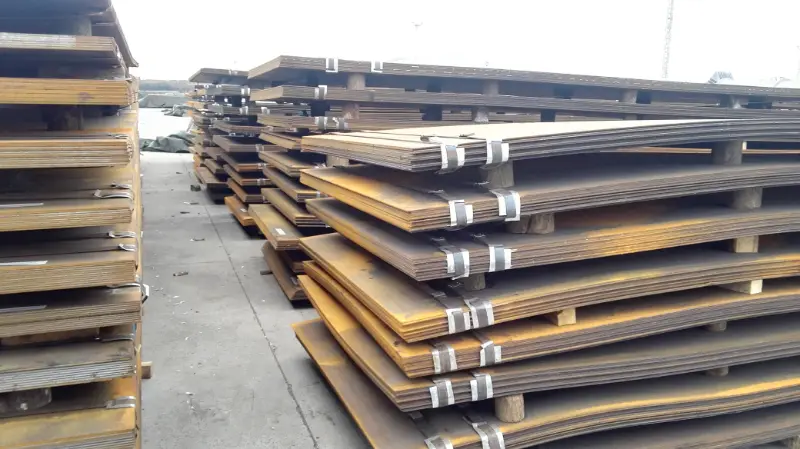
310H Stainless Steel Plate/Coil
310H Stainless Steel Plate/Coil - High-Carbon Austenitic Heat-Resistant Grade for Elevated Temperatures
Comprehensive databank for UNS S31009 / Grade 310H austenitic stainless steel plate & coil: chemical composition, mechanical & thermal properties, global equivalents, and application guidance.
Hot rolling, cold rolling, forming, welding, machining (special tools for work hardening)
- Phone : +8618037372205
- Email : [email protected]
- WhatsApp: Contact via Whtsapp
- WeChat: +8618037372205
310H Stainless Steel Plate/Coil Introduction
Grade 310H (UNS S31009) is a high-carbon modification of the classic 25Cr-20Ni austenitic stainless steel. With a controlled carbon content of 0.04–0.10 wt%, it offers superior high-temperature strength and creep resistance compared to its low-carbon counterpart 310S, while retaining excellent oxidation resistance up to 1100°C in continuous service.
Key attributes include:
- Exceptional oxidation resistance in air and combustion atmospheres, suitable for furnace components and heat treatment equipment.
- Good hot strength and structural stability at elevated temperatures, making it ideal for prolonged exposure above 800°C.
- Austenitic microstructure in the annealed condition, fully non-magnetic and weldable via common fusion processes.
- Resistance to carburization and nitriding in mildly reducing environments.
Typical delivery condition is solution annealed and descaled. The plate/coil form is widely used for petrochemical reformer tubes, radiant tubes, burner nozzles, and high-temperature material handling equipment.
310H Stainless Steel Plate/Coil Chemical Composition
Chemical requirements according to ASTM A240 for grade 310H. Iron constitutes the remainder. Elements are reported as maximums unless a range is indicated. The higher carbon content (0.04–0.10%) is deliberately selected to enhance creep strength at elevated temperatures.
| Element | Standard Value (wt.%) | Remarks |
|---|---|---|
| Carbon (C) | 0.04 – 0.10 | Enhances high-temperature strength |
| Manganese (Mn) | ≤ 2.00 | Austenite former |
| Phosphorus (P) | ≤ 0.045 | Residual impurity |
| Sulfur (S) | ≤ 0.030 | Residual impurity |
| Silicon (Si) | ≤ 0.75 | Deoxidizer; improves oxidation resistance |
| Chromium (Cr) | 24.0 – 26.0 | Primary element for oxidation resistance |
| Nickel (Ni) | 19.0 – 22.0 | Austenite stabilizer |
| Iron (Fe) | Balance | Base element |
310H Stainless Steel Plate/Coil Thermal and Electrical Physical Properties
Physical properties of 310H in the annealed condition. Density is measured at 20°C; thermal expansion and conductivity are given at specified temperature ranges. Elastic moduli and electrical resistivity are typical for wrought material. These values are useful for design calculations but may vary slightly with heat treatment and exact composition. Data from ASM International and producer datasheets.
| Property | Typical Value | Unit | Test Condition |
|---|---|---|---|
| Density (ρ) | 8.0 | g/cm³ | At 20°C |
| Elastic Modulus (E) | 200 | GPa | Room temperature |
| Shear Modulus (G) | 77 | GPa | Room temperature (approx. 0.385 × E) |
| Poisson's Ratio (ν) | 0.30 | dimensionless | Room temperature |
| Thermal Expansion Coefficient (α) | 16.0 | 10⁻⁶/°C | 20 – 100°C |
| Thermal Expansion Coefficient (α) | 17.5 | 10⁻⁶/°C | 20 – 500°C |
| Thermal Expansion Coefficient (α) | 18.5 | 10⁻⁶/°C | 20 – 1000°C |
| Thermal Conductivity (λ) | 14.2 | W/m·K | At 100°C |
| Thermal Conductivity (λ) | 21.5 | W/m·K | At 500°C |
| Specific Heat Capacity (cp) | 500 | J/kg·K | Room temperature |
| Electrical Resistivity (ρe) | 0.78 | µΩ·m | At 20°C |
310H Stainless Steel Plate/Coil Mechanical Properties
Minimum tensile and yield properties specified by ASTM A240 for plate/sheet/coil in the solution-annealed condition. Hardness values are maximums. 310H exhibits high elongation and excellent toughness; impact testing is not a standard requirement for this austenitic alloy but Charpy V-notch energy typically exceeds 100 J at room temperature. Values may vary with product thickness.
| Property | Standard Required Value | Unit | Test Condition |
|---|---|---|---|
| Tensile Strength (Rm) | ≥ 515 | MPa | Room temperature, annealed |
| Yield Strength (ReH, 0.2% offset) | ≥ 205 | MPa | Room temperature, annealed |
| Elongation (A, 2 in. or 50 mm) | ≥ 40 | % | Room temperature, annealed |
| Brinell Hardness | ≤ 217 | HBW | Room temperature, annealed |
| Rockwell B Hardness | ≤ 95 | HRB | Room temperature, annealed |
310H Stainless Steel Plate/Coil Complete Equivalent Material Standards & Substitute Grades
| Country/Region | Standard | Grade Designation | Remarks |
|---|---|---|---|
| USA | ASTM A240 / ASME SA-240 | 310H (UNS S31009) | Plate, sheet, coil – original specification |
| USA | ASTM A167 (withdrawn), ASTM A264, etc. | 310H | Historical or narrower scope |
| Europe | EN 10088-2 (stainless steel sheet/plate) | X8CrNi25-21 (1.4845) | C 0.06–0.12% – close match, often used interchangeably |
| International | ISO 15510 | X8CrNi25-21 | Corresponds to EN 1.4845 |
| China | GB/T 4237, GB/T 3280 | 20Cr25Ni20 (similar, higher Si) | Exact 310H equivalent not defined; 06Cr23Ni13 mis-match |
| Japan | JIS G4304 / G4305 | SUS310S (lower C), no direct 310H | SUS310 has higher C (max 0.25); often used but not identical |
310H Stainless Steel Plate/Coil Application Introduction
310H is engineered for high-temperature service where both oxidation resistance and high-temperature strength are critical. The elevated carbon content provides improved creep life compared to 310S. It is extensively used in thermal processing, chemical/petrochemical engineering, and power generation. Its ability to resist spalling and retain shape under cyclic heating makes it a workhorse for furnace hardware.
Product Applications: Furnace radiant tubes and burner nozzles, Annealing and carburizing boxes, Heat exchanger components and tube sheets, Kiln burner baffles and flame impingement shields, Muffle linings and belt conveyor links, High-temperature structural brackets and hangers, Petrochemical steam reformer pigtails and manifolds
Processed into products: Radiant tube assemblies (hot-formed, welded from plate/coil), Pig-tail connectors in refiners, Thermocouple protection tubes, Muffle plates for continuous furnaces, Burner retention rings, Heat treatment baskets and grids, Flue gas duct expansion joints, Welded structural supports in boilers
Application industries: Oil & Gas (refinery reformer tubes, ethylene pyrolysis), Petrochemical processing (hydrocarbon cracking, reformers), Heat treatment (furnace baskets, retorts, radiant tubes), Power generation (boiler burner nozzles, superheater supports), Cement and lime kilns (burner tips, preheater parts), Waste incineration (combustion chamber liners, thermocouple protection tubes), Automotive (exhaust components, thermal shields)
310H Stainless Steel Plate/Coil Similar / Near-Equivalent Material Recommendations
| Country/Region | Standard | Grade Designation | Remarks |
|---|---|---|---|
| USA | ASTM A240 | 310S (UNS S31008) | Low-carbon version (≤0.08 C) – similar oxidation resistance, lower high-temperature strength |
| USA | ASTM A240 | 310 (UNS S31000) | Original grade with 0.25 max C – less common now |
| USA | ASTM A240 | 309 (UNS S30900)/309S | Lower Cr & Ni (23-12), for lower temperature oxidation resistance up to ~980°C |
| Europe | EN 10088-2 | 1.4828 (X15CrNiSi20-12) | Higher silicon for better carburization resistance, used in similar temperature range |
| Europe | EN 10095 | 1.4841 (X15CrNiSi25-21) | Higher silicon variant, offering enhanced oxidation resistance |
| Global | Nickel alloys (e.g., Alloy 800H/HT) | For superior creep strength above 1000°C, but more costly |
Notes:
Welding: 310H is weldable by all common methods (SMAW, GTAW, GMAW, SAW). Use matching filler metal (e.g., ER310) or slightly over-alloyed to prevent solidification cracking. Post-weld annealing is normally not required for service at high temperature, but low interpass temperatures minimize sigma phase formation.
Heat treatment: Solution anneal at 1050–1150°C followed by rapid quenching. Avoid slow cooling through 500–900°C to prevent sigma phase embrittlement.
Corrosion resistance: Excellent in high-temperature air, oxidizing, and carburizing atmospheres. Not suitable for strongly reducing sulfur-containing gases at high temperatures; 310H may require pre-oxidation in air to form a protective oxide layer.
Machining: Due to high work hardening rate, machining requires rigid setups, sharp tools, and moderate speeds/feeds. Positive rake angles and heavy lubrication are recommended.
- Share



