
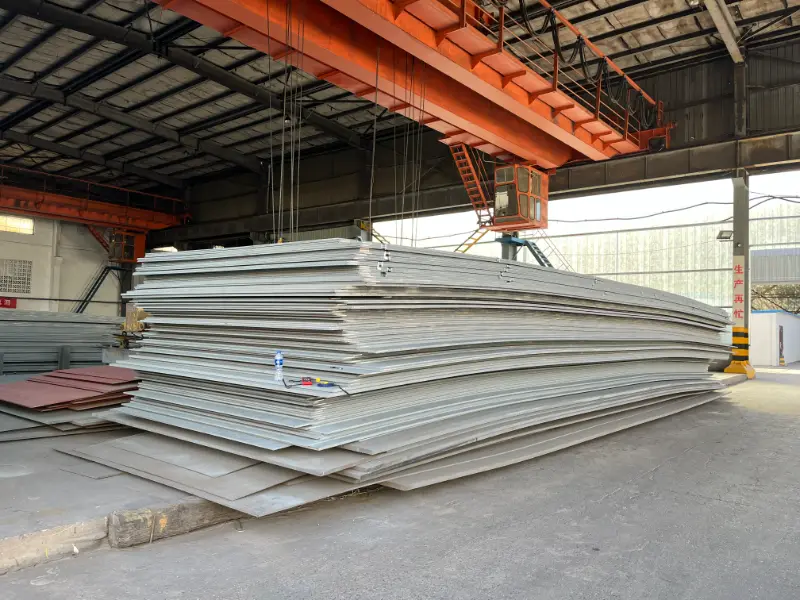
304L (S30403) Stainless Steel Plate/Coil
304L (S30403) Stainless Steel Plate/Coil: Low-Carbon Austenitic Grade for Superior Welding
Comprehensive data sheet for 304L (S30403) stainless steel plate/coil, including chemical composition, mechanical and thermal properties, international equivalents, and application insights.
Hot rolling, cold rolling, forming, welding, bending, machining, solution annealing
- Phone : +8618037372205
- Email : [email protected]
- WhatsApp: Contact via Whtsapp
- WeChat: +8618037372205
304L Stainless Steel Plate/Coil Introduction
304L (UNS S30403) is a low-carbon variant of the widely used 304 austenitic stainless steel. Its maximum carbon content of 0.030% minimizes carbide precipitation during welding, significantly improving resistance to intergranular corrosion without the need for post-weld annealing. This property makes it especially suitable for heavy-section weldments. 304L retains the excellent corrosion resistance, formability, and toughness of 304 while offering added safety in corrosive environments after fabrication.
The alloy is non-magnetic in the annealed condition, non-hardenable by heat treatment, and can be deep drawn, bent, and spun. Typical service temperatures range from cryogenic to about 425°C (800°F) in oxidizing environments, though strength decreases at elevated temperatures. It performs well in mildly acidic and alkaline solutions, and resists oxidation up to 870°C (1600°F) intermittently. Common delivery conditions include solution annealed and pickled flat products, meeting ASTM A240/A240M or equivalent international standards.
304L Stainless Steel Plate/Coil Chemical Composition
Chemical composition according to ASTM A240/A240M for grade 304L (S30403). The low carbon content (≤0.030%) suppresses chromium carbide precipitation at grain boundaries during welding or slow cooling, thus preserving corrosion resistance. Other elements are balanced to achieve the desired austenitic structure, mechanical strength, and formability.
| Element | Standard Value | Remarks |
|---|---|---|
| Carbon (C) | ≤ 0.030 | Essential for low-carbon characteristic |
| Manganese (Mn) | ≤ 2.00 | Deoxidizer, strength modifier |
| Phosphorus (P) | ≤ 0.045 | Impurity; low level reduces embrittlement risk |
| Sulfur (S) | ≤ 0.030 | Improves machinability but lowers pitting resistance |
| Silicon (Si) | ≤ 0.75 | Improves oxidation resistance |
| Chromium (Cr) | 18.0 – 20.0 | Primary corrosion resistance element |
| Nickel (Ni) | 8.0 – 12.0 | Stabilizes austenitic structure |
| Nitrogen (N) | ≤ 0.10 | Strengthening by solid solution, may be limited |
| Iron (Fe) | Balance | Matrix element |
304L Stainless Steel Plate/Coil Thermal and Electrical Physical Properties
Representative physical properties of 304L stainless steel at room temperature unless otherwise indicated. Thermal expansion and conductivity data over common temperature ranges aid in design for thermal cycling applications. Values are derived from published industry references and are typical for solution‑annealed material.
| Property | Typical Value | Unit | Test Condition |
|---|---|---|---|
| Density (ρ) | 8.0 | g/cm³ | 20 °C |
| Elastic Modulus (E) | 193 | GPa | 20 °C |
| Shear Modulus (G) | 78 | GPa | 20 °C |
| Poisson's Ratio (ν) | 0.30 | — | 20 °C |
| Thermal Expansion (α) | 17.2 | µm/m·°C | 20 – 100 °C |
| Thermal Expansion (α) | 17.8 | µm/m·°C | 20 – 315 °C |
| Thermal Expansion (α) | 18.4 | µm/m·°C | 20 – 538 °C |
| Thermal Conductivity (λ) | 14.0 | W/m·K | 20 °C |
| Thermal Conductivity (λ) | 16.2 | W/m·K | 100 °C |
| Thermal Conductivity (λ) | 21.5 | W/m·K | 500 °C |
| Specific Heat (Cp) | 500 | J/(kg·K) | 20 °C |
| Electrical Resistivity (ρₑ) | 0.72 | µΩ·m | 20 °C |
304L Stainless Steel Plate/Coil Mechanical Properties
Room‑temperature tensile properties as required by ASTM A240/A240M for solution‑annealed 304L (S30403) plate. Yield strength determined at 0.2% offset. Hardness values are typical maxima for annealed condition. No minimum impact energy is specified for standard applications, given the alloy's inherent toughness in the fully austenitic state.
| Property | Standard Requirement | Unit | Test Condition |
|---|---|---|---|
| Yield Strength (0.2% offset) | ≥ 205 | MPa | Ambient temperature, annealed |
| Tensile Strength (Rm) | ≥ 515 | MPa | Ambient temperature, annealed |
| Elongation (A50 mm) | ≥ 40 | % | 2-inch gauge length, annealed plate |
| Brinell Hardness (HBW) | ≤ 201 | — | Typical maximum for annealed condition |
| Rockwell B Hardness (HRB) | ≤ 92 | — | Typical maximum for annealed condition |
304L Stainless Steel Plate/Coil Fully Equivalent Material Standards and Substitution Grades
| Country/Region | Standard | Grade | Remarks |
|---|---|---|---|
| United States | ASTM A240/A240M | 304L (UNS S30403) | Original specification for plate/coil |
| European Union | EN 10088-2 | 1.4307 (X2CrNi19-11) | Chemically nearly identical; same designation for flat products |
| Japan | JIS G4304 | SUS304L | Equivalent grade for hot-rolled stainless steel plate |
| China | GB/T 4237 | 022Cr19Ni10 (old 00Cr19Ni10) | Harmonized with ISO and ASTM |
| South Korea | KS D 3705 | STS304L | Direct equivalent to SUS304L |
| International | ISO 15510 | X2CrNi19-11 | ISO designation matching EN and ASTM |
304L Stainless Steel Plate/Coil Application Introduction
Owing to its excellent combination of corrosion resistance, formability, and immunity to sensitisation during welding, 304L stainless steel plate/coil is a preferred material for fabrications where post‑weld heat treatment is impractical or impossible. It is employed across a broad spectrum of industries that demand sanitary conditions, durability, and aesthetic appeal.
Product Applications: Storage tanks and silos, Heat exchangers and condensers, Piping and tubing systems, Kitchen equipment and sinks, Architectural cladding and roofing, Pressure vessels, Brewing and dairy equipment, Pollution control scrubbers
Processed into products: Welded pipes and fittings, Flanges and gaskets, Bend sections and elbows, Dished ends for vessels, Machined valve bodies, Structural brackets and supports, Hygienic clamps and fasteners, Filter housings
Application industries: Food & Beverage Processing, Chemical & Petrochemical, Pharmaceutical & Biotechnology, Architecture & Construction, Automotive & Transportation, Water Treatment & Desalination, Pulp & Paper, Marine (indirect exposure)
304L Stainless Steel Plate/Coil Similar or Alternative Materials
| Country/Region | Standard | Grade | Remarks |
|---|---|---|---|
| Global | ASTM A240 / EN 10088-2 | 304 (1.4301 / S30400) | Higher carbon (≤0.08%); risk of sensitization after welding unless thin sections |
| Global | ASTM A240 / EN 10088-2 | 316L (1.4404 / S31603) | Contains molybdenum for better pitting resistance; more expensive; similar weldability |
| Global | ASTM A240 / EN 10088-2 | 321 (1.4541 / S32100) | Titanium stabilized; better high-temperature strength and resistance to intergranular attack, but not as weldable without stabilizer considerations |
| Global | ASTM A240 | 301L (S30103) | Lower nickel, work-hardening grade; used where high strength from cold working is needed, with similar weld corrosion resistance |
Notes:
Heat treatment: 304L cannot be hardened by thermal treatment. Annealing: rapid cooling after holding at 1010–1120°C (1850–2050°F) to obtain full austenitic structure and optimal corrosion resistance. Avoid slow cooling through the range 540–800°C (1000–1475°F) to prevent carbide precipitation.
Welding: Readily weldable by all common methods (TIG, MIG, SAW). Filler metal: ER308L or ER308. Pre‑heat and post‑heat are generally not needed, and interpass temperature should be kept below 150°C (300°F).
Machining: Due to its low carbon, 304L tends to work‑harden; use rigid machines, sharp tools, and coolants. Better machinability variants (e.g., 304L with higher sulfur) may be available from certain mills.
- Share



