
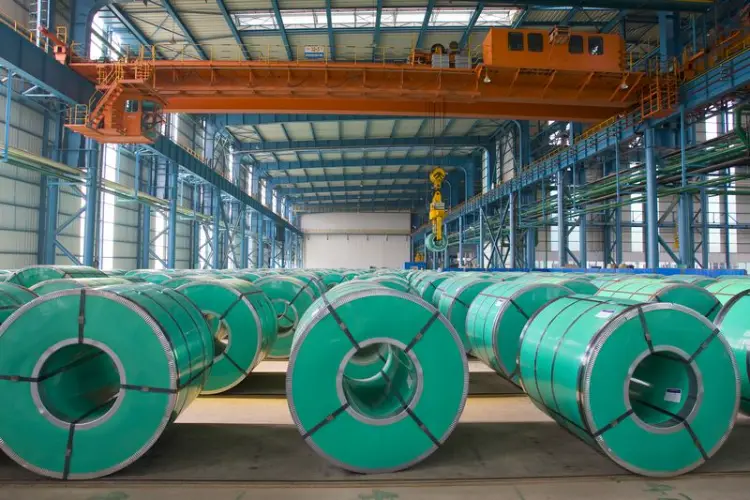
ABS Grade EH40 Shipbuilding Steel Coil
ABS Grade EH40 Shipbuilding Steel Coil: High-Strength Hull Structural Steel for Low-Temperature Service
Detailed material data for ABS EH40 shipbuilding steel coil, including chemical composition, mechanical and physical properties, international equivalents, and application guidance.
Controlled rolling, normalizing rolling, TMCP, hot rolling
- Phone : +8618037372205
- Email : [email protected]
- WhatsApp: Contact via Whtsapp
- WeChat: +8618037372205
ABS Grade EH40 Shipbuilding Steel Coil Introduction
ABS Grade EH40 is a high-strength hull structural steel defined by the American Bureau of Shipping (ABS) for use in welded ship structures. It belongs to the EH series, offering a minimum yield strength of 390 MPa and excellent notch toughness at -40°C. This grade is supplied as hot-rolled coils or plates typically processed via controlled rolling, normalizing rolling, or thermo-mechanical control process (TMCP). The steel is microalloyed with niobium, vanadium, and/or titanium to refine grain size and enhance both strength and toughness.
Key features include:
- High yield strength of 390 MPa (for thicknesses up to 50 mm)
- Guaranteed impact energy of ≥41 J at -40°C (longitudinal)
- Good weldability with controlled carbon equivalent (CEV typically ≤0.40%)
- Excellent resistance to brittle fracture in low-temperature marine environments
- Compliance with ABS and IACS UR W11 standards
Typical applications are hull plates, decks, side shells, bottom structures, and offshore platform components requiring high strength and reliability in harsh conditions.
ABS Grade EH40 Shipbuilding Steel Coil Chemical Composition
The following table lists the maximum or range limits for chemical elements in ABS EH40 steel according to ABS rules. The steel is fully killed and fine-grained, with microalloying elements added for strength and toughness. Carbon equivalent (CEV) is controlled to ensure weldability. Actual mill certificates may show tighter internal limits.
| Chemical Element | Standard Value (wt.%) | Remarks |
|---|---|---|
| C | ≤0.18 | Max carbon content |
| Si | ≤0.50 | Silicon, fully killed steel |
| Mn | 0.90~1.60 | Manganese for strength and toughness |
| P | ≤0.025 | Phosphorus, for weldability |
| S | ≤0.025 | Sulfur, for ductility |
| Al (acid soluble) | ≥0.015 | Grain refinement |
| Nb | ≤0.05 | Niobium, microalloying (typically 0.02–0.05) |
| V | ≤0.10 | Vanadium, microalloying |
| Ti | ≤0.02 | Titanium, grain refinement and nitrogen fixing |
| Cu | ≤0.35 | Residual copper |
| Cr | ≤0.20 | Chromium |
| Ni | ≤0.40 | Nickel, for toughness |
| Mo | ≤0.08 | Molybdenum |
| N | ≤0.012 | Nitrogen, if applicable |
| CEV | ≤0.40 (typical) | Carbon equivalent for weldability; may be ≤0.43 for TMCP |
ABS Grade EH40 Shipbuilding Steel Coil Thermal & Electrical Physical Properties
The following physical properties are typical for rolled high-strength structural steels at room temperature unless noted otherwise. Exact values may vary slightly with composition and processing.
| Property | Standard Value (Typical) | Unit | Test Condition |
|---|---|---|---|
| Density (ρ) | 7850 | kg/m³ | 20°C |
| Modulus of elasticity (E) | 210 | GPa | Room temperature, static |
| Shear modulus (G) | 80 | GPa | Room temperature, calculated |
| Poisson's ratio (ν) | 0.3 | — | Elastic range |
| Thermal expansion coefficient (α) | 12.0×10⁻⁶ | K⁻¹ | 20–100°C |
| Thermal conductivity (λ) | 50 | W/(m·K) | 20°C |
| Specific heat capacity | 460 | J/(kg·K) | 20°C |
| Electrical resistivity (ρ_e) | 0.20×10⁻⁶ | Ω·m | 20°C |
ABS Grade EH40 Shipbuilding Steel Coil Mechanical Properties
Mechanical properties are valid for thicknesses up to 100 mm in the as-rolled or TMCP condition. Tensile testing is performed in accordance with ABS requirements. Impact tests are conducted at -40°C for EH40 grade, with longitudinal specimens required from each heat; transverse tests may be specified.
| Property | Specification Value | Unit | Test Condition |
|---|---|---|---|
| Yield Strength (ReH) | ≥390 | MPa | Thickness ≤50 mm |
| Yield Strength (ReH) | ≥370 | MPa | Thickness 50–70 mm |
| Yield Strength (ReH) | ≥355 | MPa | Thickness 70–100 mm |
| Tensile Strength (Rm) | 510–660 | MPa | All thicknesses |
| Elongation (A5) | ≥20 | % | Thickness ≤50 mm, L0=5.65√S0 |
| Elongation (A5) | ≥19 | % | Thickness 50–70 mm |
| Elongation (A5) | ≥18 | % | Thickness 70–100 mm |
| Impact Energy (KV, longitudinal) | ≥41 (average), ≥27 (individual) | J | -40°C, V-notch, specimen size 10×10 mm |
| Impact Energy (KV, transverse) | ≥27 (average), ≥20 (individual) | J | -40°C, V-notch, when specified |
| Bend Test | No cracks | d=3a (d=diameter, a=thickness), 180° |
ABS Grade EH40 Shipbuilding Steel Coil Completely Equivalent Material Standards and Substitutable Grades
| Country/Region | Standard | Grade | Remarks |
|---|---|---|---|
| International (IACS) | UR W11 | EH40 | IACS unified requirement for high-strength hull steel |
| Norway | DNV Rules | EH40 | Identical toughness class |
| UK | LR Rules | EH40 | Lloyd's Register equivalent |
| France | BV Rules | EH40 | Bureau Veritas equivalent |
| China | CCS Rules | EH40 | China Classification Society equivalent |
| Japan | NK Rules | KE40 | ClassNK uses 'K' prefix for EH equivalent |
| Korea | KR Rules | REH40 | Korean Register designation |
| Italy | RINA Rules | EH40 | RINA equivalent |
| Russia | RS Rules | EH40 | Russian Maritime Register of Shipping equivalent |
ABS Grade EH40 Shipbuilding Steel Coil Application Introduction
ABS EH40 steel is widely employed in marine and offshore applications where high strength and superior low‑temperature fracture resistance are essential. Its typical use includes structural members of large sea‑going vessels and fixed or floating offshore installations operating in cold climates.
Key processing considerations:
- Hot‑rolled coils can be straight‑cut to plate or further formed.
- Welding is performed with low‑hydrogen procedures and preheat according to thickness (typically 50–150°C for high restraint).
- Post‑weld heat treatment is not normally required.
- Cold forming is possible, but minimum bending radii are required to avoid cracking.
- Ultrasonic testing (class C according to ABS) may be mandatory for primary structures.
Product Applications: Hull bottom and side shell plates, Strength deck plating, Longitudinal bulkheads and transverse web frames, Stiffeners and girders, Hatch coaming and deck beams, Structural flats and brackets, Offshore platform topside and hull modules
Processed into products: Bottom outer shell plates, Bilge strake and bilge keel plates, Side shell plates below waterline, Transverse bulkhead panels, Deck stringer plates, Longitudinal stiffeners (flat bars, bulb profiles), Web frame plates, Hatch side coaming plates, Breast hook and cant beam plates, Bracket plates for connections, Foundation plates for heavy machinery
Application industries: Shipbuilding (cargo vessels, tankers, bulk carriers, container ships, LNG carriers), Offshore engineering (jack‑up rigs, semi‑submersibles, FPSO hulls), Polar class vessels and icebreakers, Marine construction (dock gates, caissons, floating docks)
ABS Grade EH40 Shipbuilding Steel Coil Similar/Closely Related Materials as Substitutes
| Country/Region | Standard | Grade | Remarks |
|---|---|---|---|
| USA/International | ABS Rules | EH36 | Lower yield strength (355 MPa), same -40°C toughness |
| USA/International | ABS Rules | FH40 | Higher toughness (-60°C), same strength level |
| Europe | EN 10025-3 | S420N | Normalized structural steel, similar strength, not class-approved for shipbuilding |
| Europe | EN 10025-4 | S420M | TMCP structural steel, similar mechanicals but different chemical requirements |
| International | API 2W | Grade 50 | Offshore structural steel with similar yield, not shipbuilding approved |
| China | GB 712 | EH40 | Chinese shipbuilding steel standard, identical to CCS EH40 |
Notes:
ABS classification survey: During shipbuilding, plates must be stamped with ABS mark and heat number.
Corrosion protection: Unpainted areas require temporary weld‑through shop primer.
Ultrasonic testing: May be specified to ABS class C for critical safety areas, with acceptance levels per ABS rules.
Tolerances: Dimensional and flatness tolerances comply with standard mill practice or ABS guidelines for ship plates.
Preheating: Minimum preheat temperature depends on CEV and restraint; typically 50°C for thickness >30 mm, 75–100°C for >50 mm in high‑restraint joints.
Post‑weld heat treatment: Not required for this grade under normal conditions.
- Share



