
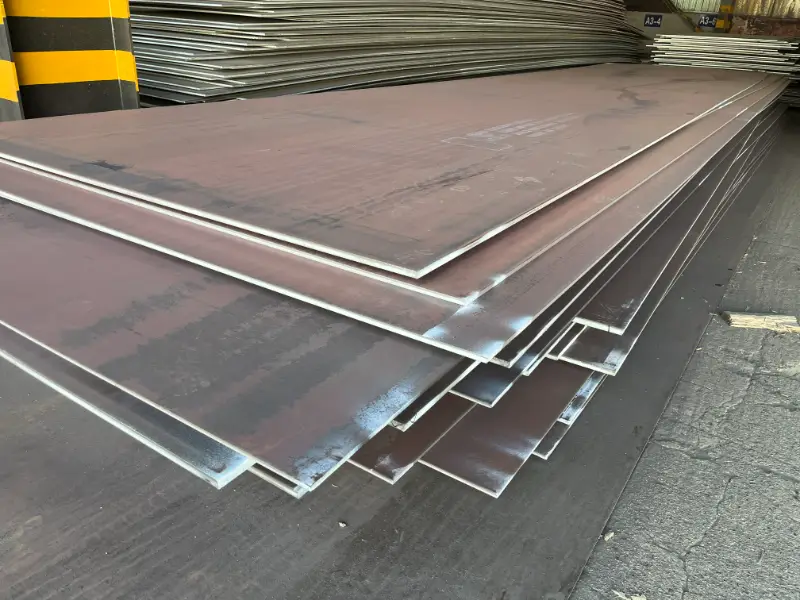
2304 (S32304) Duplex Stainless Steel
2304 (S32304) Duplex Stainless Steel: High-Strength & Corrosion-Resistant Plate/Coil
Comprehensive material properties of 2304 (UNS S32304) duplex stainless steel, including chemical, mechanical, thermal data, equivalent grades, and application guidance.
Cold forming, Hot forming, Welding (TIG, MIG, SMAW, PAW), Machining (chip-breaking tools recommended), Pickling and passivation
- Phone : +8618037372205
- Email : [email protected]
- WhatsApp: Contact via Whtsapp
- WeChat: +8618037372205
2304 Duplex Stainless Steel Introduction
2304 (UNS S32304 / EN 1.4362) is a lean duplex stainless steel with a balanced dual-phase microstructure of approximately 50% austenite and 50% ferrite. It delivers an excellent combination of high strength, good toughness, and outstanding resistance to stress corrosion cracking (SCC) in chloride-containing environments. Compared to standard austenitic grades like 304L, 2304 provides nearly twice the yield strength, allowing significant weight reduction and cost savings in structural and pressure-containing applications.
The low molybdenum content ensures adequate general corrosion resistance in many oxidizing and reducing acids, while the duplex structure offers superior resistance to intergranular corrosion. Commonly supplied as hot-rolled or cold-rolled plate and coil in the solution-annealed and pickled condition, 2304 exhibits good weldability and formability. Typical service temperature range spans from -40 °C to 300 °C. It is widely specified in chemical processing, oil & gas, marine, and desalination industries where reliability and lifecycle economy are critical.
2304 Duplex Stainless Steel Chemical Composition – According to EN 10088-2 / ASTM A240
The lean duplex chemistry of 2304 is designed to achieve a balanced ferrite/austenite ratio with controlled nitrogen addition. The low carbon content (≤0.03%) prevents intergranular chromium carbide precipitation during welding, eliminating the need for post-weld heat treatment in most cases. Nitrogen (0.05–0.20%) enhances pitting resistance and increases strength, while the modest molybdenum and copper additions further improve corrosion resistance in mildly aggressive environments. Iron constitutes the balance. This composition ensures excellent weldability and thermal stability up to 300 °C.
| Element | Standard Value (wt.%) | Notes |
|---|---|---|
| Carbon (C) | ≤ 0.03 | Max value; both ASTM and EN |
| Silicon (Si) | ≤ 1.00 | |
| Manganese (Mn) | ≤ 2.00 (EN); ≤ 2.50 (ASTM) | Higher Mn permitted in ASTM |
| Phosphorus (P) | ≤ 0.035 (EN); ≤ 0.040 (ASTM) | |
| Sulfur (S) | ≤ 0.015 (EN); ≤ 0.030 (ASTM) | Lower S improves weldability |
| Chromium (Cr) | 22.0 – 24.0 | Key element for corrosion resistance |
| Nickel (Ni) | 3.5 – 5.5 | Stabilizes austenite phase |
| Molybdenum (Mo) | 0.10 – 0.60 | Increases pitting resistance (PREN) |
| Nitrogen (N) | 0.05 – 0.20 | Strengthens and stabilizes austenite |
| Copper (Cu) | 0.10 – 0.60 | Improves general corrosion resistance |
| Iron (Fe) | Balance | Approximately 63-71% |
2304 Duplex Stainless Steel Physical & Thermal Properties
The physical properties of 2304 are representative of duplex stainless steels. The thermal expansion (13.0–14.0 ×10⁻⁶/K) is lower than that of austenitic grades, closer to carbon steel, which reduces thermal stresses in dissimilar welded joints. Its thermal conductivity is higher than that of 304L, improving heat transfer efficiency. The modulus of elasticity (200 GPa) and high strength result in greater rigidity. Electrical resistivity is relatively high, consistent with stainless alloys. All values are typical for solution-annealed material and may vary slightly with specific product form and temperature.
| Property | Typical Value | Unit | Conditions / Notes |
|---|---|---|---|
| Density (ρ) | 7.8 | g/cm³ | At 20 °C |
| Modulus of Elasticity (E) | 200 | GPa | Longitudinal, 20 °C |
| Shear Modulus (G) | 78 | GPa | Calculated from E and Poisson's ratio, 20 °C |
| Poisson's Ratio (ν) | 0.3 | Elastic range, 20 °C | |
| Thermal Expansion Coefficient (α) | 13.0 (20–100 °C); 13.5 (20–200 °C); 14.0 (20–300 °C) | 10⁻⁶/K | Mean coefficient |
| Thermal Conductivity (λ) | 15 | W/m·K | At 20 °C |
| Specific Heat Capacity (cp) | 470 | J/kg·K | At 20 °C |
| Electrical Resistivity (ρe) | 0.80 | µΩ·m | At 20 °C |
| Melting Range | ≈ 1420 – 1465 | °C | Approximate solidus/liquidus |
2304 Duplex Stainless Steel Mechanical Properties – ASTM A240 / EN 10088-2
The mechanical properties of 2304 duplex stainless steel are significantly higher than those of standard austenitic grades. The minimum yield strength of 450 MPa (65 ksi) is about twice that of 304L, which often enables thinner section design. The material maintains good ductility with elongation ≥25% and shows excellent toughness down to -40 °C. Hardness is controlled below 290 HBW to ensure adequate formability. These values are guaranteed for plate and coil products in the solution-annealed condition. Impact testing (if required by purchase order) typically reports KV₂ ≥ 40 J at -40 °C for standard thicknesses.
| Property | Required Value | Unit | Test Condition / Remarks |
|---|---|---|---|
| Yield Strength (0.2% offset, Rp0.2) | ≥ 450 | MPa (ksi) | Solution annealed; ASTM & EN for all thicknesses up to 50 mm (ASTM) |
| Tensile Strength (Rm) | ≥ 600 | MPa (ksi) | ASTM & EN |
| Elongation (A50 or A5.65√S0)) | ≥ 25 | % | Gauge length 50 mm (2 in.); applies to products ≤ 50 mm thick |
| Bend Test (180°) | d = 2t (t ≤ 10 mm); d = 3t (t > 10 mm) | No cracks; bend axis transverse to rolling direction | |
| Hardness | ≤ 290 HBW; ≤ 31 HRC | HBW / HRC | Or equivalent |
| Impact Toughness (KV2 at -40 °C) | ≥ 40 (typical); 27 min if specified | J | Longitudinal specimens; required when ordered for low-temperature service |
| Young's Modulus (E) | 200 (typical) | GPa | 20 °C, static |
2304 Duplex Stainless Steel Fully Equivalent Material Standards & Substitute Grades
| Country / Region | Standard | Grade / Designation | Remarks |
|---|---|---|---|
| Europe | EN 10088-2 / EN 10088-4 | 1.4362 / X2CrNiN23-4 | Direct equivalent to 2304; identical composition and mechanical requirements. |
| USA | ASTM A240/A240M | UNS S32304 | Principal designation for plate, sheet and coil. |
| China | GB/T 3280, GB/T 4237 | 022Cr23Ni4MoCuN / S22053 (commonly mapped) | Listed as precipitation-hardening? Check – actually GB/T 20878 gives 022Cr23Ni4MoCuN (S32304 equivalent). |
| Sweden | SS 14 23 27 | SS 2327 | Corresponds to 2304 with same lean duplex composition. |
| ISO | ISO 15510 | X2CrNiN23-4 (4572-230-03-I) | International designation aligned with EN 1.4362. |
| Japan | JIS G4304 / G4305 | SUS323J1? Not an exact match; closest is SUS329J3L (S32205) but consider SUS323J2 for lean duplex. | Often supplied as UNS S32304 under JIS with a special grade agreement. |
2304 Duplex Stainless Steel Application Introduction
2304 duplex stainless steel is ideal where high mechanical strength, good corrosion resistance, and low lifecycle cost are required. It is extensively used in environments containing chlorides, CO₂, H₂S (sour service up to NACE limits), and organic acids. The grade bridges the gap between cost-effective carbon steels and expensive, highly alloyed stainless steels.
Product Applications: Pressure vessels and storage tanks, Heat exchanger plates and tube sheets, Seawater cooling pipes, Chemical reactor vessels, Digesters and bleaching towers, Railway tank cars, Structural hollow sections and beams, Welded coiled tubing
Processed into products: Heat exchanger plates (plate heat exchanger), tubesheets, baffles, Welded and seamless pipes for process lines, Tank walls and roofs, Flanges and fittings (welded from plate), Expansion bellows (thermal movement joints), Support brackets and structural attachments, Stub ends and lap joint flanges, Agitator blades and shafts
Application industries: Chemical and petrochemical processing, Oil and gas (offshore/onshore piping, separators, storage tanks), Desalination and water treatment, Pulp and paper (digesters, bleaching equipment), Marine and coastal structures, Energy and power generation (flue gas desulfurization, heat exchangers), Food and beverage (moderate chloride environments), Construction and architecture (structural profiles, bridges)
2304 Duplex Stainless Steel Similar / Alternative Stainless Steel Grades
| Country / Region | Standard | Grade | Remark / Comparative Overview |
|---|---|---|---|
| Europe / USA | EN 1.4162 / UNS S32101 (LDX 2101) | X2CrMnNiN21-5-1 | Lean duplex with lower Ni, similar strength, slightly lower PREN (~26). Good alternative for structural applications. |
| Europe / USA | EN 1.4462 / UNS S32205 (2205) | X2CrNiMoN22-5-3 | Standard duplex with higher Mo (3%) and N; PREN ~35. Superior corrosion resistance but higher cost. Use when higher SCC or pitting resistance required. |
| Europe / USA | EN 1.4404 / UNS S316L | X2CrNiMo17-12-2 | Austenitic grade with reduced strength (yield ~240 MPa). Suitable for moderate corrosive environments but much weaker mechanically and prone to SCC. |
| Europe / USA | EN 1.4307 / UNS S304L | X2CrNi18-9 | Standard austenitic; low yield strength (~220 MPa). Can replace 2304 only in non-load-bearing, low-chloride applications. |
| USA | UNS S32304 modified / Lean duplex custom | Custom composition with higher N or Cu for specific corrosion resistance. | Can be tailored if standard 2304 is borderline for pitting but 2205 is over-specified. |
Notes:
Heat treatment: 2304 must be solution annealed at 950–1100 °C followed by rapid cooling (water quench) to avoid formation of detrimental sigma phases. Slow cooling through 600–950 °C can cause embrittlement.
Welding: Excellent weldability with all standard processes. Filler metal ER2209 (AWS A5.9) is recommended; preheat and postweld heat treatment are generally not required, but interpass temperature should be ≤150 °C. The resulting microstructure typically contains 25–60% ferrite.
Service limits: The material is suitable for long-term service between -40 °C and 300 °C. For sour service (H₂S), compliance with NACE MR0175/ISO 15156 should be verified (conditions up to Level III hardness).
Surface finish: Pickled and passivated finish (2D or 2B for cold-rolled; 1D for hot-rolled) is standard to restore optimal corrosion resistance after manufacturing.
Forming: Cold forming requires higher forces than austenitic grades due to high strength; springback compensation is necessary. Hot forming should be carried out at 1100–900 °C followed by solution annealing.
- Share



