
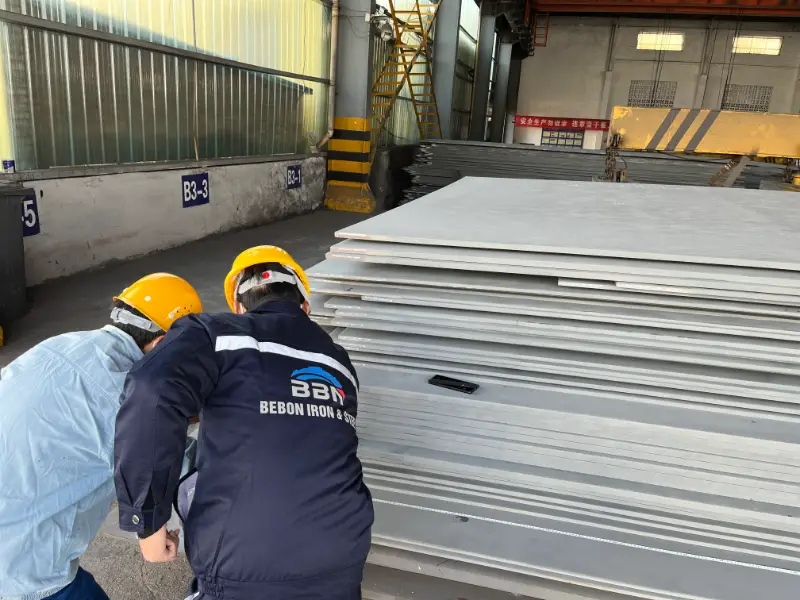
255 S32550 Duplex SS Plate/Coil
255 (UNS S32550) Duplex Stainless Steel Plate & Coil: High-Strength & Corrosion Resistant Alloy
Comprehensive technical data for 255 (UNS S32550) duplex stainless steel plate and coil, including chemical composition, mechanical properties, thermal and electrical properties, international equivalents, and application guidance.
Hot rolling, cold rolling, solution annealing (typically 1040–1120°C / 1900–2050°F followed by water quenching), machining (requires strong tools due to high strength), welding (matching filler recommendations).
- Phone : +8618037372205
- Email : [email protected]
- WhatsApp: Contact via Whtsapp
- WeChat: +8618037372205
255 S32550 Duplex SS Plate/Coil Introduction
UNS S32550, commonly known as Alloy 255 or Ferralium 255, is a super duplex stainless steel with a nominal composition of 25.5% Cr, 5.5% Ni, 3.5% Mo, and 2% Cu. It offers a unique combination of high strength, outstanding corrosion resistance, and excellent wear resistance. Compared to standard austenitic stainless steels, it provides nearly twice the yield strength while maintaining good toughness and ductility. The alloy is designed for severe applications where chloride-induced pitting and crevice corrosion are concerns, and it excels in reducing environments containing acids, including sulfuric, phosphoric, and nitric acids. Its duplex microstructure (ferrite-austenite) ensures resistance to stress corrosion cracking and good weldability. Available as plate and coil, it is suitable for heavy-section components exposed to aggressive media.
255 S32550 Duplex SS Plate/Coil Chemical Composition
The chemistry of UNS S32550 is balanced to maintain a dual-phase ferrite-austenite microstructure and to optimize pitting resistance equivalent number (PREN ≥ 40). The addition of copper enhances resistance to sulfuric acid and other reducing environments. Nitrogen acts as an austenite stabilizer and increases strength and pitting resistance. The composition strictly follows ASTM A240 for plate product.
| Element | Specification (wt. %) | Remarks |
|---|---|---|
| Carbon (C) | ≤ 0.04 | Max, prevents intergranular carbide precipitation during annealing |
| Manganese (Mn) | ≤ 1.50 | Max, austenite stabilizer |
| Silicon (Si) | ≤ 1.00 | Max, improves oxidation resistance at high temp |
| Phosphorus (P) | ≤ 0.040 | Residual, controlled for corrosion resistance |
| Sulfur (S) | ≤ 0.030 | Residual; for pressure vessel plate often ≤0.020 may apply |
| Chromium (Cr) | 24.0 – 27.0 | Primary ferrite stabilizer, essential for pitting resistance |
| Nickel (Ni) | 4.5 – 6.5 | Austenite former, provides toughness and corrosion resistance |
| Molybdenum (Mo) | 2.9 – 3.9 | Increases pitting/crevice corrosion resistance |
| Copper (Cu) | 1.5 – 2.5 | Improves resistance to reducing acids and provides some precipitation hardening potential |
| Nitrogen (N) | 0.10 – 0.25 | Strong austenite former, raises strength and PREN significantly |
255 S32550 Duplex SS Plate/Coil Thermal & Electrical Physical Properties
Physical properties are representative for wrought duplex 255 in solution-annealed condition at room temperature unless otherwise noted. These values are drawn from published alloy datasheets for UNS S32550. Thermal expansion is between that of carbon steel and austenitic stainless steel, reducing thermal fatigue risk. Thermal conductivity is higher than austenitic grades, aiding heat exchanger applications.
| Property (Symbol) | Typical Value | Unit | Test Condition / Remarks |
|---|---|---|---|
| Density (ρ) | 7.8 | g/cm³ | 20°C (68°F) |
| Density (ρ) | 0.282 | lb/in³ | 20°C |
| Elastic Modulus (E) | 200 | GPa | Tension, ambient |
| Elastic Modulus (E) | 29.0 × 10³ | ksi | Ambient |
| Shear Modulus (G) | 77 | GPa | Calculated from E and ν |
| Poisson's Ratio (ν) | 0.30 | – | Ambient, elastic range |
| Thermal Expansion Coeff. (α) linear, 20-100°C | 13.0 | 10⁻⁶/°C | Between 20°C and 100°C (68-212°F) |
| Thermal Expansion Coeff. (α) linear, 20-200°C | 13.5 | 10⁻⁶/°C | |
| Thermal Expansion Coeff. (α) linear, 20-300°C | 14.0 | 10⁻⁶/°C | |
| Thermal Conductivity (λ) | 14.2 | W/m·K | At 20°C |
| Thermal Conductivity (λ) | 98 | BTU·in/h·ft²·°F | At 68°F |
| Specific Heat Capacity (cp) | 475 | J/kg·K | At 0-100°C |
| Specific Heat Capacity (cp) | 0.114 | BTU/lb·°F | Room temperature |
| Electrical Resistivity (ρe) | 0.80 | μΩ·m | At 20°C |
| Electrical Resistivity (ρe) | 31.5 | μΩ·in | At 68°F |
255 S32550 Duplex SS Plate/Coil Mechanical Properties
Mechanical properties are based on ASTM A240 minimum requirements for solution-annealed plate at room temperature. Actual properties are typically higher, especially for thin gauge material. Yield strength (Rp0.2) and tensile strength are nearly double those of common 304/316L stainless steels. Elongation remains good, and hardness indicates high wear resistance. Impact test values are not mandated by the standard but are provided for information from typical specifications.
| Property (Symbol) | Standard Requirement (Min/Max) | Unit | Test Condition / Remarks |
|---|---|---|---|
| Tensile Strength (Rm) | ≥ 690 | MPa | Room temperature, transverse, ASTM A370 |
| Tensile Strength (Rm) | ≥ 100 | ksi | Room temperature |
| Yield Strength (ReH / Rp0.2) | ≥ 485 | MPa | 0.2% offset, room temperature |
| Yield Strength (ReH / Rp0.2) | ≥ 70 | ksi | 0.2% offset |
| Elongation (A) in 50 mm (2 in) | ≥ 15 | % | Plate thickness ≤25 mm; for thickness >25 mm elongation may be slightly lower per standard |
| Elongation (A) in 50 mm | ≥ 15 (thickness ≤1.0 in) | % | U.S. unit reference |
| Bend Test (Mandrel Diameter) | 180° bend, d = 2t | – | No cracking; t = specimen thickness, ASTM A240 |
| Hardness (Brinell) | ≤ 290 | HBW | Solution annealed; corresponds to approx. ≤31 HRC |
| Hardness (Rockwell C) | ≤ 31 | HRC | Converted typical |
| Impact Energy (KV) – typical | ≥ 100 (longitudinal) | J | At -10°C (14°F), 10 mm thick, Charpy V-notch; reference from plate producers (not ASTM requirement) |
255 S32550 Duplex SS Plate/Coil Fully Equivalent Material Standards & Replacement Grades
| Country / Region | Standard | Grade | Remarks |
|---|---|---|---|
| United States | ASTM A240 / A240M | UNS S32550 | Identical material: plate, sheet, strip. Also covered by ASTM A479 for bars and ASTM A182 for forgings. |
| Europe | EN 10028-7, EN 10088-2 | 1.4507 (X2CrNiMoCuWN 25-7-4) | European standard super duplex grade. Slight compositional differences: Ni 6.0–8.0, N 0.20–0.30, and small W addition. Corrosion and mechanical properties are comparable; often considered a direct alternative. |
255 S32550 Duplex SS Plate/Coil Application Introduction
S32550 duplex alloy is chosen when a combination of high mechanical strength (enabling weight and cost reduction through thinner sections), excellent corrosion resistance in chloride-bearing media and resistance to wear and abrasion is required. It performs exceptionally in sulfuric acid, phosphoric acid, seawater, and brine. Its high proof strength makes it ideal for structural components where fatigue and stress corrosion cracking are concerns.
Product Applications: Chemical storage tanks and pressure vessels, Heat exchanger tubes and plates, Offshore structural beams and brackets, Seawater cooling pipes and condenser tubing, Centrifuge and filter components, Wear-resistant liners for chutes and mills, High-strength bolts, nuts, and studs for corrosive environments, Pump casings and impellers for corrosive fluids, Shafts, propellers, and rudders for ships
Processed into products: Hydraulic and pneumatic cylinders, piston rods, Valve bodies, seats, and stems handling acid/chloride media, Spray nozzles and jet mixers, Fasteners for offshore mooring systems, Flanges and gaskets for high-pressure corrosive pipelines, Shaft sleeves and wear rings for pumps, Tube sheets and baffle plates for heat exchangers, Welding consumables (matching filler wire for joining), Architectural components requiring high corrosion resistance and surface finish
Application industries: Chemical and petrochemical processing (reactors, heat exchangers, piping), Oil & gas (subsea equipment, topside piping, flowlines, umbilicals), Desalination plants (evaporator vessels, brine heaters), Pulp and paper (bleaching equipment, digesters, washers), Marine and offshore engineering (propeller shafts, fasteners, pumps, valves), Pollution control (flue gas desulfurization systems, incinerator scrubbers), Renewable energy (geothermal brine systems, biomass plants), Hydrometallurgy (pressure acid leach autoclaves, storage tanks)
255 S32550 Duplex SS Plate/Coil Similar / Alternative Material Recommendations
| Country / Region | Standard | Grade | Remarks |
|---|---|---|---|
| United States | ASTM A240 / A240M | UNS S32750 (Alloy 2507) | Super duplex stainless steel with higher Mo (3.0-5.0) and lower Cu (max 1.0). Offers even higher corrosion resistance (PREN>40) but less copper benefit for reducing acids. Can replace S32550 in many corrosive services, but check sulfuric acid resistance. |
| Europe | EN 10088-2 | 1.4410 (X2CrNiMoN 25-7-4) | Standard super duplex (S32750 equivalent). Higher N and Mo, similar strength; a direct alternative but may be over-alloyed for environments where S32550's Cu addition provides specific benefits. |
| United States / Europe | ASTM A240 / EN 10088-2 | UNS S32205 (Alloy 2205) | Standard duplex 22Cr-5Ni-3Mo. Lower strength, lower corrosion resistance, and no intentional Cu addition. Suitable as a more economical alternative only in less aggressive environments where S32550 is not required. |
Notes:
Welding: Use of matching composition filler metals (e.g., ER2553 for TIG/MIG) is recommended. Preheat is generally not required; interpass temperature should be limited to 150°C (300°F) to avoid detrimental intermetallic phase formation. Solution annealing after welding is advisable for restoring optimum corrosion resistance and toughness. Heat treatment: Solution annealing at 1040–1120°C (1900–2050°F) followed by rapid water quenching. Slow cooling or intermediate holding can cause sigma and chi phase precipitation, which severely embrittles the alloy and reduces corrosion resistance. Cold working: The alloy work-hardens rapidly; extensive cold forming may require intermediate annealing. Machining: Due to high strength and work-hardening rate, rigid machines, sharp carbide tools, and adequate coolant are necessary.
- Share



