
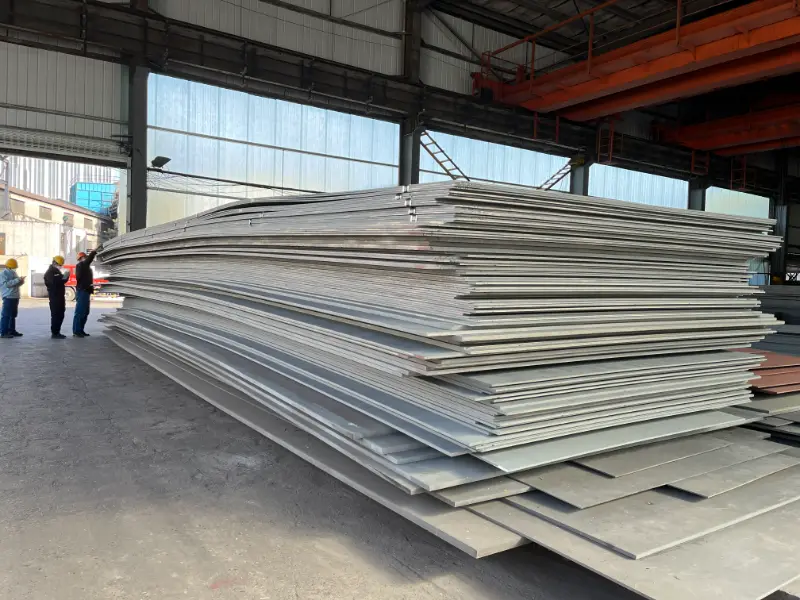
A2205 (S32205) Duplex Stainless Steel
A2205 (S32205) Duplex Stainless Steel: Technical Data, Properties & Global Equivalents
In-depth technical profile of S32205 duplex stainless steel, covering chemical composition, mechanical and physical properties, equivalent grades, and application guidance.
Hot Rolling, Cold Rolling, Forming (limited due to high strength), Welding (with suitable procedures)
- Phone : +8618037372205
- Email : [email protected]
- WhatsApp: Contact via Whtsapp
- WeChat: +8618037372205
A2205 Duplex Stainless Steel Introduction
S32205 (commonly designated 2205) is a nitrogen-enhanced duplex stainless steel characterized by a mixed microstructure of approximately equal parts austenite and ferrite. This balanced phase composition delivers a unique combination of high strength, excellent resistance to pitting and crevice corrosion, and good resistance to stress corrosion cracking (SCC). It significantly outperforms standard austenitic grades like 304L and 316L in yield strength and corrosion resistance, particularly in chloride-containing environments. Key attributes include high strength permitting thinner sections and weight reduction, very good resistance to stress corrosion cracking, and high resistance to pitting, crevice, and general corrosion.
A2205 Duplex Stainless Steel Chemical Composition
The chemical composition of S32205 duplex stainless steel is precisely balanced according to ASTM A240 to achieve its dual-phase structure. Key alloying elements include Chromium (Cr) and Molybdenum (Mo) for pitting corrosion resistance, and Nitrogen (N) as an austenite stabilizer which also enhances strength and corrosion properties. A controlled Pitting Resistance Equivalent Number (PREN = %Cr + 3.3%Mo + 16%N) typically exceeds 34, ensuring excellent chloride resistance.
| Element | Standard Value (min-max) | Notes |
|---|---|---|
| Carbon (C) | 0.030 max | Promotes austenite; kept low to prevent sensitization and carbide precipitation during welding. |
| Silicon (Si) | 1.00 max | Deoxidizer; improves oxidation resistance at high temperatures. |
| Manganese (Mn) | 2.00 max | Austenite stabilizer; improves hot workability. |
| Phosphorus (P) | 0.030 max | Residual element; kept low to maintain corrosion resistance. |
| Sulfur (S) | 0.020 max | Residual element; controlled for cleanliness and ductility. |
| Chromium (Cr) | 22.0 - 23.0 | Essential ferrite former; primary element for corrosion resistance. |
| Nickel (Ni) | 4.50 - 6.50 | Primary austenite stabilizer; dictates phase balance. |
| Molybdenum (Mo) | 3.00 - 3.50 | Significantly improves pitting and crevice corrosion resistance. |
| Nitrogen (N) | 0.14 - 0.20 | Strong austenite former; increases strength, pitting resistance, and welds austenite fraction. |
| Iron (Fe) | Balance | The base element. |
A2205 Duplex Stainless Steel Thermal and Electrical Physical Properties
The following physical properties are typical reference values for S32205 in the solution-annealed condition and are not mandatory standard requirements. These values are crucial for engineering calculations involving thermal expansion, heat transfer, and structural design. Properties are reported for the temperature range of 20°C to 100°C unless otherwise noted.
| Property | Standard Requirement Value | Unit | Test Condition |
|---|---|---|---|
| Density (ρ) | 7.8 | kg/dm³ | Room Temperature |
| Modulus of Elasticity (E) | 200 | GPa | 20°C |
| Shear Modulus (G) | 79 | GPa | 20°C |
| Poisson's Ratio (ν) | 0.3 | - | 20°C |
| Melting Range | 1425 - 1470 | °C | - |
| Thermal Expansion Coefficient (α) | 13.0 | 10⁻⁶/°C | 20°C to 100°C |
| Thermal Expansion Coefficient (α) | 13.5 | 10⁻⁶/°C | 20°C to 200°C |
| Thermal Expansion Coefficient (α) | 14.0 | 10⁻⁶/°C | 20°C to 300°C |
| Thermal Conductivity (λ) | 14.2 | W/(m·°C) | at 20°C |
| Thermal Conductivity (λ) | 15.0 | W/(m·°C) | at 100°C |
| Thermal Conductivity (λ) | 16.0 | W/(m·°C) | at 200°C |
| Thermal Conductivity (λ) | 18.0 | W/(m·°C) | at 300°C |
| Specific Heat Capacity | 480 | J/(kg·°C) | at 20°C |
| Specific Heat Capacity | 510 | J/(kg·°C) | at 100°C |
| Specific Heat Capacity | 530 | J/(kg·°C) | at 200°C |
| Specific Heat Capacity | 540 | J/(kg·°C) | at 300°C |
| Electrical Resistivity (ρ_e) | 0.80 | Ω·mm²/m | at 20°C |
| Electrical Resistivity (ρ_e) | 0.85 | Ω·mm²/m | at 100°C |
| Electrical Resistivity (ρ_e) | 0.90 | Ω·mm²/m | at 200°C |
A2205 Duplex Stainless Steel Mechanical Properties
Mechanical properties are tested at room temperature according to ASTM A240 in the solution-annealed condition. S32205 offers yield strength (ReH) more than double that of conventional austenitic steels like 316L. The tensile and yield strength properties are valid for transverse and longitudinal specimens. The values below are minimum requirements for plate, coil, and strip products.
| Property | Standard Requirement | Unit | Test Condition |
|---|---|---|---|
| Tensile Strength (Rm) | 655 min. | MPa (ksi) | Room Temperature, Transverse/Longitudinal |
| Yield Strength (ReH, 0.2% Offset) | 450 min. | MPa (ksi) | Room Temperature, Transverse/Longitudinal |
| Elongation (A) in 50mm (2in.) | 25 min. | % | Room Temperature, Standard Gauge Length |
| Hardness (Brinell) | 293 max. | HBW | Room Temperature |
| Hardness (Rockwell C) | 31 max. | HRC | Room Temperature |
A2205 Duplex Stainless Steel Full Equivalent Material Standards and Replaceable Grades
The following grades are globally recognized as direct equivalents to S32205, sharing identical or highly overlapping chemical and mechanical property requirements under their respective standards. Substitution is generally permissible with agreement.
| Country/Region | Standard | Grade Designation | Notes |
|---|---|---|---|
| USA | ASTM A240/A240M | UNS S32205 (2205) | The primary US standard for this grade. S31803 is an older, narrower-range variant that is fully contained within S32205. |
| Europe | EN 10088-2 / EN 10088-3 | 1.4462 (X2CrNiMoN22-5-3) | The European standard equivalent. Same nominal composition and strength levels. |
| Japan | JIS G 4304 / G 4305 | SUS 329J3L | Japanese industrial standard ferritic-austenitic stainless steel equivalent. |
| China | GB/T 3280 / GB/T 4237 | 022Cr23Ni5Mo3N | The Chinese national standard grade, identical in nominal chemistry to S32205. |
| International | ISO 15510 | X2CrNiMoN22-5-3 | International standard, harmonized with EN 1.4462. |
A2205 Duplex Stainless Steel Application Introduction
A2205 (S32205) duplex stainless steel plate and coil is ideally suited for demanding applications requiring high strength and excellent corrosion resistance, often enabling weight reduction through thinner gauge design compared to 316L. Its superior resistance to stress corrosion cracking (SCC) makes it a premier choice for hot water tanks and chemical process equipment where 304/316 grades are prone to failure.
Product Applications: Welded and seamless pipes and tubes, Storage tanks and all types of pressure vessels, Shell-and-tube and plate heat exchangers, Centrifuge parts and rotating equipment, Deep-sea watertight junction boxes, Architectural and structural cladding panels
Processed into products: Flanges and fittings, Pump shafts and impellers, Valve bodies and internals, Expansion bellows, Mesh and filter screens, Fasteners (bolts, nuts, washers) when made from matching bar or rod
Application industries: Oil & Gas: Subsea pipelines, manifolds, umbilicals, and flowlines., Chemical Processing: Pressure vessels, storage tanks, heat exchangers, and reactors handling chlorides., Marine & Offshore: Stilling tubes, propeller shafts, desalination plant evaporators., Pulp & Paper: Digester vessels, bleaching equipment, liquor impregnation tanks., Flue Gas Desulfurization (FGD): Absorber towers, ducting, and chimney liners in coal-fired power plants., Civil Engineering: Stainless steel rebar for bridge decks and coastal structures exposed to chloride attack.
A2205 Duplex Stainless Steel Close / Similar Alternative Materials Recommendation
| Country/Region | Standard | Grade Designation | Comparative Analysis |
|---|---|---|---|
| USA | ASTM A240 | UNS S31803 (Classic 2205) | Predecessor to S32205. Has a narrower composition range (Cr 21.0-23.0, N 0.08-0.20). S32205 was specifically designed to ensure a balanced 50/50 microstructure in weld metal heat-affected zones by mandating minimum N content. S32205 is preferred for modern projects. |
| USA | ASTM A240 | UNS S32750 (Super Duplex 2507) | High-alloy super duplex grade with significantly higher strength (Rm 800+ MPa) and PREN (>40) for extremely aggressive chloride environments. A technically superior but much costlier alternative. |
| USA | ASTM A240 | UNS S32304 (Lean Duplex 2304) | Lower-alloyed lean duplex grade with lower Mo and Ni content. Offers cost advantages where the high corrosion resistance of 2205 is not required, but has significantly lower pitting resistance (PREN ~24-25). |
Notes:
Fabrication Considerations: S32205 requires more controlled forming and welding procedures than austenitic stainless steels. Its high strength demands higher forming loads with generous bend radii. Welding must use matching or over-alloyed filler metals (e.g., ER2209) and control heat input and interpass temperature to maintain the desired ferrite-austenite phase balance. Prolonged exposure to temperatures above 300°C (572°F) can cause embrittlement due to microstructural changes (475°C embrittlement and sigma phase formation); thus, its maximum service temperature is typically limited to 300°C. The grade exhibits good machinability in the solution-annealed condition, though high cutting forces are required.
- Share



