
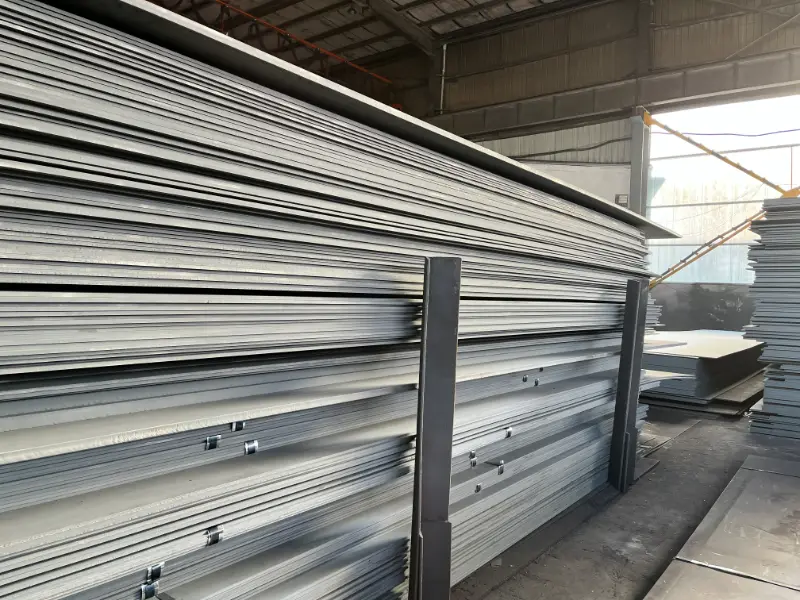
12Cr18Ni9Si3 (1Cr18Ni9Si3) Austenitic Stainless Steel
12Cr18Ni9Si3 (1Cr18Ni9Si3) Austenitic Stainless Steel | GB/T 4237
Comprehensive technical data for 12Cr18Ni9Si3 (also known as 1Cr18Ni9Si3) austenitic stainless steel plate and coil according to GB/T 4237. Includes chemical composition, mechanical properties, physical properties, and equivalent grades.
Hot rolling, cold rolling, annealing, pickling, cutting, bending, welding, deep drawing
- Phone : +8618037372205
- Email : [email protected]
- WhatsApp: Contact via Whtsapp
- WeChat: +8618037372205
12Cr18Ni9Si3 Austenitic Stainless Steel Introduction
12Cr18Ni9Si3 (former designation 1Cr18Ni9Si3) is an austenitic stainless steel specified in GB/T 4237 for hot-rolled stainless steel plates, sheets and strips. It features increased silicon content (2.0–3.0 %) which significantly enhances oxidation resistance at elevated temperatures compared to standard 18/8 grades. The alloy offers good strength and excellent ductility, with typical tensile strength above 520 MPa and elongation exceeding 40 %. Due to its austenitic structure, it is non-magnetic in the annealed condition and exhibits good formability and weldability. The material is primarily used in applications requiring moderate heat resistance, such as furnace parts and heat treatment fixtures, where it can withstand intermittent service up to about 900 °C and continuous service up to 850 °C in air.
12Cr18Ni9Si3 Austenitic Stainless Steel Chemical Composition
The following table lists the chemical requirements for 12Cr18Ni9Si3 according to GB/T 4237. The elevated silicon content provides improved oxidation resistance. Other elements are controlled within standard austenitic stainless steel limits to ensure good corrosion resistance and mechanical properties.
| Element | Specification (wt%) | Remarks |
|---|---|---|
| Carbon (C) | ≤ 0.12 | |
| Silicon (Si) | 2.00 – 3.00 | Key element for oxidation resistance |
| Manganese (Mn) | ≤ 2.00 | |
| Phosphorus (P) | ≤ 0.045 | |
| Sulfur (S) | ≤ 0.030 | |
| Chromium (Cr) | 17.00 – 19.00 | |
| Nickel (Ni) | 8.00 – 10.00 | |
| Iron (Fe) | Balance |
12Cr18Ni9Si3 Austenitic Stainless Steel Thermal and Electrical Physical Properties
Physical properties are typical values for 12Cr18Ni9Si3 in the annealed condition at room temperature unless a temperature range is indicated. These data are provided for general engineering calculations and are based on measured characteristics of 18Cr-8Ni steels with high silicon content.
| Property | Typical Value | Unit | Test Condition / Remarks |
|---|---|---|---|
| Density (ρ) | 7.9 | g/cm³ | 20 °C |
| Modulus of Elasticity (E) | 193 | GPa | 20 °C |
| Shear Modulus (G) | 74 | GPa | 20 °C, calculated from E and ν |
| Poisson's Ratio (ν) | 0.30 | - | 20 °C |
| Thermal Expansion Coefficient (α) | 17.5 | 10⁻⁶/°C | 20–100 °C |
| Thermal Expansion Coefficient (α) | 18.5 | 10⁻⁶/°C | 20–500 °C |
| Thermal Conductivity (λ) | 16.3 | W/(m·K) | 100 °C |
| Thermal Conductivity (λ) | 18.8 | W/(m·K) | 500 °C |
| Specific Heat Capacity (cp) | 500 | J/(kg·K) | 20–100 °C |
| Electrical Resistivity (ρe) | 0.72 | μΩ·m | 20 °C |
12Cr18Ni9Si3 Austenitic Stainless Steel Mechanical Properties
Mechanical properties for plate and strip in the solution annealed condition according to GB/T 4237. Values are minimum requirements at room temperature unless otherwise specified. No impact test is normally required for this grade in standard specification. Bending test may be agreed upon between supplier and purchaser.
| Property | Required Value | Unit | Test Condition |
|---|---|---|---|
| Tensile Strength (Rm) | ≥ 520 | MPa | Room temperature, solution annealed |
| Yield Strength (Rp0.2) | ≥ 205 | MPa | Room temperature, solution annealed |
| Elongation (A) | ≥ 40 | % | Gauge length 50 mm (or proportional), solution annealed |
| Hardness | ≤ 207 HBW (≤ 95 HRB) | - | Solution annealed, for reference |
12Cr18Ni9Si3 Austenitic Stainless Steel Fully Equivalent Material Standards and Replaceable Grades
There is no exact international equivalent for 12Cr18Ni9Si3 because of its specific silicon range. The table below lists grades that are chemically and functionally the closest. Direct substitution should be verified against specific Si and C content.
| Country/Region | Standard | Grade | Remarks |
|---|---|---|---|
| China | GB/T 4237 | 12Cr18Ni9Si3 (1Cr18Ni9Si3) | Original grade |
| USA | ASTM A240 / ASTM A276 | 302B (UNS S30215) | Si 2.0–3.0, C ≤0.15, Cr 17–19, Ni 8–10; very close match |
| International | ISO 15510 | X8CrNiSi18-9 | Si 1.7–2.3, C ≤0.08, may need adjustment for Si minimum |
| Europe | EN 10088-1 / EN 10095 | 1.4833 (X8CrNiSi18-9) | Si 1.5–2.0, C ≤0.08, less Si but similar heat resistance |
| Japan | JIS G4304 / G4305 | SUS 302B | Si 2.0–3.0, C ≤0.15, equivalent to AISI 302B |
12Cr18Ni9Si3 Austenitic Stainless Steel Application Introduction
12Cr18Ni9Si3 is designed for service conditions where both corrosion resistance and elevated temperature oxidation resistance are required. Thanks to its high silicon content, a protective oxide layer forms at high temperatures, retarding further oxidation. The steel is readily fabricated by shearing, bending, drawing and welding. It is recommended for use in environments up to 850 °C continuous and 900 °C intermittent.
Product Applications: Hot-rolled and cold-rolled stainless steel plates and coils, Furnace trays, baskets, and muffles, Radiant tubes and heater sheaths, High-temperature bolts and nuts, Annealing and quenching boxes, Burner nozzles and flame holders
Processed into products: Furnace conveyor belts and links, Heat exchanger plates and baffles, Expansion joints and bellows for hot gas ducts, Welded pipes and headers, Distillation column internals, Support frames for heating elements
Application industries: Heat treatment and furnace construction, Petrochemical processing, Power generation (exhaust systems, recuperators), Automotive (high-temperature exhaust components), Industrial oven manufacturing, Food processing equipment (where high-temperature cleaning is used)
12Cr18Ni9Si3 Austenitic Stainless Steel Closely Related / Similar Substitute Materials
| Country/Region | Standard | Grade | Remarks |
|---|---|---|---|
| China | GB/T 4237 | 12Cr18Ni9 (1Cr18Ni9) | Standard 18-8 without elevated Si; lower heat resistance |
| China | GB/T 4237 | 12Cr18Ni9Si4 (1Cr18Ni9Si4) | Si 3.5–4.5, even higher oxidation resistance for higher temperature service |
| USA | ASTM A240 | 304 (UNS S30400) | Silicon typically ≤1.0; less oxidation resistance but widely available |
| Europe | EN 10088-1 | 1.4301 (X5CrNi18-10) | Low Si, similar general corrosion resistance, not for high-temperature oxidation |
| Europe | EN 10095 | 1.4841 (X15CrNiSi25-21) | Higher Cr and Ni, excellent heat resistance, more costly |
Notes:
The material is typically supplied with a solution annealed and descaled surface. For improved high-temperature performance, the maximum service temperature should be limited based on environment. In sulfur-containing atmospheres, the nickel content makes the alloy susceptible to sulfidation at high temperatures; a higher chromium grade may be required. The silicon addition increases the tendency for sigma phase formation during long-term exposure in the 600–800 °C range, which can cause embrittlement. Welding consumables recommended: ER308LSi or ER309 for dissimilar joints. Post-weld annealing is generally not required but may be performed to restore full corrosion resistance.
- Share



