
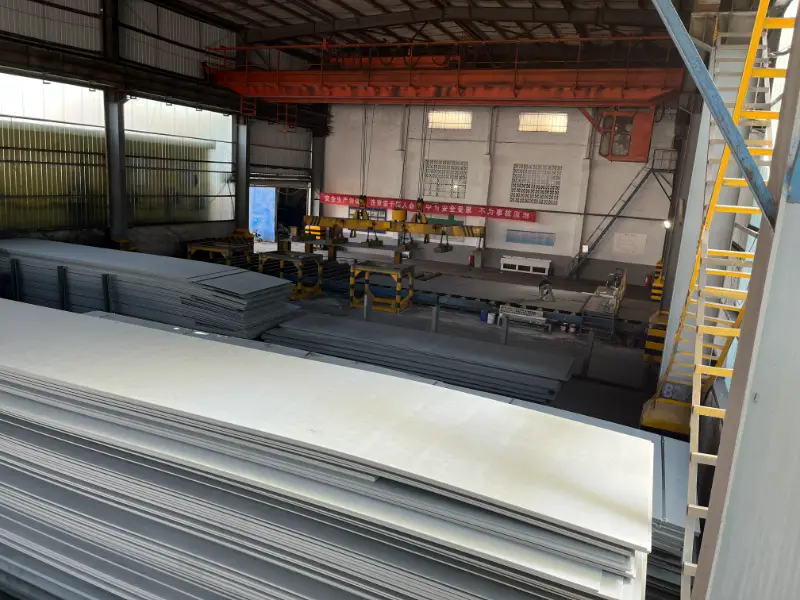
10Cr15 (1Cr15) Ferritic Stainless Steel Plate/Coil under GB/T 4237
10Cr15 (1Cr15) Ferritic Stainless Steel Plate/Coil under GB/T 4237 - Properties and Global Equivalents
Complete technical data for 10Cr15 (1Cr15) ferritic stainless steel according to GB/T 4237, including chemical composition, mechanical properties, physical properties, international equivalent grades, and application guidance.
Hot rolling, cold rolling, annealing, pickling, slitting, cutting, forming, bending, deep drawing, welding (with caution)
- Phone : +8618037372205
- Email : [email protected]
- WhatsApp: Contact via Whtsapp
- WeChat: +8618037372205
10Cr15 Ferritic Stainless Steel Plate/Coil under GB/T 4237 Introduction
10Cr15 (1Cr15) is a ferritic stainless steel standardized in GB/T 4237 for hot-rolled stainless steel plates, sheets and strips. It features a chromium content of 14.0–16.0%, low carbon, and a fully ferritic microstructure at all temperatures. This grade offers good general corrosion resistance, moderate formability, and excellent ductility in the annealed condition. It is non-hardenable by heat treatment and is widely used in applications where slightly higher chromium than standard 12% Cr steels is required. Its mechanical strength is moderate, with typical tensile strength above 450 MPa and yield strength above 205 MPa. The alloy exhibits good oxidation resistance up to about 800°C continuously.
- Ferritic structure, non-hardenable by quenching
- Good corrosion resistance in mildly aggressive environments
- Excellent polishability and surface finish capabilities
- Cost-effective alternative to austenitic grades in many architectural and appliance applications
10Cr15 Ferritic Stainless Steel Plate/Coil under GB/T 4237 Chemical Composition
The following chemical composition limits apply to 10Cr15 (1Cr15) according to GB/T 4237. The alloy is defined by its chromium range, with strict control on carbon, silicon, manganese, phosphorus and sulfur to ensure ferritic structure and adequate corrosion resistance.
| Chemical Element | Standard Value | Remarks |
|---|---|---|
| Carbon (C) | ≤ 0.12 | Maximum |
| Silicon (Si) | ≤ 1.00 | Maximum |
| Manganese (Mn) | ≤ 1.00 | Maximum |
| Phosphorus (P) | ≤ 0.040 | Maximum |
| Sulfur (S) | ≤ 0.030 | Maximum |
| Chromium (Cr) | 14.00 – 16.00 | Defines corrosion resistance |
| Nickel (Ni) | ≤ 0.60 | Residual, not intentionally added |
10Cr15 Ferritic Stainless Steel Plate/Coil under GB/T 4237 Thermal and Electrical Physical Properties
Physical properties listed below are typical reference values for fully annealed 10Cr15 (1Cr15) ferritic stainless steel. These values are not normative but are representative of the alloy under standard conditions. They are essential for design calculations involving thermal expansion, heat transfer, and electrical resistance.
| Property | Standard Requirement Value | Unit | Test Condition |
|---|---|---|---|
| Density (ρ) | 7.70 | g/cm³ | At 20°C |
| Elastic Modulus (E) | 200 | GPa | At 20°C |
| Shear Modulus (G) | 77 | GPa | At 20°C |
| Poisson's Ratio (ν) | 0.28 | – | At 20°C |
| Thermal Expansion Coefficient (α) | 10.4 | µm/m·°C | 20–100°C range |
| Thermal Expansion Coefficient (α) | 10.8 | µm/m·°C | 20–200°C range |
| Thermal Expansion Coefficient (α) | 11.2 | µm/m·°C | 20–400°C range |
| Thermal Conductivity (λ) | 26.0 | W/m·K | At 100°C |
| Thermal Conductivity (λ) | 26.1 | W/m·K | At 500°C |
| Specific Heat Capacity | 460 | J/kg·K | At 20°C |
| Electrical Resistivity (ρ_e) | 0.60 | µΩ·m | At 20°C |
10Cr15 Ferritic Stainless Steel Plate/Coil under GB/T 4237 Mechanical Properties
Mechanical properties for 10Cr15 (1Cr15) are obtained from solution-annealed condition as per GB/T 4237. Tests are performed at room temperature on longitudinal specimens. The guaranteed minimum values may vary with plate thickness; values below are for thickness range up to 13.5 mm unless noted. Hardness and bending data are provided for quality control.
| Property | Standard Requirement | Unit | Test Condition |
|---|---|---|---|
| Yield Strength (ReH) | ≥ 205 | MPa | Ambient temperature, 0.2% offset |
| Tensile Strength (Rm) | ≥ 450 | MPa | Ambient temperature |
| Elongation (A) | ≥ 22 | % | Gauge length 50 mm |
| Brinell Hardness | ≤ 183 | HBW | Annealed, typical maximum |
| Bend Test (t ≤ 8 mm) | 180° bend, d = 2a | – | Mandrel diameter d, a = specimen thickness |
| Bend Test (t > 8 mm) | 180° bend, d = 3a | – | Mandrel diameter d |
10Cr15 Ferritic Stainless Steel Plate/Coil under GB/T 4237 Exactly Equivalent Material Standards and Replaceable Grades
| Country/Region | Standard | Grade | Remarks |
|---|---|---|---|
| China | GB/T 4237 | 10Cr15 (1Cr15) | Original designation |
| USA | ASTM A240/A240M | Type 430 (UNS S43000) | Identical Cr range, equivalent performance |
| Japan | JIS G4304 | SUS430 | Direct equivalent |
| Europe (EU) | EN 10088-2 | 1.4016 (X6Cr17) | Minor Cr difference; interchangeable in most uses |
| International | ISO 15510 | X6Cr17 | Identical chemical and mechanical requirements |
10Cr15 Ferritic Stainless Steel Plate/Coil under GB/T 4237 Application Introduction
10Cr15 (1Cr15) ferritic stainless steel is widely used in environments requiring moderate corrosion resistance combined with good formability and lower cost than austenitic grades. It is especially suitable for indoor and mildly outdoor exposure, and for components exposed to organic acids, nitric acid solutions, and atmospheric conditions. It is not recommended for highly corrosive chloride-rich environments due to potential pitting and stress corrosion cracking resistance lower than austenitic stainless steels.
- Excellent for deep-drawn parts when in the annealed condition
- Commonly used in bright annealed or polished finishes for aesthetic appeal
- Good weldability with low heat input and proper filler (e.g., 430Nb or austenitic filler)
- Often selected for cost-sensitive mass-production items
Product Applications: Stainless steel sinks and kitchen worktops, Decorative profiles and handrails, Automotive exhaust mufflers and catalytic converter shells, Domestic water heater parts and combustion chambers, Chemical storage and reaction vessels for mild oxidizing acids, Heat exchanger baffles and tube supports
Processed into products: Washing machine inner and outer drums, Deep-drawn kitchen sinks, Elevator cabin wall panels and control boards, Automotive exhaust flanges and brackets, Nitric acid storage tank shells, Food processing conveyor parts and cutting tables, Trim rings and bezels in consumer electronics, Tube sheets for low-pressure heat exchangers
Application industries: Home appliance manufacturing (washing machine drums, refrigerator panels), Architectural and building construction (interior cladding, elevator panels), Automotive industry (exhaust systems, trim parts), Food and beverage processing (trays, containers, cutlery), Chemical process equipment (storage tanks for nitric acid, handling equipment), Thermal and heat exchange systems (support structures, tubesheets)
10Cr15 Ferritic Stainless Steel Plate/Coil under GB/T 4237 Similar or Alternative Materials with Comparable Performance
| Country/Region | Standard | Grade | Remarks |
|---|---|---|---|
| China | GB/T 4237 | 10Cr17 (1Cr17) | Higher Cr (16-18%), slightly better corrosion resistance, fully interchangeable in many applications |
| China | GB/T 4237 | 06Cr13 (0Cr13) | Lower Cr (11.5-13.5%), lower cost but reduced corrosion performance |
| USA | ASTM A240 | Type 434 (UNS S43400) | Mo addition improves crevice corrosion, suitable for more aggressive media |
Notes:
This grade is classified as a ferritic stainless steel with no significant nickel content, making it less susceptible to nickel price volatility. It exhibits magnetic properties (ferromagnetic) and is susceptible to embrittlement after exposure to temperatures between 400–550°C (885°F embrittlement) and after long periods at room temperature (475°C embrittlement). Welding should be performed with preheating to 150–200°C and subsequent annealing at 780–850°C to restore ductility. When replacing with international equivalents like SUS430 or 1.4016, confirm that the product standard and delivery condition align with the intended application requirements.
- Share



