
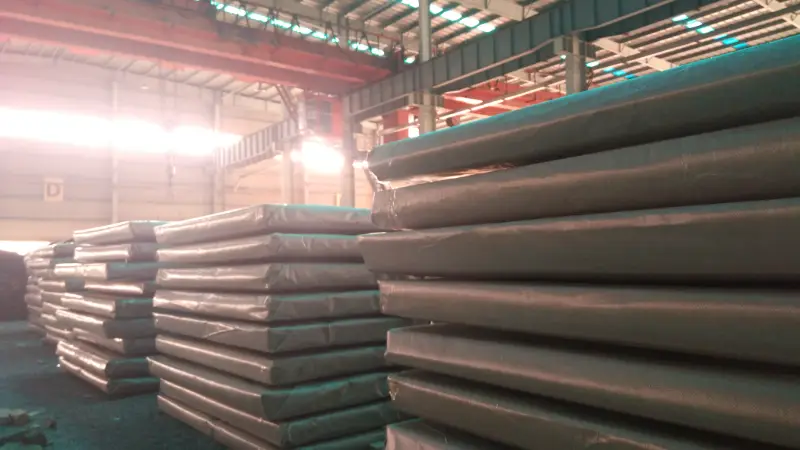
022Cr12 (00Cr12) Ferritic Stainless Steel to GB/T4237
022Cr12 (00Cr12) Ferritic Stainless Steel to GB/T4237 - Composition, Properties and Equivalents
Detailed material data for 022Cr12 (00Cr12) ferritic stainless steel plate and coil under GB/T4237, including chemical composition, mechanical and physical properties, international equivalents, and typical applications.
Hot rolling, cold rolling (subsequent processing allowed)
- Phone : +8618037372205
- Email : [email protected]
- WhatsApp: Contact via Whtsapp
- WeChat: +8618037372205
022Cr12 Ferritic Stainless Steel to GB/T4237 Introduction
022Cr12 (formerly 00Cr12) is a low-carbon ferritic stainless steel supplied as hot-rolled plate and coil under Chinese standard GB/T 4237. This grade exhibits good corrosion resistance in mildly aggressive environments, excellent thermal conductivity, and low thermal expansion compared to austenitic stainless steels. The very low carbon content minimizes intergranular corrosion after welding.
- Offers moderate strength and good ductility in the annealed condition.
- Is magnetic and cannot be hardened by heat treatment.
- Provides a cost-effective alternative to higher-alloyed stainless steels for applications such as automotive exhaust systems, containers, and architectural trim.
022Cr12 Ferritic Stainless Steel to GB/T4237 Chemical Composition
The chemical composition of 022Cr12 is controlled to ensure a fully ferritic microstructure and good corrosion resistance. The maximum limits for carbon, phosphorus, sulfur, and nickel are specified in GB/T 4237. Key feature: ultra-low carbon content (≤0.03%) that prevents intergranular corrosion after welding, eliminating the need for stabilizing elements.
| Element | Standard Value (wt%) | Remarks |
|---|---|---|
| C | ≤ 0.03 | |
| Si | ≤ 1.00 | |
| Mn | ≤ 1.00 | |
| P | ≤ 0.035 | |
| S | ≤ 0.030 | |
| Cr | 10.50 – 12.50 | Primary alloying element for corrosion resistance |
| Ni | ≤ 0.60 | Residual element, kept low to maintain ferritic structure |
| N | ≤ 0.10 | General limit; enhances pitting resistance slightly |
| Fe | Balance | Remainder |
022Cr12 Ferritic Stainless Steel to GB/T4237 Thermal and Electrical Physical Properties
The following physical properties are typical for 12% Cr ferritic stainless steel in the annealed condition. Data are representative and may be used for design and engineering calculations. Note: Thermal expansion coefficient is lower than that of austenitic grades, which improves dimensional stability under temperature changes.
| Property | Typical Value | Unit | Test Condition |
|---|---|---|---|
| Density (ρ) | 7.75 | g/cm³ | At room temperature |
| Modulus of elasticity (E) | 200 | GPa | At room temperature |
| Shear modulus (G) | 78 | GPa | Calculated |
| Poisson's ratio (ν) | 0.30 | — | Room temperature |
| Thermal expansion coefficient (α) | 10.5 | 10⁻⁶/K | 20 – 100 °C |
| Thermal expansion coefficient (α) | 11.0 | 10⁻⁶/K | 20 – 200 °C |
| Thermal expansion coefficient (α) | 11.5 | 10⁻⁶/K | 20 – 300 °C |
| Thermal expansion coefficient (α) | 12.0 | 10⁻⁶/K | 20 – 400 °C |
| Thermal conductivity (λ) | 25.0 | W/(m·K) | At 20 °C |
| Thermal conductivity (λ) | 25.0 | W/(m·K) | At 100 °C |
| Thermal conductivity (λ) | 26.0 | W/(m·K) | At 200 °C |
| Thermal conductivity (λ) | 26.0 | W/(m·K) | At 300 °C |
| Specific heat capacity | 460 | J/(kg·K) | At 20 °C |
| Electrical resistivity (ρₑ) | 0.60 | µΩ·m | At 20 °C |
022Cr12 Ferritic Stainless Steel to GB/T4237 Mechanical Properties
The mechanical properties below are according to the requirements of GB/T 4237 for hot-rolled plates and coils in the annealed condition. Test specimens are taken transverse to the rolling direction. Note: The bending test uses a bend angle of 180° and the reported hardness values are indicative for quality control.
| Property | Required Value | Unit | Test Condition |
|---|---|---|---|
| Yield Strength (ReH) | ≥ 170 | MPa | 0.2% offset, room temperature |
| Tensile Strength (Rm) | ≥ 280 | MPa | Room temperature |
| Elongation after fracture (A) | ≥ 25 | % | Gauge length 50 mm (A50) |
| Bend Test (Bend angle 180°) | d = 2a | — | Dia of former = 2 × specimen thickness (a) |
| Hardness (HBW) | ≤ 200 | — | Brinnell hardness |
| Hardness (HRB) | ≤ 90 | — | Rockwell B hardness |
| Hardness (HV) | ≤ 200 | — | Vickers hardness |
022Cr12 Ferritic Stainless Steel to GB/T4237 Fully Equivalent Material Standards and Designations
| Country/Region | Standard | Designation | Remarks |
|---|---|---|---|
| China | GB/T 4237 | 022Cr12 (00Cr12) | Original grade, hot-rolled plate/coil |
| Japan | JIS G4304 / G4305 | SUS410L | Same chemistry, hot/cold rolled forms |
| International | ISO 15510 | X2Cr12 | Chemically identical ferritic grade |
022Cr12 Ferritic Stainless Steel to GB/T4237 Application Introduction
Due to its good balance of corrosion resistance, thermal conductivity, and cost, 022Cr12 finds wide use in mildly corrosive environments. Its ferritic structure eliminates stress corrosion cracking in chloride environments, a common concern with austenitic grades. Typical industries:
- Automotive
- Building & Construction
- Household Appliances
- Industrial Equipment
Product Applications: Exhaust system components (mufflers, pipes, catalytic converter shells), Decorative architectural panels and facades, Kitchen sinks and cookware, Storage tanks and containers for mildly corrosive chemicals, Heat shields and thermal insulation parts, Chimney liners and flue gas ducts
Processed into products: Muffler bodies and end caps, Catalytic converter shells, Exhaust manifold heat shields, Window frames and curtain wall components, Sheet metal housings for home appliances, Light-gauge structural sections in corrosive atmospheres
Application industries: Automotive Manufacturing, Architectural and Construction, Household Appliance Production, Industrial Container Fabrication, Heat Exchanger Manufacturing, Chimney and Flue Lining
022Cr12 Ferritic Stainless Steel to GB/T4237 Similar or Close Substitute Materials
| Country/Region | Standard | Designation | Remarks |
|---|---|---|---|
| USA | ASTM A240 | 409 (S40900) | Ti-stabilized version; better weld corrosion resistance, similar base properties |
| Germany/Europe | EN 10088-2 | 1.4003 (X2CrNi12) | Contains 0.3-1.0 Ni for improved strength and toughness, otherwise similar |
| China | GB/T 4237 | 06Cr13 (0Cr13, S41008) | Higher carbon (≤0.08), slightly lower corrosion resistance; can be used in less demanding environments |
| Japan | JIS G4304 | SUS410 | Higher carbon (≤0.15) martensitic/ferritic steel; used where higher strength is needed |
Notes:
Welding: 022Cr12 has good weldability. However, coarse grain growth in the heat-affected zone can slightly reduce toughness. Preheating is generally not required, but post-weld annealing (700–760 °C) may restore ductility. Fabrication: Cold forming operations such as bending, drawing, and deep drawing are possible. Because the material does not work-harden as rapidly as austenitic stainless steels, it can be formed into complex shapes with moderate effort. Corrosion resistance: Suitable for rural, urban, and mildly industrial atmospheres. Not recommended for strong acids or halide-rich environments without evaluation.
- Share



