
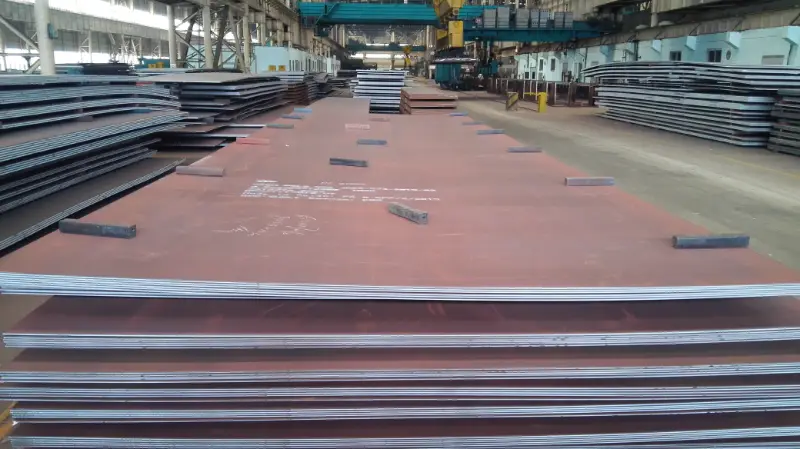
022Cr19Ni13Mo4N Austenitic Stainless Steel Plate/Coil
022Cr19Ni13Mo4N Austenitic Stainless Steel Plate/Coil - GB/T 4237 Data & Equivalents
Explore the complete technical profile of 022Cr19Ni13Mo4N (S31783) stainless steel plate/coil according to GB/T 4237. Chemical composition, mechanical properties, physical data, international equivalents, and application guidance.
Hot rolling, cold rolling, solution annealing, pickling, cutting, forming
- Phone : +8618037372205
- Email : [email protected]
- WhatsApp: Contact via Whtsapp
- WeChat: +8618037372205
022Cr19Ni13Mo4N Austenitic Stainless Steel Plate/Coil Introduction
022Cr19Ni13Mo4N is a low‑carbon, nitrogen‑enhanced austenitic stainless steel specified in GB/T 4237 as S31783. It is designed for superior corrosion resistance, especially in chloride‑containing environments, thanks to its higher molybdenum and nitrogen additions compared to standard 317L.
- Excellent pitting and crevice corrosion resistance
- Good strength and ductility
- Suitable for welded structures due to low carbon content
- Used extensively in chemical processing, pulp & paper, and marine applications
022Cr19Ni13Mo4N Austenitic Stainless Steel Plate/Coil Chemical Composition
Chemical limits as required by GB/T 4237-2015 for grade 022Cr19Ni13Mo4N. The alloy is characterized by low carbon, elevated molybdenum (~4%), and a deliberate nitrogen addition to improve strength and pitting resistance.
| Element | Standard Value | Remarks |
|---|---|---|
| Carbon (C) | ≤0.030 | Low carbon for weldability |
| Silicon (Si) | ≤1.00 | |
| Manganese (Mn) | ≤2.00 | |
| Phosphorus (P) | ≤0.045 | |
| Sulfur (S) | ≤0.030 | |
| Chromium (Cr) | 18.00 – 20.00 | |
| Nickel (Ni) | 12.00 – 14.00 | |
| Molybdenum (Mo) | 3.50 – 4.50 | Key element for chloride resistance |
| Nitrogen (N) | 0.10 – 0.20 | Enhances strength and pitting resistance |
022Cr19Ni13Mo4N Austenitic Stainless Steel Plate/Coil Thermal & Electrical Physical Properties
Physical properties at room temperature unless otherwise stated. These are typical values for 022Cr19Ni13Mo4N (similar to 317LMN) and are suitable for engineering calculations. Data are not part of GB/T 4237 but represent commonly accepted figures.
| Property | Typical Value | Unit | Test Condition / Temperature |
|---|---|---|---|
| Density (ρ) | 8.0 | g/cm³ | 20 °C |
| Modulus of elasticity (E) | 200 | GPa | 20 °C |
| Shear modulus (G) | 77 | GPa | 20 °C |
| Poisson's ratio (ν) | 0.3 | — | 20 °C |
| Thermal expansion coefficient (α) | 16.5 | µm/m·°C | 20–100 °C |
| Thermal conductivity (λ) | 14 | W/m·K | 100 °C |
| Specific heat capacity (cp) | 500 | J/kg·K | 20 °C |
| Electrical resistivity (ρe) | 0.74 | µΩ·m | 20 °C |
022Cr19Ni13Mo4N Austenitic Stainless Steel Plate/Coil Mechanical Properties – GB/T 4237 Solution Annealed Condition
Minimum mechanical property requirements for plates/coils in the solution annealed condition per GB/T 4237-2015. The addition of nitrogen results in higher yield and tensile strengths compared to conventional 317L.
| Property | Standard Requirement | Unit | Test Condition |
|---|---|---|---|
| Tensile strength (Rm) | ≥ 550 | MPa | Room temperature, transverse specimen |
| Yield strength (Rp0.2) | ≥ 240 | MPa | Room temperature, transverse specimen |
| Elongation after fracture (A) | ≥ 40 | % | Gauge length 50 mm, thickness ≤8 mm; applies to all thicknesses as per standard |
| Hardness | ≤ 217 | HBW | Brinell hardness test, solution annealed |
022Cr19Ni13Mo4N Austenitic Stainless Steel Plate/Coil Exact Equivalent Material Standards & Substitutable Grades
| Country/Region | Standard | Grade | Remarks |
|---|---|---|---|
| China | GB/T 4237 | 022Cr19Ni13Mo4N (S31783) | Original grade; exact match |
| USA | ASTM A240/A240M | UNS S31726 (317LMN) | Close match but Mo 4.0–5.0% vs 3.5–4.5%; Cr 17.0–20.0% vs 18.0–20.0% |
| Europe | EN 10088-2 | 1.4439 (X2CrNiMoN17-13-5) | Slightly lower Cr (16.5–18.5%) and higher Mo (4.0–5.0%); functionally similar in many applications |
| International | ISO 15510 | X2CrNiMoN18-13-5 | Cr 17.0–19.0%, Mo 4.0–5.0%; not an exact match but widely considered equivalent for engineering purposes |
022Cr19Ni13Mo4N Austenitic Stainless Steel Plate/Coil Application Introduction
022Cr19Ni13Mo4N is chosen where good chloride pitting and crevice corrosion resistance is required, combined with higher mechanical strength than standard 317L. It excels in aggressive chemical and marine environments.
Product Applications: Storage tanks and pressure vessels, Heat exchangers and condensers, Piping systems and fittings, Column trays and internals, Evaporators and crystallizers, Desalination plant components
Processed into products: Flanges and gaskets, Valve bodies and pump casings, Welded tube sheets, Expansion bellows, Fasteners and studs (where low chloride corrosion risk), Structural supports for corrosive environments
Application industries: Chemical processing plants (acid storage, reactors), Pulp and paper industry (bleaching equipment), Marine and offshore engineering (seawater piping, heat exchangers), Pharmaceutical and food processing equipment, Petrochemical and oil & gas (sweet and mildly sour service), Power generation (condenser tubes, flue gas desulfurization)
022Cr19Ni13Mo4N Austenitic Stainless Steel Plate/Coil Similar / Alternative Grades for Comparable Performance
| Country/Region | Standard | Grade | Remarks |
|---|---|---|---|
| China | GB/T 4237 | 022Cr19Ni13Mo3 (S31703, 317L) | Lower Mo (3.0–4.0%), no deliberate N; lower strength and pitting resistance |
| USA | ASTM A240 | UNS S31703 (317L) | Similar base but without nitrogen; suitable for less demanding corrosion environments |
| Europe | EN 10088-2 | 1.4438 (X2CrNiMo18-15-4) | Approximate EN counterpart of 317L; Mo around 4%, no N addition |
| International | ISO 15510 | X2CrNiMoN17-13-3 | Nitrogen version of 317L, but Mo 3.0–4.0%; lower corrosion resistance than 022Cr19Ni13Mo4N |
| Global | Various | 904L (1.4539 / N08904) | Higher Ni and Mo, better resistance but increased cost; used as upgrade alternative |
Notes:
Fabrication notes: The steel can be formed by bending, rolling, and drawing in the solution-annealed condition. Welding should be done with low heat input and matching filler metal (e.g., ER 317LMN or EN ISO 14343-A: W 18 16 5 N L) to retain corrosion resistance. Post-weld annealing is generally not required for thin sections, but full solution treatment may restore maximum corrosion resistance. Machining requires sharp tools and adequate cooling due to work hardening. The material is non-magnetic in the annealed condition.
- Share



