
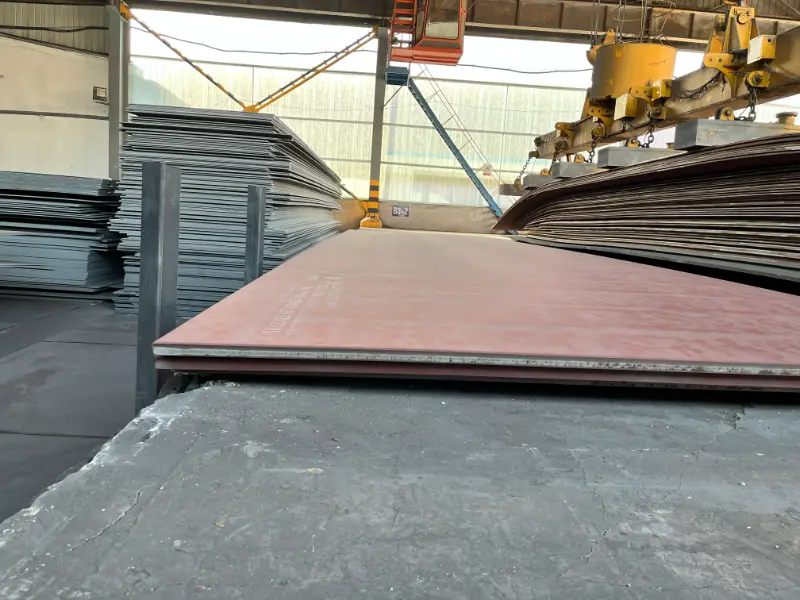
022Cr19Ni10 (304L) Stainless Steel Plate/Coil
022Cr19Ni10 (304L) Stainless Steel Plate/Coil: GB/T 4237 Properties and Global Equivalents
In-depth material data for 022Cr19Ni10 (00Cr19Ni10) austenitic stainless steel plate and coil according to GB/T 4237. Includes chemical composition, mechanical and physical properties, international cross-references, and application guidance.
Forming, welding, bending, machining, cold rolling, deep drawing
- Phone : +8618037372205
- Email : [email protected]
- WhatsApp: Contact via Whtsapp
- WeChat: +8618037372205
022Cr19Ni10 Stainless Steel Plate/Coil Introduction
022Cr19Ni10, also known by its superseded designation 00Cr19Ni10, is an ultra-low carbon austenitic stainless steel standardised under GB/T 4237 for hot-rolled plates and coils. It is the Chinese equivalent of the internationally recognised AISI 304L (UNS S30403) grade. The material offers excellent corrosion resistance in a wide range of atmospheric and chemical environments, combined with superior weldability due to its low carbon content, which minimises the risk of intergranular corrosion after welding or stress relieving. In the solution-annealed condition, it is essentially non-magnetic and exhibits good ductility and toughness even at cryogenic temperatures. Typical applications span industries requiring hygiene, durability and formability, such as food processing, chemical and petrochemical equipment, architectural panels, and medical devices. The standard delivery condition is solution heat treated and pickled, ensuring a clean, scale-free surface ready for further fabrication.
022Cr19Ni10 Stainless Steel Plate/Coil Chemical Composition
The chemical composition of 022Cr19Ni10 according to GB/T 4237 is designed for excellent corrosion resistance and weldability. The ultra-low carbon content (≤0.030%) effectively suppresses chromium carbide precipitation during welding, making it suitable for applications in the as-welded condition without post-weld heat treatment. Strict control of phosphorus and sulfur ensures good hot workability and surface quality.
| Chemical Element | Standard Value (%) | Remarks |
|---|---|---|
| C | ≤0.030 | Ultra-low carbon for intergranular corrosion resistance |
| Si | ≤1.00 | Silicon as deoxidiser |
| Mn | ≤2.00 | Manganese for hot workability |
| P | ≤0.045 | Phosphorus limited for ductility |
| S | ≤0.030 | Sulfur controlled for surface quality |
| Cr | 18.00 – 20.00 | Key element for passivity and corrosion resistance |
| Ni | 8.00 – 12.00 | Stabilises austenitic structure and enhances ductility |
022Cr19Ni10 Stainless Steel Plate/Coil Thermal and Electrical Physical Properties
The physical properties are typical for the 18Cr-10Ni low-carbon austenitic stainless steel family. Values are influenced by exact composition and heat treatment but serve as reliable engineering references. The material exhibits a relatively high thermal expansion coefficient and a low thermal conductivity, which should be considered when designing components that operate across a broad temperature range or require heat transfer efficiency.
| Property | Typical Value | Unit | Test Condition / Remarks |
|---|---|---|---|
| Density (ρ) | 7.93 | g/cm³ | At 20°C |
| Modulus of Elasticity (E) | 193 | GPa | At 20°C, dynamic method |
| Shear Modulus (G) | 78 | GPa | At 20°C, estimated from E and Poisson's ratio |
| Poisson's Ratio (ν) | 0.29 | – | At 20°C |
| Thermal Expansion Coefficient (α) | 17.2 | μm/m·°C | 20–100°C |
| Thermal Expansion Coefficient (α) | 17.7 | μm/m·°C | 20–200°C |
| Thermal Expansion Coefficient (α) | 18.1 | μm/m·°C | 20–300°C |
| Thermal Conductivity (λ) | 16.2 | W/m·K | At 20°C |
| Specific Heat Capacity | 500 | J/kg·°C | At 20°C |
| Electrical Resistivity (ρe) | 0.73 | μΩ·m | At 20°C |
022Cr19Ni10 Stainless Steel Plate/Coil Mechanical Properties
The mechanical properties are guaranteed in the solution-annealed condition as specified in GB/T 4237. The material exhibits a low yield strength typical of austenitic grades, combined with high elongation, which facilitates severe cold forming and deep drawing operations. The values below represent the minimum requirements at room temperature for plate thicknesses commonly supplied.
| Property | Standard Requirement | Unit | Test Condition |
|---|---|---|---|
| Tensile Strength (Rm) | ≥480 | MPa | Room temperature, solution annealed |
| Yield Strength (Rp0.2) | ≥175 | MPa | Room temperature, solution annealed |
| Elongation after fracture (A) | ≥40 | % | Gauge length 50 mm, solution annealed |
| Bend Test (180°) | No cracks, bending angle 180°, bend diameter d=2a (a = plate thickness) | – | Room temperature, solution annealed |
022Cr19Ni10 Stainless Steel Plate/Coil Complete Equivalent Standards and Substitutable Grades
| Country/Region | Standard | Grade | Remarks |
|---|---|---|---|
| International (ISO) | ISO 15510 | X2CrNi19-11 | Identical chemical composition and application range |
| Europe (EU) | EN 10088-2/3 | 1.4306 (X2CrNi19-11) | Direct equivalent; also designated as "304L" in common trade |
| United States | ASTM A240/A240M | UNS S30403 (Type 304L) | Most widely used global equivalent for 022Cr19Ni10 |
| Japan | JIS G4304/G4305 | SUS304L | Fully interchangeable in terms of chemical and mechanical properties |
022Cr19Ni10 Stainless Steel Plate/Coil Application Introduction
022Cr19Ni10 (304L) is a versatile austenitic stainless steel that excels in applications requiring good chemical resistance, weldability without post-weld treatment, and good low-temperature toughness. It is widely employed across industries where cleanability, structural integrity, and compliance with food or medical standards are essential. Typical end uses range from large storage tanks and heat exchangers to precision medical instruments and architectural elements.
Product Applications: Storage tanks and silos, Heat exchangers and condensers, Piping systems and fittings, Kitchen sinks, worktops, and commercial catering equipment, Surgical instruments and medical trays, Architectural facade panels and curtain walls, Pressure vessels and reactors
Processed into products: Flanges and pipe connections, Valve bodies and pump casings, Expansion joints and bellows, Filter housings and strainers, Structural frames and support brackets, Impellers and agitator shafts, Sterilisation chambers and autoclaves
Application industries: Chemical and petrochemical processing, Food and beverage production (including dairies, breweries, and catering equipment), Pharmaceutical and biotechnology, Medical device manufacturing, Architecture and construction (cladding, handrails, structural sections), Heat exchange and pressure vessel production, Cryogenic engineering (LNG storage and transportation), Water treatment and desalination
022Cr19Ni10 Stainless Steel Plate/Coil Recommendations for Similar/Closely Related Alternative Materials
| Country/Region | Standard | Grade | Remarks |
|---|---|---|---|
| China | GB/T 4237 | 06Cr19Ni10 (0Cr18Ni9, AISI 304) | Higher carbon (≤0.08%), may suffer from weld decay if not solution treated; similar corrosion resistance but lower weldability |
| China | GB/T 4237 | 022Cr17Ni12Mo2 (00Cr17Ni14Mo2, AISI 316L) | Contains Mo for increased pitting resistance in chloride environments; slightly higher strength, can replace 022Cr19Ni10 when higher corrosion resistance is needed |
| China | GB/T 4237 | 12Cr18Ni9 (1Cr18Ni9, AISI 302) | Higher carbon and lower nickel, higher hardness after cold working; not recommended for welded chemical equipment |
Notes:
The material is typically supplied in the solution-annealed condition and descaled by pickling. For applications requiring a bright, reflective finish, bright annealing can be specified. Post-weld heat treatment is generally not required, but if performed, a full solution anneal at 1010–1120°C followed by rapid cooling is recommended to restore maximum corrosion resistance. Welding consumables matching or slightly over-alloyed (e.g., ER308L) should be used to maintain the low-carbon balance.
- Share



