
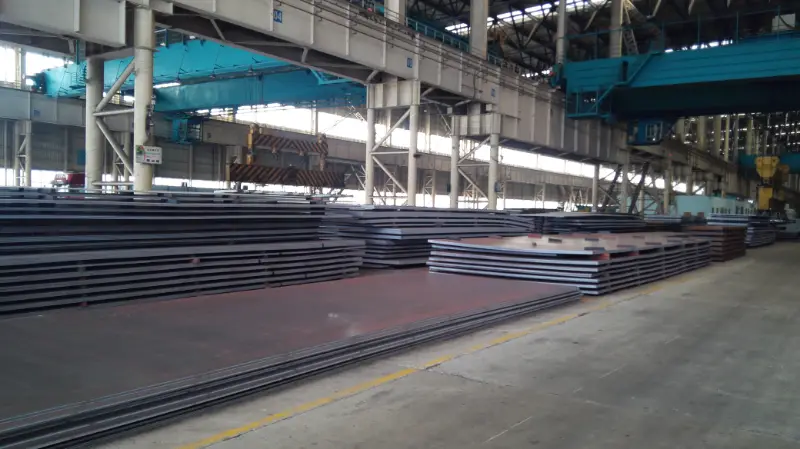
015Cr24Ni22Mo8Mn3CuN
015Cr24Ni22Mo8Mn3CuN - Superior Austenitic Stainless Steel Plate/Coil for Extreme Corrosion Resistance
Explore the complete technical data for 015Cr24Ni22Mo8Mn3CuN stainless steel including chemical composition, mechanical and physical properties, international equivalents, and application guidance. Ideal for highly corrosive environments like chemical plants, seawater systems, and FGD units.
Hot rolling, cold rolling, welding, forming, machining
- Phone : +8618037372205
- Email : [email protected]
- WhatsApp: Contact via Whtsapp
- WeChat: +8618037372205
015Cr24Ni22Mo8Mn3CuN Introduction
015Cr24Ni22Mo8Mn3CuN is a super austenitic stainless steel defined in GB/T 4237, characterized by very low carbon (≤0.015%), high chromium (about 24%), high nickel (about 22%), high molybdenum (about 8%), and intentional additions of manganese, copper, and nitrogen. This grade provides outstanding resistance to pitting, crevice corrosion, and stress corrosion cracking in chloride-containing environments, as well as excellent corrosion resistance in a wide range of acids. It is supplied as hot-rolled plate or coil in solution-annealed condition and is widely used in chemical processing, marine engineering, flue gas desulfurization, and other demanding applications where 6% Mo grades are insufficient.
015Cr24Ni22Mo8Mn3CuN Chemical Composition
The chemical composition of 015Cr24Ni22Mo8Mn3CuN conforms to GB/T 4237. It features very low carbon to prevent intergranular corrosion, high molybdenum and nitrogen for superior pitting resistance, and controlled copper for enhanced sulfuric acid resistance. All values are ladle analysis limits.
| Element | Standard Value | Remarks |
|---|---|---|
| C | ≤0.015 | |
| Si | ≤0.50 | |
| Mn | 2.00–4.00 | |
| P | ≤0.030 | |
| S | ≤0.005 | |
| Cr | 23.00–25.00 | |
| Ni | 21.00–23.00 | |
| Mo | 7.00–8.00 | |
| Cu | 0.30–0.60 | |
| N | 0.45–0.55 |
015Cr24Ni22Mo8Mn3CuN Thermal and Electrical Physical Properties
Physical properties at ambient and elevated temperatures. These values are typical for the 015Cr24Ni22Mo8Mn3CuN type alloy and are suitable for engineering calculations. Data reflect annealed condition. Variations may occur due to product form and exact composition.
| Property | Standard Requirement Value | Unit | Test Condition |
|---|---|---|---|
| Density (ρ) | 8.0 | g/cm³ | 20°C |
| Elastic Modulus (E) | 195 | GPa | 20°C |
| Shear Modulus (G) | 75 | GPa | 20°C (calculated) |
| Poisson's Ratio (ν) | 0.31 | - | 20°C |
| Thermal Expansion Coefficient (α) | 14.5 | µm/m·°C | 20–100°C |
| Thermal Expansion Coefficient (α) | 14.8 | µm/m·°C | 20–200°C |
| Thermal Expansion Coefficient (α) | 15.1 | µm/m·°C | 20–300°C |
| Thermal Expansion Coefficient (α) | 15.4 | µm/m·°C | 20–400°C |
| Thermal Conductivity (λ) | 11.5 | W/m·K | 20°C |
| Thermal Conductivity (λ) | 13 | W/m·K | 100°C |
| Thermal Conductivity (λ) | 14 | W/m·K | 200°C |
| Thermal Conductivity (λ) | 15 | W/m·K | 300°C |
| Thermal Conductivity (λ) | 16 | W/m·K | 400°C |
| Specific Heat Capacity (cp) | 455 | J/kg·K | 20°C |
| Specific Heat Capacity (cp) | 475 | J/kg·K | 100°C |
| Specific Heat Capacity (cp) | 500 | J/kg·K | 200°C |
| Specific Heat Capacity (cp) | 525 | J/kg·K | 300°C |
| Electrical Resistivity (ρe) | 0.85 | µΩ·m | 20°C |
015Cr24Ni22Mo8Mn3CuN Mechanical Properties
Mechanical properties per GB/T 4237 for hot-rolled plate in solution-annealed condition. Tests are performed at room temperature. The high strength combined with excellent ductility allows for demanding structural applications even in corrosive environments.
| Property | Standard Requirement | Unit | Test Condition |
|---|---|---|---|
| Yield Strength (Rp0.2) | ≥430 | MPa | Room temperature, annealed |
| Tensile Strength (Rm) | ≥750 | MPa | Room temperature, annealed |
| Elongation (A) | ≥40 | % | Gauge length 50 mm |
| Brinell Hardness (HBW) | ≤250 | — | As per GB/T 231.1 |
| Rockwell Hardness (HRB) | ≤100 | — | As per GB/T 230.1 |
015Cr24Ni22Mo8Mn3CuN Fully Equivalent Material Standards and Substitute Grades
| Country/Region | Standard | Grade | Remarks |
|---|---|---|---|
| USA | ASTM A240/A240M | UNS S32654 | Identical chemistry and mechanical properties |
| Europe | EN 10088-2 | 1.4652 – X1CrNiMoCuN24-22-8 | Fully equivalent super austenitic grade |
| International | ISO 9328-5 | X1CrNiMoCuN24-22-8 | Composition and requirements match GB/T 4237 |
015Cr24Ni22Mo8Mn3CuN Application Introduction
015Cr24Ni22Mo8Mn3CuN is selected when service conditions exceed the limits of conventional stainless steels and even 6% Mo grades, especially where high resistance to pitting (PREN ≥ 56), crevice corrosion, and stress corrosion cracking is mandatory. It is fully compatible with standard welding and forming practices for austenitic grades. Common uses span:
Product Applications: Hot-rolled plates and coils, Heat exchanger plate packs, Welded and seamless pipes, Pressure vessels and storage tanks, FGD absorber internals and outlet ducts
Processed into products: Flanges, gaskets, and bolting, Pump shafts and impellers, Valve bodies and seats, Expansion bellows, Tube sheets and baffle plates, Spray nozzles and piping spools
Application industries: Chemical processing (acetic acid, phosphoric acid, sulfuric acid handling), Oil & gas (offshore platforms, subsea equipment), Seawater desalination and cooling systems, Flue gas desulfurization (FGD) scrubbers, Pulp & paper (bleaching equipment, digesters), Pollution control equipment (absorbers, ducts), Food processing (high chloride, corrosive media)
015Cr24Ni22Mo8Mn3CuN Similar / Close Alternative Materials
| Country/Region | Standard | Grade | Remarks |
|---|---|---|---|
| USA / Europe | ASTM A240 / EN 10088 | UNS N08367 / 1.4529 (AL-6XN / X1NiCrMoCuN25-20-7) | 6% Mo super austenitic; lower Mo (6.2%) and Cr; good alternative where 8% Mo not required |
| USA / Europe | ASTM A240 / EN 10088 | UNS S31254 / 1.4547 (254 SMO) | 6% Mo grade; excellent chloride resistance but less than 015Cr24Ni22Mo8Mn3CuN |
| USA / Europe | ASTM B625 / EN 10088 | UNS N08904 / 1.4539 (904L) | High-alloy austenitic; Mo 4.3%; for less severe acidic environments |
Notes:
Welding: Use matching filler metals (e.g., AWS A5.14 ERNiCrMo-13 for TIG; AWS A5.11 ENiCrMo-13 for SMAW). Low heat input and proper interpass temperature control are recommended to avoid hot cracking.
Heat treatment: Solution annealing at 1150–1200 °C followed by rapid water quenching. Slow cooling can cause precipitation of intermetallic phases.
PREN: Minimum pitting resistance equivalent number (PREN = %Cr + 3.3×%Mo + 30×%N) ≥ 56.
- Share



