
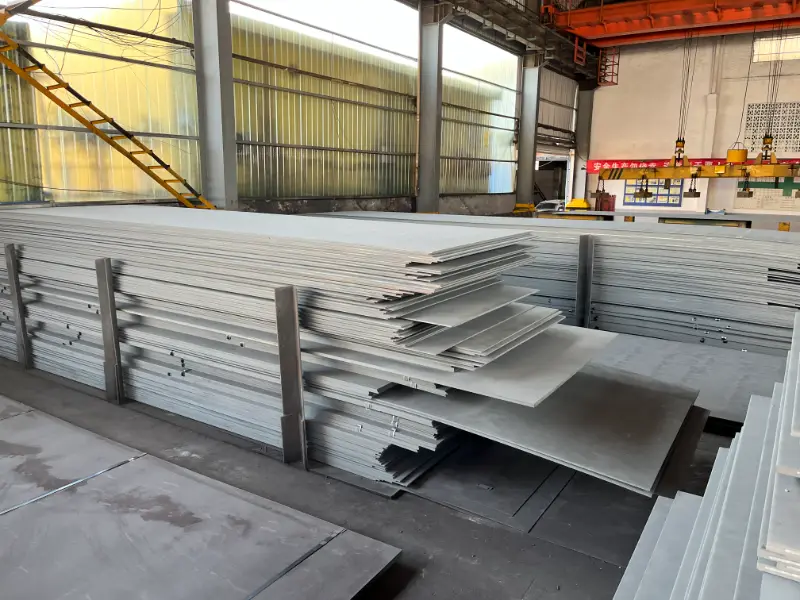
X70CrMo15 (1.4109) Martensitic Stainless Steel
X70CrMo15 (1.4109) Martensitic Stainless Steel - EN 10088-1 Plate & Coil Data
Complete material data for X70CrMo15 (1.4109) martensitic stainless steel to EN 10088-1: chemical composition, mechanical properties, physical data, international equivalents, and application guidance for plate and coil.
Hot rolled, cold rolled, soft annealed, quenched and tempered
- Phone : +8618037372205
- Email : [email protected]
- WhatsApp: Contact via Whtsapp
- WeChat: +8618037372205
X70CrMo15 Martensitic Stainless Steel Introduction
X70CrMo15 (material number 1.4109) is a high-carbon martensitic stainless steel with additions of chromium and molybdenum, classified under EN 10088-1 as a corrosion-resisting steel. It is supplied in the form of plate and coil according to EN 10088-2. The alloy achieves high hardness and wear resistance after heat treatment, combined with good corrosion resistance in mildly aggressive environments. Typical applications include cutlery, surgical instruments, bearings, valve parts, and pump shafts. In the soft-annealed condition it exhibits good machinability; after quenching and tempering it develops maximum hardness (up to ~60 HRC) while retaining sufficient toughness.
X70CrMo15 Martensitic Stainless Steel Chemical Composition
Chemical composition according to EN 10088-2:2014 for grade X70CrMo15 (1.4109). The high carbon content ensures high hardness after heat treatment; chromium provides corrosion resistance; molybdenum improves pitting resistance and wear properties.
| Element | Standard Value (wt%) | Remarks |
|---|---|---|
| Carbon (C) | 0.65 – 0.75 | |
| Silicon (Si) | ≤ 1.00 | |
| Manganese (Mn) | ≤ 1.00 | |
| Phosphorus (P) | ≤ 0.040 | |
| Sulfur (S) | ≤ 0.015 | |
| Chromium (Cr) | 14.0 – 16.0 | |
| Molybdenum (Mo) | 0.40 – 0.80 | |
| Nickel (Ni) | ≤ 0.50 | |
| Iron (Fe) | Balance |
X70CrMo15 Martensitic Stainless Steel Thermal and Electrical Physical Properties
Physical properties are typical for martensitic stainless steels of this type. Data are provided for general engineering guidance at room temperature unless otherwise noted. They are not guaranteed minimum values.
| Property | Typical Value | Unit | Test Condition |
|---|---|---|---|
| Density (ρ) | 7.70 | g/cm³ | 20°C |
| Elastic Modulus (E) | 215 | GPa | 20°C |
| Shear Modulus (G) | 84 | GPa | 20°C (calculated) |
| Poisson's Ratio (ν) | 0.30 | — | 20°C |
| Thermal Expansion Coefficient (α) | 10.5 | 10⁻⁶/K | 20–100°C |
| Thermal Expansion Coefficient (α) | 11.0 | 10⁻⁶/K | 20–200°C |
| Thermal Expansion Coefficient (α) | 11.5 | 10⁻⁶/K | 20–500°C |
| Thermal Conductivity (λ) | 23 | W/m·K | 20°C |
| Specific Heat Capacity | 460 | J/kg·K | 20°C |
| Electrical Resistivity (ρ_e) | 0.60 | μΩ·m | 20°C |
X70CrMo15 Martensitic Stainless Steel Mechanical Properties
Mechanical properties according to EN 10088-2:2014 for flat products. Values depend on product form, thickness, and heat treatment condition. The soft annealed (+A) condition is supplied for further processing; the quenched and tempered (+QT) condition gives high strength and hardness. Data below are for plate/coil up to 50 mm thickness.
| Property | Standard Required Value | Unit | Test Condition |
|---|---|---|---|
| Tensile Strength (Rm) | ≤ 900 | MPa | Soft annealed (+A) |
| Yield Strength (Rp0.2) | — | MPa | Soft annealed (+A) – not normally determined |
| Elongation (A%) | — | % | Soft annealed (+A) – usually limited |
| Tensile Strength (Rm) | ≥ 700 | MPa | Quenched and tempered (+QT) – typical range 700–950 MPa depending on tempering temperature |
| Yield Strength (Rp0.2) | ≥ 500 | MPa | Quenched and tempered (+QT) – typical min. |
| Elongation (A5) | ≥ 8 | % | Quenched and tempered (+QT) for thickness ≤ 3 mm |
| Impact Energy (KV) | — | J | Not normally specified; low toughness |
| Hardness | ≤ 280 HBW | HBW | Soft annealed (+A) |
| Hardness | ≥ 56 HRC | HRC | Quenched and tempered (+QT) – typical after low-temp temper |
X70CrMo15 Martensitic Stainless Steel Exact Equivalent Material Standards & Substitute Grade Recommendations
| Country / Region | Standard | Grade | Remarks |
|---|---|---|---|
| EU | EN 10088-1 | X70CrMo15 (1.4109) | Original grade |
| Germany | DIN EN 10088-2 | X70CrMo15 | Identical to EN |
| France | NF EN 10088-2 | X70CrMo15 | Identical to EN |
| UK | BS EN 10088-2 | X70CrMo15 | Identical to EN |
| Italy | UNI EN 10088-2 | X70CrMo15 | Identical to EN |
| Sweden | SS-EN 10088-2 | X70CrMo15 | Identical to EN |
| International | ISO 683-17 | X70CrMo15 | Equivalent grade in ISO standard for heat-treatable steels |
X70CrMo15 Martensitic Stainless Steel Application Introduction
X70CrMo15 is optimized for applications that require a combination of high hardness, wear resistance, and moderate corrosion resistance. After heat treatment it reaches the highest hardness in the martensitic stainless steel family, making it ideal for cutting tools and wear components. Typical industries and products include:
Product Applications: Blades, knives, scissors, Surgical scalpels and forceps, Ball bearings and roller bearings, Valve seats, stems, and balls, Pump shafts and sleeves, Nozzles and spray discs, Food processing knives and cutters
Processed into products: Knife blades (ready for final sharpening after heat treatment), Bearing races and rolling elements (requiring 58–60 HRC), Valve trim parts (seats, discs) for mild corrosive media, Wear plates and guides (high surface hardness), Precision measurement tools (e.g., caliper parts)
Application industries: Cutlery and kitchenware, Medical and surgical instruments, Mechanical engineering (bearings, valve parts), Pump and compressor manufacturing, Food processing equipment, Aerospace (minor structural parts requiring high hardness)
X70CrMo15 Martensitic Stainless Steel Similar / Closest Alternative Material Recommendations
| Country / Region | Standard | Grade | Remarks |
|---|---|---|---|
| USA | ASTM A276 / A276M | 440C (UNS S44004) | Similar high-carbon martensitic stainless; slightly different Cr range (16.0–18.0%), no Mo specification; similar hardness and wear resistance |
| Japan | JIS G4303 | SUS440C | Close to AISI 440C; often considered interchangeable with X70CrMo15 in many applications |
| China | GB/T 1220 | 9Cr18Mo | Contains similar C and Cr content with Mo addition; closest Chinese equivalent |
| Russia | GOST 5632 | 95Х18 | High-carbon Cr steel without Mo; lower wear and pitting resistance but sometimes used as substitute |
Notes:
- Heat treatment: Hardening from 1010–1065°C, quenching in oil or air, followed by tempering at 150–300°C to obtain high hardness. For improved toughness a higher tempering temperature may be used, but this lowers hardness.
- Welding: Not recommended for load-bearing welded joints due to high hardenability and risk of cracking. If welding is necessary, preheating to 200–300°C and post-weld heat treatment are required.
- Machinability: In the soft annealed condition, machinability is fair (comparable to AISI 440C). Carbide tooling is recommended.
- Corrosion resistance: Best performance after hardening and polishing. Not resistant to strong acids or chlorides; pitting resistance is limited.
- Share



