
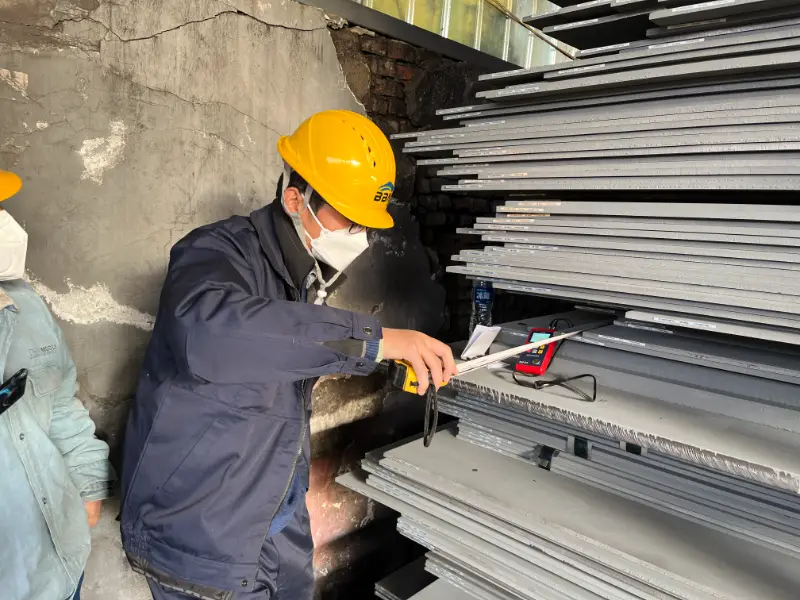
X6CrMoNb17-1 EN 10088-1 Ferritic Stainless Steel Plate/Coil
X6CrMoNb17-1 (1.4526) Ferritic Stainless Steel: Properties, Equivalents and Applications per EN 10088-1
Detailed material data for X6CrMoNb17-1 (1.4526) ferritic stainless steel according to EN 10088-1/2, including chemical composition, mechanical and physical properties, international equivalents, and application guidance for plate, coil and strip products.
Cold forming, bending, deep drawing, welding (common processes, low heat input recommended for ferritic grades), machining
- Phone : +8618037372205
- Email : [email protected]
- WhatsApp: Contact via Whtsapp
- WeChat: +8618037372205
X6CrMoNb17-1 EN 10088-1 Ferritic Stainless Steel Plate/Coil Introduction
X6CrMoNb17-1 (material number 1.4526) is a niobium-stabilized ferritic stainless steel defined in EN 10088-1. It combines
- Moderate chromium content (16–18 %) for good corrosion resistance
- A deliberate molybdenum addition (0.8–1.4 %) to enhance pitting and crevice corrosion resistance, particularly in chloride-containing environments
- Niobium stabilization (at least 10×C, max 0.80 %) that reduces susceptibility to intergranular corrosion after welding or heating, while refining the grain structure
The alloy offers a cost-effective alternative to austenitic grades in many mildly aggressive media, while maintaining good formability, weldability, and oxidation resistance up to approximately 800 °C. Typical delivery condition is annealed and pickled (2D/2B surface for coil/plate). This grade is widely used for automotive exhaust components, domestic appliances, and industrial equipment where a combination of corrosion resistance and elevated-temperature strength is required.
X6CrMoNb17-1 EN 10088-1 Ferritic Stainless Steel Plate/Coil Chemical Composition according to EN 10088-1
The chemical composition of X6CrMoNb17-1 is controlled to ensure a balanced ferritic structure, adequate corrosion resistance, and effective stabilization. Niobium is intentionally added to bind carbon and nitrogen, thereby preventing chromium carbide formation at grain boundaries. The limits are given for heat analysis as per EN 10088-1.
| Element | Standard value (wt%) | Remarks |
|---|---|---|
| Carbon (C) | ≤ 0.08 | Maximum carbon content |
| Silicon (Si) | ≤ 1.00 | Silicon improves oxidation resistance |
| Manganese (Mn) | ≤ 1.00 | Manganese as a deoxidizer |
| Phosphorus (P) | ≤ 0.040 | Maximum phosphorus |
| Sulfur (S) | ≤ 0.015 | Low sulfur for weldability and formability |
| Chromium (Cr) | 16.0 – 18.0 | Essential for corrosion resistance |
| Molybdenum (Mo) | 0.80 – 1.40 | Enhances pitting/crevice corrosion resistance |
| Niobium (Nb) | 10×C – 0.80 | Stabilizing element; minimum 10 times carbon content to ensure full stabilization |
X6CrMoNb17-1 EN 10088-1 Ferritic Stainless Steel Plate/Coil Thermal and Electrical Physical Properties
The following physical properties are typical for X6CrMoNb17-1 in the annealed condition. They are based on the ferritic stainless steel group data provided in EN 10088-1 (informative annex). Values may vary slightly depending on actual composition and heat treatment.
| Property | Typical value | Unit | Test condition / temperature range |
|---|---|---|---|
| Density (ρ) | 7.7 | g/cm³ | At 20 °C |
| Modulus of elasticity (E) | 200 | GPa | At 20 °C |
| Shear modulus (G) | 77 | GPa | At 20 °C |
| Poisson's ratio (ν) | 0.28 | – | At 20 °C |
| Thermal expansion (α) | 10.5 | 10⁻⁶/K | 20–100 °C |
| Thermal expansion (α) | 11.0 | 10⁻⁶/K | 20–200 °C |
| Thermal expansion (α) | 11.5 | 10⁻⁶/K | 20–300 °C |
| Thermal expansion (α) | 12.0 | 10⁻⁶/K | 20–400 °C |
| Thermal conductivity (λ) | 25 | W/(m·K) | At 20 °C |
| Specific heat capacity | 460 | J/(kg·K) | At 20 °C |
| Electrical resistivity (ρₑ) | 0.60 | Ω·mm²/m | At 20 °C |
X6CrMoNb17-1 EN 10088-1 Ferritic Stainless Steel Plate/Coil Mechanical Properties
The mechanical properties listed below apply to flat products (plate, coil, strip) in the annealed (+A) condition at room temperature. Requirements vary slightly with product thickness as defined in EN 10088-2. The values are minimums unless otherwise stated.
| Property | Standard requirement | Unit | Test condition / thickness range |
|---|---|---|---|
| Yield strength (Rp0.2) | ≥ 280 | MPa | Cold-rolled strip/coil, thickness ≤ 6 mm |
| Tensile strength (Rm) | 450 – 630 | MPa | Cold-rolled strip/coil, thickness ≤ 6 mm |
| Elongation (A80) | ≥ 20 | % | Cold-rolled strip/coil, thickness < 3 mm |
| Elongation (A) | ≥ 20 | % | Cold-rolled strip/coil, 3 mm ≤ thickness ≤ 6 mm |
| Yield strength (Rp0.2) | ≥ 280 | MPa | Hot-rolled plate, thickness ≤ 12 mm |
| Tensile strength (Rm) | 450 – 630 | MPa | Hot-rolled plate, thickness ≤ 12 mm |
| Elongation (A) | ≥ 18 | % | Hot-rolled plate, thickness ≤ 12 mm |
| Hardness (HBW) | ≤ 200 | HBW | All thicknesses (for reference) |
X6CrMoNb17-1 EN 10088-1 Ferritic Stainless Steel Plate/Coil Completely Equivalent Material Standards and Replaceable Grades
| Country/Region | Standard | Grade | Remarks |
|---|---|---|---|
| European Union | EN 10088-1/2 | X6CrMoNb17-1 (1.4526) | Reference material definition |
| USA | ASTM A240/A240M | 436 (UNS S43600) | Similar composition; carbon max 0.12 vs 0.08, fully interchangeable for most applications |
| Japan | JIS G4305 | SUS436L | Low-carbon variant (C ≤ 0.025); Nb stabilised, highly equivalent |
| China | GB/T 3280 | 019Cr17Mo1Nb (S11780) | Digital code S11780; low-carbon equivalent with Nb addition, fully matching requirements |
| ISO | ISO 15510 | X6CrMoNb17-1 | Identical to European grade |
X6CrMoNb17-1 EN 10088-1 Ferritic Stainless Steel Plate/Coil Application Introduction
X6CrMoNb17-1 is predominantly used where cost-effective, corrosion-resistant stainless steel is required with good fabrication characteristics. It is especially suitable for components exposed to mildly corrosive environments, including chlorides, and where post-weld sensitization must be avoided. Typical industries and products:
Product Applications: Automotive exhaust manifolds and catalytic converter housings, Hot water tanks and heat exchanger shells, Chimney liners and flue gas pipes, Kitchen sink bowls and worktops, Industrial piping for mild corrosive media
Processed into products: Deep-drawn parts: dishwasher inner liners, washing machine tubs, kitchen sink bowls, Bent and welded tubes: exhaust pipes, heat exchanger tubes, Flanges and connectors in low-pressure chemical systems, Stampings and brackets for high-temperature automotive environment, Laser-welded or seam-welded hollow sections for structural applications
Application industries: Automotive (exhaust systems, diesel particulate filters, tubing), White goods / Domestic appliances (washing machine drums, dishwasher interiors, oven parts), Heating, Ventilation and Air Conditioning (HVAC) (heat exchangers, flue gas ducts), Food and beverage processing (equipment where moderate corrosion resistance is sufficient), Chemical processing (storage vessels for selected chemicals)
X6CrMoNb17-1 EN 10088-1 Ferritic Stainless Steel Plate/Coil Similar or Alternative Materials with Proximate Properties
| Country/Region | Standard | Grade | Remarks and Comparative Analysis |
|---|---|---|---|
| European Union | EN 10088-2 | X2CrMoTi18-2 (1.4521 / 444) | Contains 2 % Mo for higher pitting resistance; Ti stabilized instead of Nb; tensile strength slightly higher |
| USA | ASTM A240 | 444 (UNS S44400) | 18Cr-2Mo-Ti grade; superior localised corrosion resistance, often used in similar applications requiring stronger pitting resistance |
| European Union | EN 10088-2 | X3CrTi17 (1.4510) | Mo-free ferritic; lower corrosion resistance but cost-effective for mild environments; Nb not required |
| China | GB/T 3280 | 022Cr17Ti (S11770) | Ti-stabilized 17Cr without Mo; less suitable for chloride exposure compared to X6CrMoNb17-1 |
Notes:
- For optimum corrosion resistance, the material should be supplied in the annealed and pickled condition. Post-weld annealing is generally not required because of the niobium stabilization.
- Welding procedures should use low heat input and filler metals such as AWS E/ER 436L or matching composition to avoid excessive grain growth and maintain toughness.
- The maximum service temperature in air is approximately 800 °C for continuous use; higher temperatures may cause excessive scaling.
- Surface finishes defined according to EN 10088-2 (e.g., 2B, 2D, 1D) influence appearance and formability; 2B is commonly used for general purposes.
- The data presented are based on official EN standards and are intended for general guidance; specific requirements should be confirmed with the material certificate.
- Share



