
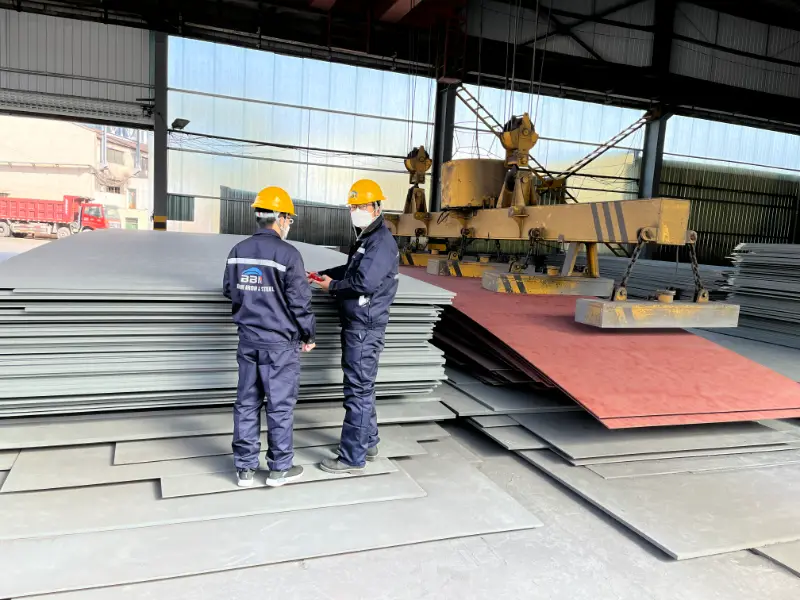
X3CrTi17 (1.4510) Ferritic Stainless Steel
X3CrTi17 (1.4510) Titanium-Stabilized Ferritic Stainless Steel – EN 10088-1 Plate & Coil
Complete data for X3CrTi17 (1.4510) ferritic stainless steel: chemical composition, mechanical and physical properties, international equivalents, and application guide.
Welding, deep drawing, bending, punching, machining (similar to other ferritic stainless steels), electropolishing
- Phone : +8618037372205
- Email : [email protected]
- WhatsApp: Contact via Whtsapp
- WeChat: +8618037372205
X3CrTi17 Ferritic Stainless Steel Introduction
X3CrTi17 (EN 1.4510) is a titanium-stabilized ferritic stainless steel defined in EN 10088-1. It contains approximately 17% chromium, and the addition of titanium prevents sensitization during welding or exposure to medium temperatures, ensuring excellent resistance to intergranular corrosion. This grade combines good general corrosion resistance with high thermal conductivity, low thermal expansion, and magnetic properties. It cannot be hardened by heat treatment and is typically supplied in the annealed condition. Compared to the unstabilized X6Cr17 (1.4016), X3CrTi17 offers superior weldability and stability against grain boundary carbide precipitation, making it an ideal choice for welded structures, domestic appliances, and automotive exhaust components.
X3CrTi17 Ferritic Stainless Steel Chemical Composition
Chemical composition according to EN 10088-1:2014 for grade X3CrTi17 (1.4510). The titanium content is controlled to ensure stabilization: Ti ≥ 4×(C+N) + 0.15% to a maximum of 0.80%. This ratio guarantees that all carbon and nitrogen are bound as titanium carbonitrides, preventing chromium carbide formation at grain boundaries.
| Element | Standard Value (wt%) | Remarks |
|---|---|---|
| Carbon (C) | ≤ 0.05 | Upper limit for ferritic corrosion resistance |
| Silicon (Si) | ≤ 1.00 | Deoxidation element |
| Manganese (Mn) | ≤ 1.00 | Austenite stabilizer, kept low |
| Phosphorus (P) | ≤ 0.040 | Residual, controlled |
| Sulfur (S) | ≤ 0.015 | Low sulfur for improved weldability and formability |
| Chromium (Cr) | 16.0 – 18.0 | Primary alloying element for corrosion resistance |
| Titanium (Ti) | ≥ 4×(C+N) + 0.15 | ≤ 0.80 | Stabilizing element; minimum follows stabilization formula as defined in EN 10088-1 |
| Nitrogen (N) | Typically ≤ 0.040 | Not explicitly specified in standard but limited for Ti calculation |
X3CrTi17 Ferritic Stainless Steel Thermal and Electrical Physical Properties
Physical properties at room temperature and typical thermal characteristics up to 400°C. X3CrTi17 is ferromagnetic and exhibits higher thermal conductivity and lower thermal expansion than austenitic stainless steels. These properties make it suitable for thermal cycling applications.
| Property | Typical Value | Unit | Test Condition |
|---|---|---|---|
| Density (ρ) | 7.7 | g/cm³ | At 20°C |
| Modulus of Elasticity (E) | 220 | GPa | At 20°C, tension |
| Shear Modulus (G) | 84 | GPa | Calculated from E and Poisson's ratio |
| Poisson's Ratio (ν) | 0.30 | — | At 20°C |
| Thermal Expansion Coefficient (α) | 10.5 × 10⁻⁶ | K⁻¹ | 20°C – 200°C |
| Thermal Expansion Coefficient (α) | 11.0 × 10⁻⁶ | K⁻¹ | 20°C – 400°C |
| Thermal Conductivity (λ) | 25 | W/(m·K) | At 20°C |
| Thermal Conductivity (λ) | 27 | W/(m·K) | At 500°C |
| Specific Heat Capacity | 460 | J/(kg·K) | At 20°C |
| Electrical Resistivity (ρ_e) | 0.60 | Ω·mm²/m | At 20°C |
| Magnetic Properties | Ferromagnetic | — | At all temperatures below Curie point |
X3CrTi17 Ferritic Stainless Steel Mechanical Properties
Minimum mechanical properties for flat products in solution annealed condition according to EN 10088-2:2014. Values depend on product thickness. For thickness ≤ 6 mm, the yield strength Rp0.2 must be ≥ 230 MPa. For thickness 6 mm < t ≤ 12 mm, Rp0.2 ≥ 200 MPa (if applicable). The material exhibits excellent drawability, moderate strength, and high ductility.
| Property | Required Value | Unit | Test Condition / Thickness Range |
|---|---|---|---|
| Yield Strength (Rp0.2) | ≥ 230 | MPa | Transverse, t ≤ 6 mm (cold rolled strip / hot rolled plate) |
| Yield Strength (Rp0.2) | ≥ 200 | MPa | Transverse, 6 mm < t ≤ 12 mm (if hot rolled) |
| Tensile Strength (Rm) | 420 – 600 | MPa | Transverse, t ≤ 6 mm |
| Elongation (A50) | ≥ 23 | % | Transverse, t ≤ 3 mm; gauge length 50 mm |
| Elongation (A) | ≥ 23 | % | Transverse, 3 mm < t ≤ 12 mm; gauge length 5.65√S₀ |
| Bend Test (Mandrel Diameter) | No cracks (180°) | — | Bend diameter = 0.5 × thickness, t ≤ 6 mm |
| Hardness (HV) | ≤ 180 | HV | Reference; not mandatory for delivery condition but typical annealed value |
| Impact Energy (KV₂, 20°C) | ≥ 40 (longitudinal) | J | Typical value for ferritic stainless steel (not required by EN 10088-2 for this grade but indicative) |
X3CrTi17 Ferritic Stainless Steel Fully Equivalent Standards and Corresponding Substitutable Grades
| Country/Region | Standard | Designation | Remarks |
|---|---|---|---|
| European Union | EN 10088-1 / EN 10088-2 | X3CrTi17 (1.4510) | Original designation |
| International (ISO) | ISO/TS 15510 | X3CrTi17 | Identical composition and technical conditions |
| USA | ASTM A240/A240M | 439 (UNS S43035) | Chemical composition closely matches; stabilized with Ti; accepted equivalent |
| Japan | JIS G4304 / G4305 | SUS430LX | Titanium stabilized 17% Cr grade; corresponds to X3CrTi17 within typical limits |
| China | GB/T 3280 | 022Cr17Ti (S11863) | Ferritic stainless steel with ultra-low carbon and Ti stabilization; nearest match |
| Russia | GOST 5632 | 08Х17Т (08Kh17T) | Approximate equivalent; check exact chemical limits |
X3CrTi17 Ferritic Stainless Steel Application Introduction
X3CrTi17 (1.4510) is widely used in environments that require moderate corrosion resistance combined with good weldability and resistance to intergranular corrosion. Its titanium stabilization eliminates the need for post-weld annealing in many cases, allowing the steel to be used in welded assemblies such as washing machine tubs and automotive exhaust parts. The ferritic structure provides high thermal conductivity and low expansion, making it suitable for heat exchangers and thermal cycling components. Key application areas and typical products are listed below:
Product Applications: Washing machine drums and outer tubs, Dishwasher internal cabinets and spray arms, Kitchen sinks and worktops, Automotive exhaust manifolds, mufflers and catalytic converter shells, Flue liners and chimney ducts, Heat exchanger plates and tubes, Catering trays and preparation tables, Elevator cabin cladding
Processed into products: Deep-drawn cylindrical shells (washing machine tubs), Welded tubular components (exhaust pipes), Stamped baffles and brackets (automotive heat shields), Roll-formed profiled sheets (roofing and cladding), Laser-welded tailored blanks (complex formed parts), Dome parts and hoppers (food processing machinery)
Application industries: Household appliance manufacturing, Automotive industry (exhaust systems, trim), Food service and catering equipment, Architectural and interior design (decorative panels, elevators), Heating, ventilation and air conditioning (HVAC), Chemical processing (mild environments)
X3CrTi17 Ferritic Stainless Steel Similar or Nearby Alternative Materials
| Country/Region | Standard | Designation | Remarks |
|---|---|---|---|
| EU | EN 10088-1 | X6Cr17 (1.4016) | Unstabilized 17% Cr ferritic; lower cost but prone to weld decay; inferior corrosion resistance after welding |
| EU | EN 10088-1 | X3CrNb17 (1.4511) | Niobium (columbium) stabilized version; similar properties, slightly different stabilization mechanism |
| EU | EN 10088-1 | X2CrMoTi17-1 (1.4520) | Contains molybdenum (~1%) for improved pitting resistance in chloride environments; comparable strength |
| USA | ASTM A240 | 430 (UNS S43000) | Unstabilized 17% Cr; cheaper alternative but restricted welding applications |
| USA | ASTM A240 | 441 (UNS S44100) | Dual stabilized (Nb+Ti) 18Cr-0.5Mo; higher temperature strength and corrosion resistance |
| Japan | JIS G4304 | SUS430J1L | Very low C, N with Nb-Ti stabilization; designed for deep drawing; close performance |
Notes:
Welding considerations: X3CrTi17 is readily weldable by common methods (TIG, MIG, resistance welding). Filler metal should be of similar composition (e.g., 1.4510 or 1.4509 type). Low heat input and interpass temperature control (max 150°C) are recommended to avoid grain growth in the heat-affected zone. Heat treatment: Soft annealing is performed at 760–820°C followed by air cooling or water quenching. Stress relief at 600–700°C may be applied but is not usually required. Surface condition: Standard delivery options include 2D (cold-rolled, annealed, descaled) and 2B (cold-rolled, annealed, descaled, skin passed). Bright annealed (BA) surface is also available for improved aesthetics.
- Share



