
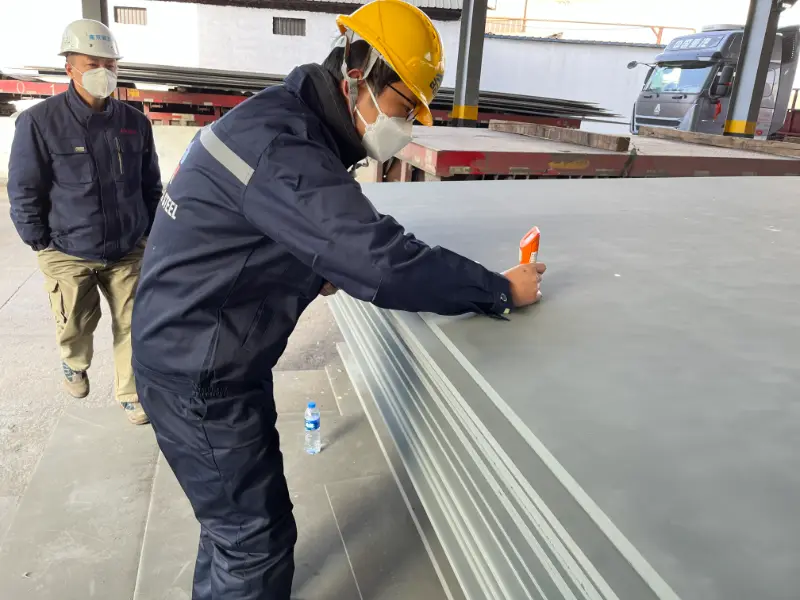
SUSXM7 Austenitic Stainless Steel
SUSXM7 Austenitic Stainless Steel: Cold Formability Champion with Added Copper
Deep dive into SUSXM7 (JIS G4304/G4305) stainless steel plate and coil: chemical composition, mechanical properties, thermal data, international equivalents, and key applications in fasteners, deep-drawn parts, and more.
Cold heading, deep drawing, bending, stamping, welding, machining, solution annealing
- Phone : +8618037372205
- Email : [email protected]
- WhatsApp: Contact via Whtsapp
- WeChat: +8618037372205
SUSXM7 Austenitic Stainless Steel Introduction
SUSXM7 is a copper-bearing austenitic stainless steel standardized under JIS G4304 (hot-rolled stainless steel plates) and JIS G4305 (cold-rolled stainless steel sheets and coils). By adding approximately 3.0–4.0% copper to the classic 18Cr-8Ni composition, SUSXM7 achieves a significant reduction in work hardening rate and cold deformation resistance compared to SUS304. This makes it the premier choice for severe cold forming operations such as deep drawing, cold heading, and swaging.
- Excellent cold formability and low work hardening rate
- Good corrosion resistance comparable to SUS304 in many environments
- Non-magnetic in the annealed condition
- Weldable with standard austenitic stainless steel procedures
- Supplied in solution-annealed condition for maximum ductility
Its unique balance of formability and corrosion resistance fills the gap where standard 304 requires costly intermediate annealing, boosting productivity in high-speed automatic machining and fastener manufacturing.
SUSXM7 Austenitic Stainless Steel Chemical Composition per JIS G4304/G4305
The following table lists the specified limits for the chemical composition of SUSXM7 stainless steel. Copper is intentionally added to depress the martensite transformation temperature during cold work, thus sustaining excellent ductility. Phosphorus and sulfur are kept at low levels to preserve corrosion resistance and hot workability.
| Element | Standard Value (max unless range given) | Remarks |
|---|---|---|
| Carbon (C) | ≤ 0.08 | Austenite stabilizer; kept low to minimize carbide precipitation |
| Silicon (Si) | ≤ 1.00 | Deoxidizer; improves oxidation resistance at elevated temperatures |
| Manganese (Mn) | ≤ 2.00 | Austenite former; controls sulfur-induced hot shortness |
| Phosphorus (P) | ≤ 0.045 | Residual element; overly high can reduce toughness |
| Sulfur (S) | ≤ 0.030 | Improves machinability but may impair weldability and corrosion resistance |
| Nickel (Ni) | 8.50 – 10.50 | Primary austenite stabilizer; maintains FCC structure and ductility |
| Chromium (Cr) | 17.00 – 19.00 | Essential for corrosion resistance via passive film formation |
| Copper (Cu) | 3.00 – 4.00 | Key addition to lower work hardening rate and boost cold formability |
SUSXM7 Austenitic Stainless Steel Thermal and Electrical Physical Properties
These values represent the average physical behaviour of SUSXM7 in the solution-annealed condition. They assist in design calculations for thermal expansion, heat transfer, and electrical resistance. Property variations between supplier heats are negligible for most engineering purposes. All data are valid for room temperature unless stated otherwise.
| Property | Typical Value | Unit | Test Condition |
|---|---|---|---|
| Density (ρ) | 7.93 | g/cm³ | 20°C |
| Modulus of Elasticity (E) | 193 | GPa | 20°C, tension |
| Shear Modulus (G) | 77 | GPa | 20°C |
| Poisson's Ratio (ν) | 0.3 | — | 20°C, elastic range |
| Mean Coefficient of Thermal Expansion (α) | 16.0 × 10⁻⁶ | 1/K | 20–100°C |
| Mean Coefficient of Thermal Expansion (α) | 17.0 × 10⁻⁶ | 1/K | 20–500°C |
| Thermal Conductivity (λ) | 16.3 | W/(m·K) | at 100°C |
| Thermal Conductivity (λ) | 21.5 | W/(m·K) | at 500°C |
| Specific Heat Capacity | 500 | J/(kg·K) | 20°C |
| Electrical Resistivity (ρₑ) | 0.73 | µΩ·m | 20°C |
SUSXM7 Austenitic Stainless Steel Mechanical Properties
Tensile properties and hardness are measured on solution-annealed material at room temperature as per JIS G4304/G4305 specifications. The low yield-to-tensile ratio and high elongation underline the exceptional ductility needed for cold forging and deep drawing processes. Hardness limits ensure suitability for severe deformation without excessive tool wear.
| Property | Standard Requirement | Unit | Test Condition / Remarks |
|---|---|---|---|
| Yield Strength (0.2% offset, ReH) | ≥ 205 | MPa | Room temperature, solution annealed |
| Tensile Strength (Rm) | ≥ 520 | MPa | Room temperature, solution annealed |
| Elongation (A) | ≥ 40 | % | Gauge length 50 mm, thickness ≤ 8 mm |
| Elongation (A) | ≥ 40 | % | Gauge length 50 mm, thickness > 8 mm to ≤ 75 mm |
| Bend Test (180°) | D = thickness (no cracking) | — | Room temperature, thickness ≤ 75 mm |
| Hardness (HBW) | ≤ 187 | HBW | Solution annealed |
| Hardness (HRB) | ≤ 90 | HRB | Solution annealed |
| Hardness (HV) | ≤ 200 | HV | Solution annealed |
SUSXM7 Austenitic Stainless Steel Complete Equivalent Standards and Replaceable Grades
| Country / Region | Standard | Grade | Remarks |
|---|---|---|---|
| Japan | JIS G4304 / G4305 | SUSXM7 | Original specification; plate/coil |
| USA | ASTM A240/A240M | UNS S30430 | Identical chemistry; commonly called 304Cu |
| Europe | EN 10088-2 | 1.4567 (X3CrNiCu18-9-4) | Melts analysis identical; some minor processing variances |
| China | GB/T 3280 | S30480 (06Cr18Ni9Cu3) | Direct equivalent; widely used in cold heading |
| International | ISO 15510 | X3CrNiCu18-9-4 | Harmonized with EN and JIS limits |
SUSXM7 Austenitic Stainless Steel Application Introduction
Thanks to its copper-enhanced low work hardening, SUSXM7 excels in high-speed cold forming operations where standard 304 would crack or require multiple annealing steps. It retains good corrosion resistance, making it suitable for a wide array of mildly corrosive environments. The steel is non-magnetic after annealing, which is often required in electronics and medical device components.
Product Applications: Cold-headed fasteners: hex bolts, carriage bolts, machine screws, wing nuts, and special cold-formed shapes, Deep-drawn articles: kitchen sinks, stainless steel pots, deep shells, and cylindrical cans, Formed wire products: springs, clips, wire forms, and spring washers, Architectural sheet metal: elevator panels, cladding, column covers, Small stamped parts: brackets, clamps, battery contacts, and EMI shielding parts
Processed into products: Automotive exhaust sensors housings requiring non-magnetic properties, Refrigeration system evaporator plates and tubing connectors, Pharmaceutical equipment stirrer blades and fastening elements, Precision electronic enclosure screws and threaded inserts, Thread rolling dies for light-duty applications, Custom drawn stainless steel wire for mesh and filtration components
Application industries: Fastener and cold heading industry (bolts, nuts, rivets, self-tapping screws), Automotive (fuel system components, hose clamps, trim, sensor housings), Food processing and kitchenware (sinks, mixing bowls, deep-drawn cookware), Chemical and petrochemical (low-pressure vessels, containers for organic acids), Architecture and construction (decorative panels, handrails, elevator interiors), Medical devices and surgical instruments (non-magnetic components)
SUSXM7 Austenitic Stainless Steel Similar or Nearby Replacement Materials
| Country / Region | Standard | Grade | Remarks |
|---|---|---|---|
| Japan | JIS G4304/G4305 | SUS304 | Standard 18-8 without Cu; higher work hardening rate, requires intermediate annealing for deep draws |
| Japan | JIS G4304/G4305 | SUS304L | Low carbon version of 304; improved weldability but similar work hardening to 304 |
| Japan | JIS G4304/G4305 | SUS303 | Selenium/sulfur added; excellent machinability but lower cold formability and significant corrosion resistance loss |
| USA | ASTM A240 | 304 (UNS S30400) | Direct parallel to SUS304; best for general use when extreme cold working is absent |
| Europe | EN 10088-2 | 1.4301 (X5CrNi18-10) | Standard 304; comparable cold work behaviour to SUS304 |
Notes:
The described data is typical for plate/coil product forms under JIS G4304 and G4305. Properties of bar, wire, or forgings may differ and are covered by JIS G4303. Welding consumables should match the copper content (e.g., ER308Cu) to maintain corrosion resistance. For applications requiring post-weld stress relief, a full solution anneal is recommended. Intergranular corrosion resistance in the as-welded condition is adequate for most service environments but may be improved by using low-carbon or stabilized fillers.
- Share



