
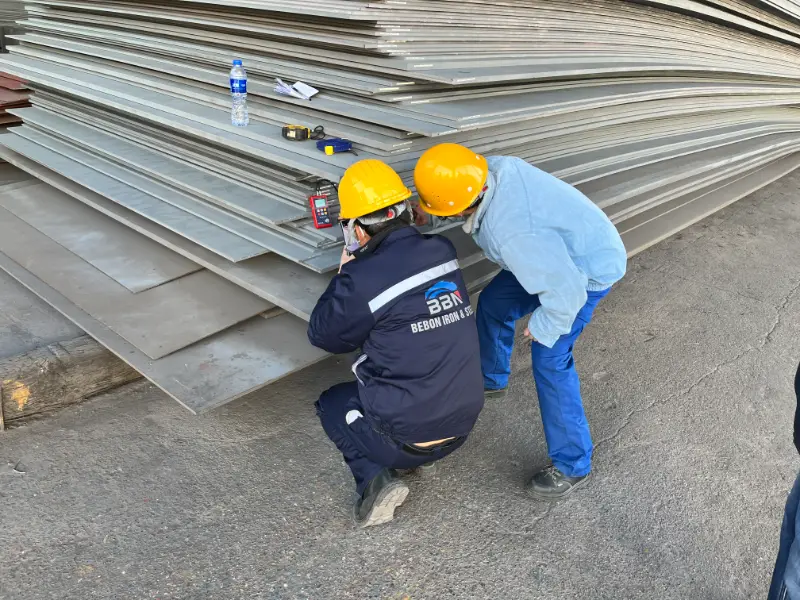
SUS316Ti Stainless Steel Plate/Coil
SUS316Ti Stainless Steel Plate/Coil: JIS G4304/G4305 Austenitic Grade
Explore SUS316Ti stainless steel under JIS G4304 and G4305 standards. Chemical composition, mechanical properties, thermal data, international equivalents, and application guidance for plate and coil products.
Hot rolling, cold rolling, solution annealing, pickling, cutting, forming, welding, machining
- Phone : +8618037372205
- Email : [email protected]
- WhatsApp: Contact via Whtsapp
- WeChat: +8618037372205
SUS316Ti Stainless Steel Plate/Coil Introduction
SUS316Ti is a titanium-stabilized austenitic stainless steel grade defined in JIS G4304 (hot-rolled) and JIS G4305 (cold-rolled) for plates, sheets, and coils. The addition of titanium significantly improves resistance to intergranular corrosion by forming stable carbides, preventing chromium depletion at grain boundaries after welding or prolonged exposure to temperatures in the sensitization range (425–815 °C). The steel exhibits excellent corrosion resistance in a wide range of environments, good high-temperature strength, and outstanding formability and weldability. Its typical applications include chemical processing equipment, heat exchangers, pharmaceutical apparatus, and components exposed to mildly corrosive media or elevated temperatures up to approximately 800°C. Delivered in solution-annealed condition, SUS316Ti offers a balanced combination of mechanical integrity and corrosion performance, making it a preferred material for demanding industrial applications.
SUS316Ti Stainless Steel Plate/Coil Chemical Composition
The chemical composition of SUS316Ti is specified in JIS G4304 and G4305. Titanium is added with a minimum content of 5 times the carbon content (Ti ≥ 5 × C) to stabilize the structure against intergranular corrosion. The composition ensures the austenitic structure and provides molybdenum for enhanced pitting and crevice corrosion resistance. All values given in percent by weight.
| Element | Standard Value | Remarks |
|---|---|---|
| Carbon (C) | ≤ 0.08 | |
| Silicon (Si) | ≤ 1.00 | |
| Manganese (Mn) | ≤ 2.00 | |
| Phosphorus (P) | ≤ 0.045 | |
| Sulfur (S) | ≤ 0.030 | |
| Nickel (Ni) | 10.00 – 14.00 | |
| Chromium (Cr) | 16.00 – 18.00 | |
| Molybdenum (Mo) | 2.00 – 3.00 | |
| Titanium (Ti) | ≥ 5 × C, and ≤ 0.70 | Stabilizing element; typical minimum is 5×C% |
SUS316Ti Stainless Steel Plate/Coil Thermal and Electrical Physical Properties
These physical properties are typical for SUS316Ti (1.4571) in solution-annealed condition and are derived from standard technical literature and equivalent grade EN 10088-1. They are not specified within JIS G4304/4305 but are essential for design calculations. Values may vary with temperature and processing history.
| Property | Typical Value | Unit | Test Condition |
|---|---|---|---|
| Density (ρ) | 8.0 | g/cm³ | at 20 °C |
| Elastic Modulus (E) | 193 | GPa | at 20 °C |
| Shear Modulus (G) | 74 | GPa | at 20 °C |
| Poisson's Ratio (ν) | 0.30 | – | at 20 °C |
| Thermal Expansion Coefficient (α) | 16.0 | 10⁻⁶/K | 20–100 °C |
| Thermal Expansion Coefficient (α) | 17.5 | 10⁻⁶/K | 20–500 °C |
| Thermal Conductivity (λ) | 15 | W/m·K | at 20 °C |
| Specific Heat Capacity (c) | 500 | J/kg·K | at 20 °C |
| Electrical Resistivity (ρ_e) | 0.74 | µΩ·m | at 20 °C |
SUS316Ti Stainless Steel Plate/Coil Mechanical Properties
Mechanical properties are for solution-annealed condition as per JIS G4304 (hot-rolled plate) and JIS G4305 (cold-rolled sheet/coil). Elongation values depend on thickness and product form. Hardness gives maximum limits. Values are minimum unless stated otherwise.
| Property | Standard Requirement | Unit | Test Condition / Thickness |
|---|---|---|---|
| Tensile Strength (Rm) | ≥ 520 | MPa | Hot-rolled plate (all thicknesses) |
| Tensile Strength (Rm) | ≥ 520 | MPa | Cold-rolled sheet/coil (all thicknesses) |
| Yield Strength (0.2% Proof, ReH) | ≥ 205 | MPa | Hot-rolled plate (all thicknesses) |
| Yield Strength (0.2% Proof, ReH) | ≥ 205 | MPa | Cold-rolled sheet/coil (all thicknesses) |
| Elongation (A) | ≥ 40 | % | Hot-rolled plate thickness ≤ 8 mm |
| Elongation (A) | ≥ 30 | % | Hot-rolled plate thickness 8 mm < t ≤ 75 mm |
| Elongation (A) | ≥ 40 | % | Cold-rolled sheet/coil thickness ≤ 5 mm |
| Elongation (A) | ≥ 30 | % | Cold-rolled sheet/coil thickness > 5 mm |
| Hardness (HBW) | ≤ 187 | HB | All products |
| Hardness (HRB) | ≤ 90 | HRB | All products |
| Hardness (HV) | ≤ 200 | HV | All products |
SUS316Ti Stainless Steel Plate/Coil Fully Equivalent Material Standards and Substitutable Grades
| Country/Region | Standard | Grade/Designation | Remarks |
|---|---|---|---|
| Europe | EN 10088-2 / EN 10088-3 | 1.4571 (X6CrNiMoTi17-12-2) | Identical chemistry and similar mechanical properties; widely used in Europe. |
| USA | ASTM A240/A240M | 316Ti (UNS S31635) | Ti content requirement (≥5×(C+N) but ≤0.70); often interchangeable. |
| China | GB/T 3280 | 06Cr18Ni12Mo2Ti (formerly 0Cr18Ni12Mo2Ti) | Equivalent based on ISO; check Ti/C ratio specification. |
| South Korea | KS D 3698 | STS316Ti | Adopts JIS system; directly equivalent to SUS316Ti. |
| International | ISO 15510 | X6CrNiMoTi17-12-2 | International designation; identical in composition. |
SUS316Ti Stainless Steel Plate/Coil Application Introduction
SUS316Ti is widely selected for its excellent corrosion resistance and stabilization against sensitization. It can be formed, welded, and machined using conventional stainless steel methods. Typical applications span chemical, petrochemical, pharmaceutical, food, and marine industries. The material is suitable for both cryogenic and elevated-temperature service up to approximately 800°C. Its ability to maintain corrosion resistance after welding makes it ideal for large fabrications that cannot be post‑weld annealed.
Product Applications: Pressure vessels and storage tanks, Shell and tube heat exchangers, plate heat exchangers, Pipes, tubes, and fittings for corrosive fluids, Flanges, valves, and pump casings, Reactor vessels and columns, Expansion joints and bellows, Kitchen equipment, sinks, and countertops, Architectural cladding and roofing panels
Processed into products: Heat exchanger tube bundles, tube sheets, Weld neck flanges, blind flanges, Nozzles, manways, and sight glasses, Agitators and mixing blades, Fasteners (bolts, nuts) for corrosive environments, Springs and wire mesh for filtration, Thin‑gauge stamped parts, deep‑drawn sinks, Precision machined valves and fittings
Application industries: Chemical and petrochemical processing, Pharmaceutical and biotechnology equipment, Pulp and paper manufacturing, Food and beverage production, Marine and offshore engineering, Architectural and construction, Power generation (heat exchangers, boiler components), Automotive exhaust systems (high‑temperature parts)
SUS316Ti Stainless Steel Plate/Coil Similar/Comparable Alternative Material Recommendations
| Country/Region | Standard | Grade | Remarks on Similarity and Differences |
|---|---|---|---|
| Japan | JIS G4304/4305 | SUS316 | Same base composition but no Ti stabilization; susceptible to intergranular corrosion after welding in corrosive environments. |
| Japan | JIS G4304/4305 | SUS316L | Lower carbon (≤0.03) to minimize sensitization; no Ti; often used instead of 316Ti for welded applications if carbon is strictly controlled. |
| Europe | EN 10088-2 | 1.4404 (X2CrNiMo17-12-2) | Low‑carbon version of 1.4571 without Ti; comparable corrosion resistance but may need post‑weld annealing in severe media. |
| Japan | JIS G4304/4305 | SUS317 | Higher Mo content (3.0–4.0%) for better pitting resistance; lacks Ti stabilization. |
| USA | ASTM A240 | 316L (UNS S31603) | Low‑carbon equivalent of 316; often substitutes 316Ti where welding is required, provided solution treatment is applied. |
Notes:
Special considerations:
- SUS316Ti should not be continuously operated at temperatures between 425 °C and 815 °C for prolonged periods if exposed to highly aggressive media, as sigma phase may form and reduce ductility.
- Post‑weld heat treatment is typically not required for full corrosion resistance; however, for optimum performance in extremely corrosive acids, solution annealing may be recommended.
- The material is magnetic in cold‑worked condition; annealed condition is non‑magnetic.
- For heavy sections (>75 mm), elongation values may be lower; consult the standard or supplier for specific data.
- Physical properties may vary depending on the exact heat treatment and product thickness; values provided are typical at 20 °C.
- Share



