
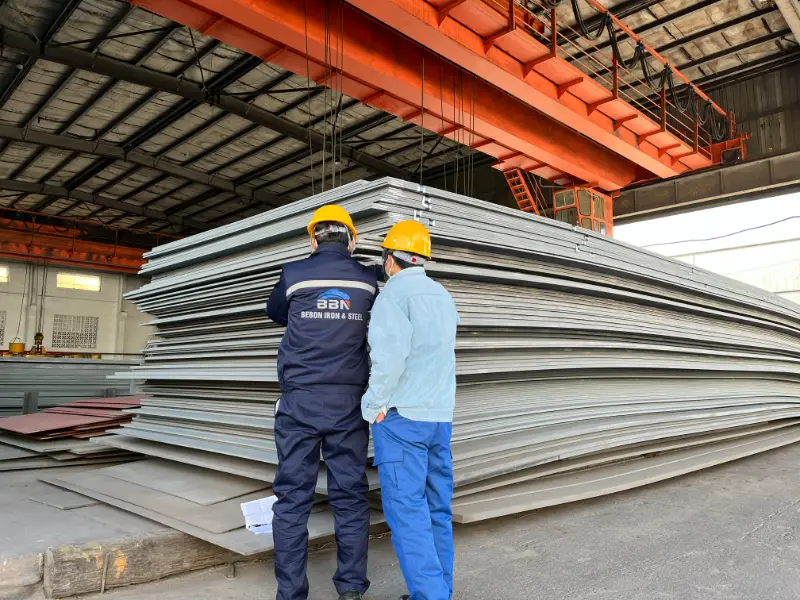
SUS304 Stainless Steel Plate/Coil
SUS304 Stainless Steel Plate/Coil: JIS G4304 & JIS G4305 Austenitic Grade
Complete material data for SUS304 stainless steel according to Japanese standards JIS G4304 and JIS G4305, including chemical composition, mechanical and physical properties, international equivalents, similar grades, and application recommendations.
Hot rolling, cold rolling, solution annealing, pickling, skin-pass rolling, bright annealing
- Phone : +8618037372205
- Email : [email protected]
- WhatsApp: Contact via Whtsapp
- WeChat: +8618037372205
SUS304 Stainless Steel Plate/Coil Introduction
SUS304 is a classic austenitic chromium-nickel stainless steel specified in JIS G4304 (hot-rolled stainless steel plates, sheets and strips) and JIS G4305 (cold-rolled stainless steel plates, sheets and strips). It features a balanced combination of corrosion resistance, formability, and weldability, making it the most widely used stainless steel globally. The material is supplied in the solution-annealed condition, which ensures a fully austenitic microstructure free of chromium carbides. Key attributes include:
- Excellent resistance to a wide range of atmospheric, chemical, and food-processing environments.
- Good ductility and deep-drawing capability, especially in cold-rolled conditions (2B, BA finishes).
- Superb weldability by all common fusion methods, with low intergranular corrosion risk in thin sections (post-weld annealing may be required for heavy sections).
- Non-magnetic in the annealed state, though slight magnetism may develop after cold work.
- Typical delivery as plates, sheets, coils, and strips with surface finishes such as No.1 (HR) or 2B/BA (CR).
Internationally, it is equivalent to AISI 304, UNS S30400, EN 1.4301, and GB 06Cr19Ni10. It meets the demands of food equipment, architectural cladding, chemical tanks, and general engineering.
SUS304 Stainless Steel Plate/Coil Chemical Composition
The chemical composition of SUS304 is defined in JIS G4304 and G4305. The alloy is essentially an 18Cr-8Ni stainless steel with controlled carbon to avoid sensitization during welding. The table below lists the standard limits for all specified elements. Values are percent by weight in the heat (ladle) analysis unless otherwise noted.
- Low carbon (≤0.08%) ensures good corrosion resistance after welding in thin sections.
- Nickel (8.00–10.50%) stabilizes the austenitic structure and contributes to ductility.
- Chromium (18.00–20.00%) provides oxidation and corrosion resistance.
- Nitrogen is generally limited to ≤0.10% to maintain formability.
| Element | Standard Value (wt%) | Remarks |
|---|---|---|
| Carbon (C) | ≤0.08 | |
| Silicon (Si) | ≤1.00 | |
| Manganese (Mn) | ≤2.00 | |
| Phosphorus (P) | ≤0.045 | |
| Sulfur (S) | ≤0.030 | |
| Nickel (Ni) | 8.00–10.50 | |
| Chromium (Cr) | 18.00–20.00 | |
| Nitrogen (N) | ≤0.10 | Optional; controlled to optimize strength |
SUS304 Stainless Steel Plate/Coil Thermal and Electrical Physical Properties
The physical properties below are typical for SUS304 in the annealed condition and are not part of the mandatory JIS G4304/G4305 specifications. They are compiled from widely accepted technical data at various temperatures. These values are essential for design calculations involving thermal expansion, heat transfer, and electrical resistance.
- Density, elastic moduli, and Poisson's ratio are given at room temperature.
- The coefficient of thermal expansion (α) is the mean value between 20°C and the indicated temperature.
- Thermal conductivity and specific heat are temperature-dependent; representative values at commonly referenced temperatures are shown.
- Electrical resistivity is for the annealed condition; cold work may slightly increase it.
| Property | Typical Value | Unit | Temperature/ Condition |
|---|---|---|---|
| Density (ρ) | 7.93 | g/cm³ | 20°C |
| Modulus of elasticity (E) | 193 | GPa | 20°C |
| Shear modulus (G) | 74 | GPa | 20°C |
| Poisson's ratio (ν) | 0.30 | – | 20°C |
| Coefficient of thermal expansion (α) | 16.0 | ×10⁻⁶/K | 20–100°C |
| Coefficient of thermal expansion (α) | 16.8 | ×10⁻⁶/K | 20–300°C |
| Coefficient of thermal expansion (α) | 17.5 | ×10⁻⁶/K | 20–500°C |
| Thermal conductivity (λ) | 16.2 | W/m·K | 100°C |
| Thermal conductivity (λ) | 21.5 | W/m·K | 500°C |
| Specific heat capacity (c) | 500 | J/kg·K | 0–100°C |
| Electrical resistivity (ρₑ) | 0.72 | μΩ·m | 20°C (annealed) |
SUS304 Stainless Steel Plate/Coil Mechanical Properties
The following mechanical properties are specified for SUS304 in the solution-annealed condition according to JIS G4304 and JIS G4305. Values are tested at room temperature using standard flat or round specimens. For hot-rolled and cold-rolled products, tensile properties are identical; hardness and bend test parameters depend on thickness.
- Yield strength is determined by the 0.2% offset method (Rp0.2).
- Elongation is measured with gauge length 50 mm for thickness ≤8 mm, and gauge length 200 mm for thickness >8 mm (in JIS G4304). For cold-rolled sheets (JIS G4305), gauge length is 50 mm for thickness ≤3 mm and may differ above 3 mm.
- Bend test (180°) applies to thickness ≤10 mm with a mandrel diameter equal to the sheet thickness (d=1t). No cracks shall appear.
- Hardness is not mandatory but is commonly guaranteed; HBW, HRB, or HV values are often provided in purchase specifications.
| Property | Standard Requirement | Unit | Test Condition |
|---|---|---|---|
| Yield strength (Rp0.2) | ≥205 | MPa | Room temperature; solution annealed |
| Tensile strength (Rm) | ≥520 | MPa | Room temperature; solution annealed |
| Elongation (A) | ≥40 | % | Thickness ≤8 mm; gauge length 50 mm |
| Elongation (A) | ≥40 | % | Thickness >8 mm to ≤75 mm; gauge length 200 mm |
| Bend test | 180°; d=1t (no cracks) | – | Thickness ≤10 mm; full-section specimen |
| Hardness (HBW) | ≤201 | HBW | Optional; solution annealed |
| Hardness (HRB) | ≤92 | HRB | Optional; solution annealed |
| Hardness (HV) | ≤210 | HV | Optional; solution annealed |
SUS304 Stainless Steel Plate/Coil Fully Equivalent Material Standards and Replaceable Grades
| Country/Region | Standard | Grade | Remarks |
|---|---|---|---|
| Japan | JIS G4304 / G4305 | SUS304 | Original specification |
| United States | ASTM A240/A240M | 304 (UNS S30400) | Identical composition and properties |
| European Union | EN 10088-2 | X5CrNi18-10 (1.4301) | Minor compositional differences (e.g., Ni 8.0–10.5%) but fully interchangeable |
| China | GB/T 3280 | 06Cr19Ni10 (old: 0Cr18Ni9) | Same alloy concept; strength and elongation slightly adjusted |
| International | ISO 15510 | X5CrNi18-10 | Compositionally equivalent |
| South Korea | KS D 3698 | STS304 | Adopts JIS SUS304 parameters |
SUS304 Stainless Steel Plate/Coil Application Introduction
SUS304 is a versatile stainless steel suitable for a wide range of environments where good corrosion resistance and hygienic surfaces are required. Its excellent formability allows deep drawing, spinning, and bending, while its weldability supports complex fabricated structures. Typical applications span from domestic items to industrial equipment.
- Industries: Food and beverage, architecture, chemical processing, medical, automotive, kitchenware, oil & gas (non-critical piping).
- Products: Sinks, cookware, countertops, chemical storage tanks, architectural cladding, automotive exhaust components, dairy equipment, brewing tanks, heat exchangers, fasteners.
- Components: The material is readily formed into shells, panels, and enclosures; it can be machined into bolts, nuts, flanges, and fittings; welded into piping and pressure vessels; and cold-worked into springs, fasteners, and precision parts.
Product Applications: Stainless steel sinks, Cookware (pots, pans), Commercial kitchen counters and shelves, Chemical storage and transport tanks, Architectural cladding and panels, Automotive mufflers and exhaust tubing, Heat exchangers and evaporators, Brewery and dairy tubing, Fasteners (screws, bolts, nuts), Springs and wire forms
Processed into products: Deep-drawn sinks and bowls, Welded pressure vessel shells, Stamped brackets and flanges, Roll-formed architectural profiles, Laser-cut blanks for machinery parts, Cold-headed bolts and screws, Machined valve bodies and pump casings, Bent tubes and pipe systems, Precision shim washers, Spring clips and constant-force springs
Application industries: Food and Beverage Processing, Architecture and Construction, Chemical and Petrochemical, Medical Devices and Hospital Equipment, Automotive (exhaust and trim), Kitchen and Catering, General Engineering
SUS304 Stainless Steel Plate/Coil Near/Similar Alternative Material Recommendations
| Country/Region | Standard | Grade | Remarks |
|---|---|---|---|
| Japan | JIS G4304/G4305 | SUS304L | Low carbon (≤0.030%) to prevent intergranular corrosion after welding; slightly lower strength |
| European Union | EN 10088-2 | X2CrNi19-11 (1.4306) | Low-carbon 304L equivalent; preferred for welded thick sections |
| United States | ASTM A240 | 304L (UNS S30403) | Low-carbon variant with improved weldability |
| Japan | JIS G4304 | SUS304J1 / SUS304J2 | Copper-added for improved deep drawability; slightly modified composition |
| Japan | JIS G4304 | SUS316 | Contains 2–3% Mo for enhanced pitting resistance in chloride environments; higher cost |
| China | GB/T 3280 | 022Cr19Ni10 (304L) | Low-carbon grade for welded structures |
Notes:
Surface finishes: SUS304 is available in various finishes: hot-rolled No.1 (rough, pickled), cold-rolled 2B (smooth, matte), BA (bright-annealed), No.4 (brushed), and HL (hairline). Magnetic behavior: Annealed SUS304 is non-magnetic, but cold forming (e.g., deep drawing, bending) can induce partial martensitic transformation, causing the material to become slightly magnetic. This does not compromise corrosion resistance but may affect applications requiring strict non-magnetic properties. Welding: All standard welding processes (TIG, MIG, SMAW, resistance) are applicable. For heavy sections (>3 mm) or aggressive environments, post-weld solution annealing is recommended to restore full corrosion resistance. SUS304L is often preferred to avoid sensitization without heat treatment. Heat treatment: Cannot be hardened by heat treatment; cold work is the only strengthening mechanism. Pickling and passivation: Removal of oxide scale after hot working and pickling restores the passive layer; passivation treatments (nitric acid-based) further improve pitting resistance.
- Share



