
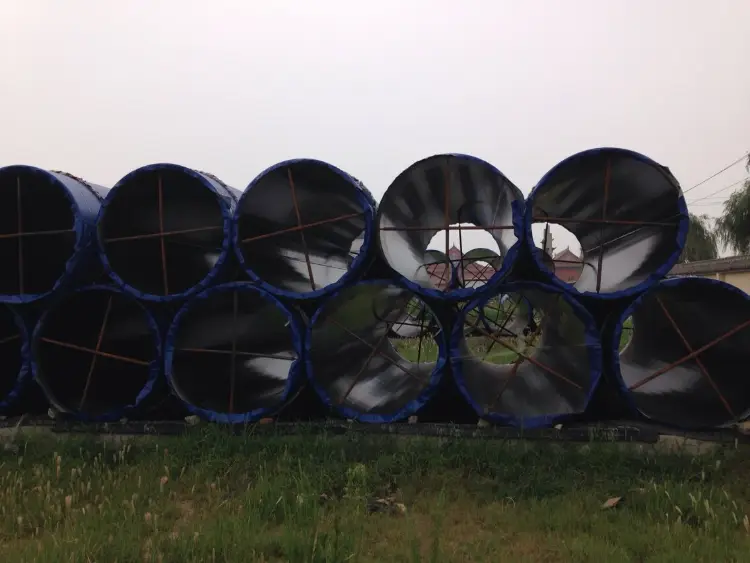
S355NLH LSAW Pipe to EN10219
S355NLH LSAW Pipe to EN10219: High-Strength Hollow Sections for Arctic and Offshore Structures
Comprehensive material data for S355NLH LSAW pipe per EN 10219-1. View chemical composition, yield & tensile strength, Charpy impact at -50°C, thermal properties, international equivalents, and application examples for bridges, offshore platforms, and wind turbines.
Cold forming, submerged arc welding (LSAW), cutting, machining, bending, galvanizing
- Phone : +8618037372205
- Email : [email protected]
- WhatsApp: Contact via Whtsapp
- WeChat: +8618037372205
S355NLH LSAW Pipe to EN10219 Introduction
EN10219 S355NLH is a thermomechanically rolled weldable fine-grain structural steel supplied as cold-formed welded structural hollow sections, typically in LSAW (Longitudinal Submerged Arc Welded) pipe form. It guarantees a minimum yield strength of 355 MPa and exceptional toughness down to -50°C (designated by 'L'). The 'N' indicates a normalized or normalized rolled delivery condition, ensuring consistent mechanical properties and excellent weldability. The grade is characterized by a low carbon equivalent and a fine-grained microstructure through microalloying with niobium, vanadium, and titanium. S355NLH offers a high strength-to-weight ratio, making it ideal for heavy-duty structural applications in low-temperature environments. It fully complies with the European standard EN 10219-1, delivering reliable performance for demanding engineering projects.
S355NLH LSAW Pipe to EN10219 Chemical Composition
The chemical composition of S355NLH according to EN 10219-1 defines maximum limits for impurity and alloying elements to ensure an optimum balance of strength, toughness, and weldability. The steel is grain-refined with aluminum, niobium, vanadium, and titanium. A low carbon equivalent (CEV) allows welding without preheating in many cases. Copper, chromium, nickel, and molybdenum are residual elements kept at low levels.
| Element | Standard Value (wt%) | Remarks |
|---|---|---|
| C (Carbon) | ≤0.18 | For t ≤ 40 mm |
| Si (Silicon) | ≤0.50 | |
| Mn (Manganese) | 0.90 – 1.65 | For t ≤ 40 mm; adjusted for heavier sections |
| P (Phosphorus) | ≤0.025 | |
| S (Sulfur) | ≤0.020 | |
| Al (Aluminum) | ≥0.020 | Total aluminum |
| Nb (Niobium) | ≤0.05 | |
| V (Vanadium) | ≤0.12 | |
| Ti (Titanium) | ≤0.05 | |
| Cr (Chromium) | ≤0.30 | |
| Ni (Nickel) | ≤0.50 | |
| Mo (Molybdenum) | ≤0.10 | |
| Cu (Copper) | ≤0.35 | |
| N (Nitrogen) | ≤0.015 | |
| CEV (Carbon Equivalent) | ≤0.45 | Typically for thickness ≤40 mm |
S355NLH LSAW Pipe to EN10219 Thermal and Electrical Physical Properties
Typical physical properties of S355NLH steel at room temperature. These values are representative for low-alloy structural steels and are suitable for thermal expansion calculations, heat transfer analysis, and electrical design. Actual values may vary slightly depending on production route and section size. Thermal conductivity and specific heat are given for the 20–100°C range.
| Property | Typical Value | Unit | Test Condition |
|---|---|---|---|
| Density (ρ) | 7850 | kg/m³ | At 20°C |
| Elastic Modulus (E) | 210 | GPa | At 20°C |
| Shear Modulus (G) | 80.8 | GPa | Calculated |
| Poisson's Ratio (ν) | 0.3 | - | Typical |
| Thermal Expansion Coefficient (α) | 12.0 | 10⁻⁶/K | 20–100°C |
| Thermal Expansion Coefficient (α) | 12.5 | 10⁻⁶/K | 20–200°C |
| Thermal Expansion Coefficient (α) | 13.0 | 10⁻⁶/K | 20–300°C |
| Thermal Conductivity (λ) | 50 | W/(m·K) | At 20°C |
| Specific Heat Capacity | 460 | J/(kg·K) | At 20°C |
| Electrical Resistivity (ρ_e) | 0.25 | Ω·mm²/m | Typical at 20°C |
S355NLH LSAW Pipe to EN10219 Mechanical Properties
Mechanical properties of S355NLH hollow sections are verified by tensile testing at room temperature and Charpy V-notch impact testing at -50°C. The yield strength depends on wall thickness, while tensile strength is guaranteed within a defined range. Elongation values ensure sufficient ductility for cold forming and structural design. The impact energy of 27 J at -50°C demonstrates reliable brittle fracture resistance. Bend tests confirm the material's cold formability.
| Property | Standard Required Value | Unit | Test Condition |
|---|---|---|---|
| Yield Strength (ReH) | 355 | MPa | Wall thickness t ≤ 16 mm |
| Yield Strength (ReH) | 345 | MPa | 16 mm < t ≤ 40 mm |
| Yield Strength (ReH) | 335 | MPa | 40 mm < t ≤ 63 mm |
| Yield Strength (ReH) | 325 | MPa | 63 mm < t ≤ 80 mm |
| Tensile Strength (Rm) | 470 – 630 | MPa | t ≤ 80 mm |
| Elongation (A), min. | 22 | % | Longitudinal; t ≤ 40 mm |
| Elongation (A), min. | 20 | % | Transverse; t ≤ 40 mm |
| Impact Energy (KV2) | ≥27 | J | At -50°C, longitudinal, average of 3 specimens |
| Bend Test | No cracking | D = 3a for t ≤ 16 mm; D = 4a for t > 16 mm |
S355NLH LSAW Pipe to EN10219 Fully Equivalent Material Standards and Substitution Grades
| Country/Region | Standard | Grade | Remarks |
|---|---|---|---|
| European Union | EN 10219-1 | S355NLH | Direct equivalent; cold-formed welded hollow sections |
| Germany | DIN EN 10219 | S355NLH | Identical adoption |
| United Kingdom | BS EN 10219 | S355NLH | Identical adoption |
| International | ISO 630-2 | S355N | Base material equivalent (not for hollow sections); comparable chemical and mechanical properties |
| USA | ASTM A500 | Grade C | Similar yield strength but different impact toughness requirements; not a low-temperature grade |
S355NLH LSAW Pipe to EN10219 Application Introduction
S355NLH LSAW pipes are engineered for demanding structural applications where high strength, superior toughness at very low temperatures, and reliable weldability are essential. The normalized microstructure ensures consistent properties across the cross-section, reducing residual stresses and improving fatigue performance. Below are typical industries, end products, and specific components made from this grade.
Product Applications: Offshore platform legs, braces, and jacket structures, Bridge main girders, arches, and trusses, High-rise building columns and transfer trusses, Wind turbine tower tubular sections and transition pieces, Mobile crane booms and lattice masts, LNG and cryogenic storage tank supports
Processed into products: Structural rack frames for subsea modules, Boom sections for heavy-duty telescopic cranes, Large-diameter piling pipes for marine foundations, Chord members in railway and highway truss bridges, Lattice towers for power transmission, Fatigue-critical nodes in offshore jacket structures
Application industries: Offshore Engineering, Bridge Construction, Heavy Structural Engineering, Wind Energy, Crane and Lifting Equipment, Shipbuilding (structural members), Pressure Vessels and Low-Temperature Storage Tanks
S355NLH LSAW Pipe to EN10219 Similar / Alternative Material Recommendations
| Country/Region | Standard | Grade | Remarks |
|---|---|---|---|
| European Union | EN 10219-1 | S355NH | Hollow section with normalized condition but impact tested at -20°C, not -50°C |
| European Union | EN 10219-1 | S355J2H | J2 guarantees impact at -20°C; lower toughness but otherwise similar strength and chemistry |
| European Union | EN 10210-1 | S355NLH | Hot-finished hollow section with identical grade designation and low-temperature toughness |
| USA | ASTM A572 | Grade 50 | 345 MPa minimum yield, not specifically a hollow section; Charpy requirements optional |
| Japan | JIS G 3466 | STKR490 | Square hollow sections, tensile strength 490 N/mm², no -50°C toughness guarantee |
Notes:
For LSAW pipes, the longitudinal weld seam must be fully inspected using ultrasonic or radiographic testing (UT/RT) as per EN 10219-2. Dimensional tolerances are governed by EN 10219-2. The steel is suitable for hot-dip galvanizing. In aggressive environments, supplementary corrosion protection is recommended. When welding, appropriate consumables matching the -50°C toughness requirement should be selected. The material can be delivered with 3.1 or 3.2 certification according to EN 10204.
- Share



