
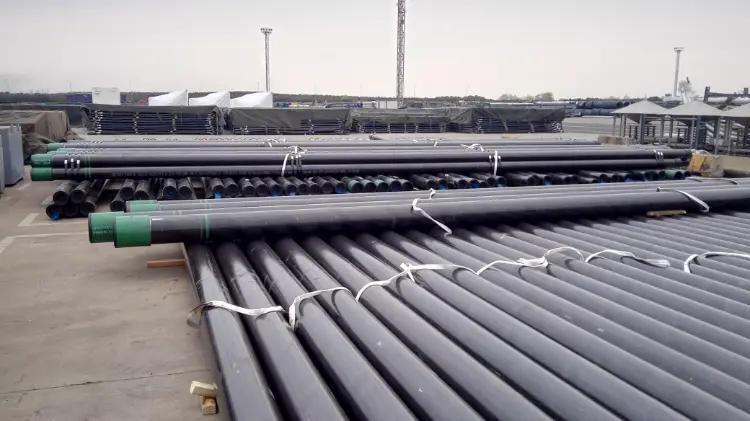
S355K2 Steel for LSAW Pipe
S355K2 Steel for LSAW Pipe: EN 10025-2 Grade Specification & Properties
Complete material data for S355K2 structural steel for LSAW pipes per EN 10025-2, including chemical composition, mechanical and physical properties, international equivalents, and application guidance.
Hot rolling, thermomechanical rolling, normalizing, welding, bending, machining
- Phone : +8618037372205
- Email : [email protected]
- WhatsApp: Contact via Whtsapp
- WeChat: +8618037372205
S355K2 Steel for LSAW Pipe Introduction
S355K2 is a hot-rolled structural steel grade specified in EN 10025-2, widely used for welded tubular products such as longitudinally submerged arc welded (LSAW) pipes. It delivers a minimum yield strength of 355 MPa and guarantees impact toughness of at least 27 J at -20°C, making it suitable for low-temperature applications. The steel is typically supplied in a normalized or thermomechanically rolled condition, offering excellent weldability, good formability, and consistent mechanical properties across a range of thicknesses. Typical applications include structural frameworks, offshore platforms, pressure vessels, and pipeline systems, where reliable strength and ductility are essential.
S355K2 Steel for LSAW Pipe Chemical Composition
The chemical composition of S355K2 is controlled to ensure consistent strength, toughness, and weldability. The limits are taken from EN 10025-2:2004 Table 2 for the K2 quality. A minimum total aluminum content guarantees fine grain structure. Niobium, vanadium, and titanium are microalloyed to refine grains and improve strength without compromising toughness. Note: additional elements may be present but are not specified unless agreed.
| Element | Standard Value (max % unless range) | Remarks |
|---|---|---|
| Carbon, C | ≤ 0.20 | |
| Silicon, Si | ≤ 0.55 | |
| Manganese, Mn | ≤ 1.60 | Higher Mn may be agreed for improved properties |
| Phosphorus, P | ≤ 0.025 | K2 quality requirement (lower than standard S355) |
| Sulfur, S | ≤ 0.025 | K2 quality requirement |
| Aluminum, Al (total) | ≥ 0.020 | Grain refining element |
| Niobium, Nb | ≤ 0.05 | |
| Vanadium, V | ≤ 0.12 | |
| Titanium, Ti | ≤ 0.05 | |
| Nb+V+Ti sum | ≤ 0.22 | Combined microalloy limit |
| Chromium, Cr | ≤ 0.30 | |
| Nickel, Ni | ≤ 0.30 | |
| Molybdenum, Mo | ≤ 0.10 | |
| Copper, Cu | ≤ 0.55 | |
| Nitrogen, N | Usually ≤ 0.012 | Not specified; may be agreed |
S355K2 Steel for LSAW Pipe Thermal and Electrical Physical Properties
The physical properties listed are typical for S355K2 structural steel at room temperature and ambient conditions. These values are derived from standard engineering references for low‑alloy carbon steels and are not part of EN 10025‑2 requirements. They are provided for design and simulation purposes.
| Property | Typical Value | Unit | Test Condition / Remarks |
|---|---|---|---|
| Density, ρ | 7850 | kg/m³ | Ambient temperature |
| Modulus of elasticity, E | 210 | GPa | Room temperature |
| Shear modulus, G | 81 | GPa | Calculated, G = E/[2(1+ν)] |
| Poisson's ratio, ν | 0.3 | – | Elastic range |
| Thermal expansion coefficient, α | 12.0 | ×10⁻⁶ K⁻¹ | 20–100°C |
| Thermal expansion coefficient, α | 12.5 | ×10⁻⁶ K⁻¹ | 20–200°C |
| Thermal conductivity, λ | 54 | W/(m·K) | 20°C |
| Thermal conductivity, λ | 50 | W/(m·K) | 200°C |
| Specific heat capacity, c | 465 | J/(kg·K) | 20–100°C |
| Electrical resistivity, ρe | 0.22 | Ω·mm²/m | Ambient temperature |
S355K2 Steel for LSAW Pipe Mechanical Properties
Mechanical properties for S355K2 are defined in EN 10025-2:2004 Tables 6 and 7. Values depend on nominal thickness. The yield strength decreases as thickness increases, while tensile strength has a lower and upper bound. Elongation is measured on a proportional gauge length Lo=5.65√So. Impact energy (KV) is guaranteed at -20°C with a minimum of 27 J (longitudinal). Bending test requirements apply when specified.
| Property | Standard Requirement (min–max or min) | Unit | Test Condition / Nominal Thickness (t) |
|---|---|---|---|
| Yield Strength, ReH | 355 | MPa | t ≤ 16 mm |
| Yield Strength, ReH | 345 | MPa | 16 < t ≤ 40 mm |
| Yield Strength, ReH | 335 | MPa | 40 < t ≤ 63 mm |
| Yield Strength, ReH | 325 | MPa | 63 < t ≤ 80 mm |
| Yield Strength, ReH | 315 | MPa | 80 < t ≤ 100 mm |
| Yield Strength, ReH | 295 | MPa | 100 < t ≤ 150 mm |
| Yield Strength, ReH | 285 | MPa | 150 < t ≤ 200 mm |
| Yield Strength, ReH | 275 | MPa | 200 < t ≤ 250 mm |
| Yield Strength, ReH | 265 | MPa | 250 < t ≤ 400 mm |
| Tensile Strength, Rm | 470–630 | MPa | t ≤ 100 mm |
| Tensile Strength, Rm | 450–600 | MPa | 100 < t ≤ 400 mm |
| Elongation after fracture, A | 22 | % | t ≤ 40 mm (Lo=5.65√So) |
| Elongation after fracture, A | 21 | % | 40 < t ≤ 63 mm |
| Elongation after fracture, A | 20 | % | 63 < t ≤ 100 mm |
| Elongation after fracture, A | 18 | % | 100 < t ≤ 150 mm |
| Elongation after fracture, A | 17 | % | 150 < t ≤ 250 mm |
| Elongation after fracture, A | 16 | % | 250 < t ≤ 400 mm |
| Impact energy, KV2 | ≥ 27 | J | -20°C; longitudinal Charpy-V |
| Bend test (mandrel diameter) | 2t (bend angle 180°) | – | t ≤ 100 mm (when required) |
S355K2 Steel for LSAW Pipe Fully Equivalent Material Standards & Substitutable Grades
| Country/Region | Standard | Grade | Remarks |
|---|---|---|---|
| European Union | EN 10025-2 | S355K2 | Direct standard; K2 = -20°C, ≥27J impact |
| International | ISO 630-2 | S355K2 | Identical technical content |
| United Kingdom | BS EN 10025-2 | S355K2 | British adoption of EN |
| Germany | DIN EN 10025-2 | S355K2 | German adoption of EN |
| France | NF EN 10025-2 | S355K2 | French adoption of EN |
| China | GB/T 1591-2018 | Q355D | 355 MPa yield, -20°C impact requirement (27J); slight chemical differences possible |
S355K2 Steel for LSAW Pipe Application Introduction
S355K2 is ideal for welded structures exposed to moderate climates and low temperatures. It is commonly specified for LSAW pipes in oil and gas pipeline systems, offshore structural members, and heavy steel frames. The combination of high strength, good weldability, and notch toughness at -20°C allows fabrication of reliable and durable components.
Product Applications: Longitudinally submerged arc welded (LSAW) pipes, Spiral welded pipes, Rectangular and circular hollow sections, Heavy plates for bridge girders, Structural profiles and beams
Processed into products: Pipe piles and foundation segments, Crane booms and lifting equipment, Offshore jacket legs and bracing, Wind tower tubular sections, Steel bridge box girders
Application industries: Oil & gas transmission (pipelines), Offshore & marine engineering (platforms, jackets), Civil engineering & construction (bridges, high-rise buildings), Pressure vessel & storage tank manufacturing, Wind turbine tower fabrication
S355K2 Steel for LSAW Pipe Similar/Alternative Materials with Comparable Performance
| Country/Region | Standard | Grade | Remarks |
|---|---|---|---|
| USA | ASTM A572/A572M | Grade 50 [with Charpy at -20°C (S5)] | Yield 345 MPa; impact test must be specified separately |
| Japan | JIS G3106 | SM490C | Yield 325 MPa (≤16 mm), tensile 490–610 MPa, impact ≥47J at -20°C; slightly lower strength |
| China (old) | GB/T 1591-2008 | Q345D | Old standard; similar properties but verification of -20°C Charpy advised |
Notes:
S355K2 may be supplied as thermomechanically rolled (M) or normalized (N). For LSAW pipe, the base material is usually delivered in strip/plate form that complies with EN 10025-2; the finished pipe properties must also satisfy applicable pipeline standards (e.g., API 5L, ISO 3183). Additional testing, such as through-thickness properties (Z-quality), can be ordered in accordance with EN 10164. When welding, low-hydrogen procedures and preheating may be needed depending on thickness and hydrogen diffusible levels.
- Share



