
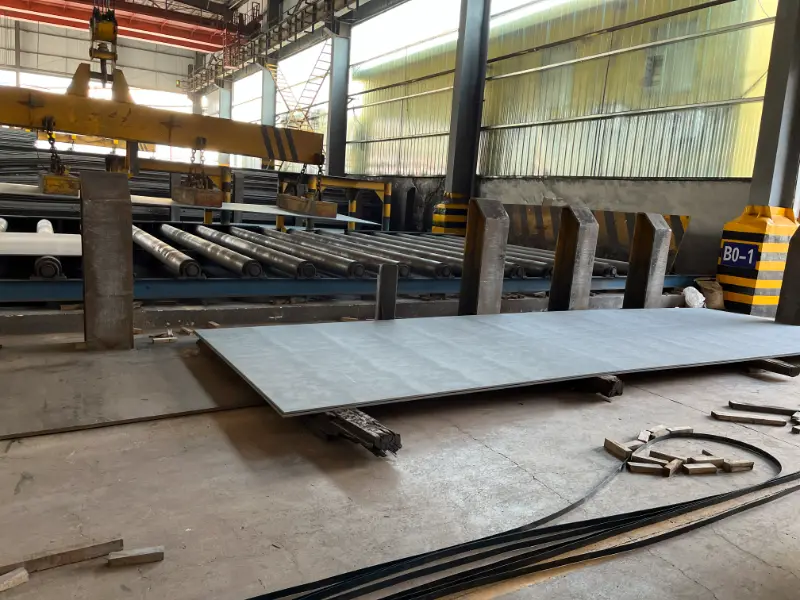
EN10025-2 S355J2 Structural Steel
EN10025-2 S355J2 Structural Steel - LSAW Pipe Material Data & Properties
Complete material data for S355J2 structural steel according to EN10025-2, including chemical composition, mechanical & thermal properties, international equivalents, and applications, particularly for LSAW pipe manufacturing.
Hot rolling, cold forming, welding (including SAW for LSAW pipes), forging, machining
- Phone : +8618037372205
- Email : [email protected]
- WhatsApp: Contact via Whtsapp
- WeChat: +8618037372205
EN10025-2 S355J2 Structural Steel Introduction
S355J2 is a high-strength low-alloy structural steel grade defined in EN 10025-2:2004. It belongs to the S355 family and offers a minimum yield strength of 355 MPa with guaranteed impact energy at -20 °C (J2). Widely utilized in welded structures, it is especially suitable for LSAW (Longitudinally Submerged Arc Welded) pipes used in offshore platforms, bridges, and heavy machinery. The steel provides excellent weldability, good cold-forming properties, and reliable toughness at low temperatures. Delivery condition is typically normalized or as-rolled, depending on thickness and customer requirements, ensuring consistent mechanical performance.
EN10025-2 S355J2 Structural Steel Chemical Composition
Maximum limits based on EN 10025-2:2004 for thickness ≤ 150 mm. The steel is fully killed and may contain grain-refining elements such as Nb, V, Ti. Carbon Equivalent Value (CEV) is controlled to ensure weldability; typical CEV ≤ 0.45 for thickness ≤ 30 mm.
| Element | Maximum Value (%) | Remarks |
|---|---|---|
| C (Carbon) | 0.22 | max. |
| Si (Silicon) | 0.55 | max. |
| Mn (Manganese) | 1.60 | max. |
| P (Phosphorus) | 0.025 | max. |
| S (Sulphur) | 0.025 | max. |
| Cu (Copper) | 0.55 | max. |
| N (Nitrogen) | 0.012 | max.; sufficiently bound by Al or other elements |
| CEV (Carbon Equiv.) | 0.45 | typical max. for t ≤ 30 mm; higher values may be agreed |
EN10025-2 S355J2 Structural Steel Thermal & Electrical Physical Properties
These values are typical for S355J2 and similar C-Mn structural steels. They are not mandatory requirements of EN 10025-2 but are useful for design and simulation. Data are measured at room temperature unless otherwise specified.
| Property | Typical Value | Unit | Condition / Remarks |
|---|---|---|---|
| Density (ρ) | 7850 | kg/m³ | at 20 °C |
| Modulus of elasticity (E) | 210 | GPa | at 20 °C |
| Shear modulus (G) | 80 | GPa | at 20 °C |
| Poisson's ratio (ν) | 0.3 | – | elastic range |
| Thermal expansion coefficient (α) | 12.0 × 10⁻⁶ | 1/K | 20 °C – 100 °C |
| Thermal expansion coefficient (α) | 13.0 × 10⁻⁶ | 1/K | 20 °C – 300 °C |
| Thermal conductivity (λ) | 50 | W/(m·K) | at 20 °C |
| Specific heat capacity (cp) | 460 | J/(kg·K) | at 20 °C |
| Electrical resistivity (ρe) | 0.20 – 0.25 | μΩ·m | at 20 °C |
EN10025-2 S355J2 Structural Steel Mechanical Properties
Specified values for flat and long products according to EN 10025-2. For LSAW pipes, properties may be verified on the pipe body in accordance with relevant product standards (e.g., EN 10219, API 5L). Impact test temperature is -20 °C for J2 quality, minimum 27 J on longitudinal specimens.
| Property | Standard Value | Unit | Test Condition |
|---|---|---|---|
| Upper yield strength (ReH) | ≥ 355 | MPa | Thickness ≤ 16 mm |
| Upper yield strength (ReH) | ≥ 345 | MPa | Thickness > 16 mm ≤ 40 mm |
| Upper yield strength (ReH) | ≥ 335 | MPa | Thickness > 40 mm ≤ 63 mm |
| Upper yield strength (ReH) | ≥ 325 | MPa | Thickness > 63 mm ≤ 80 mm |
| Upper yield strength (ReH) | ≥ 315 | MPa | Thickness > 80 mm ≤ 100 mm |
| Tensile strength (Rm) | 470 – 630 | MPa | Thickness ≤ 100 mm |
| Tensile strength (Rm) | 450 – 600 | MPa | Thickness > 100 mm ≤ 150 mm |
| Elongation after fracture (A) | ≥ 22 | % | Thickness ≤ 40 mm (L0 = 80 mm) |
| Elongation after fracture (A) | ≥ 21 | % | Thickness > 40 mm ≤ 63 mm |
| Elongation after fracture (A) | ≥ 20 | % | Thickness > 63 mm ≤ 100 mm |
| Impact energy (KV) at -20 °C | ≥ 27 | J | Longitudinal, V-notch, average of 3 tests |
EN10025-2 S355J2 Structural Steel Completely Matched Equivalent Standards and Designations
| Country / Region | Standard & Grade | Designation | Remarks |
|---|---|---|---|
| Europe | EN 10025-2:2004 | S355J2 | Identical base standard |
| Germany | DIN EN 10025-2 | S355J2 | Direct adoption of EN standard |
| United Kingdom | BS EN 10025-2 | S355J2 | Identical to EN |
| France | NF EN 10025-2 | S355J2 | Identical to EN |
| Italy | UNI EN 10025-2 | S355J2 | Identical to EN |
| Spain | UNE EN 10025-2 | S355J2 | Identical to EN |
| Poland | PN-EN 10025-2 | S355J2 | Identical to EN |
| International | ISO 630-2 | S355D | Same strength and impact class; slightly different trace element limits |
EN10025-2 S355J2 Structural Steel Application Introduction
S355J2 is a versatile structural steel grade designed for heavy-duty welded fabrications where a minimum yield strength of 355 MPa and reliable low-temperature toughness are required. It is especially popular for LSAW pipes used in marine environments, structural hollow sections, and bridge construction. The steel can be shaped by hot rolling, cold bending, and welded using all conventional methods, including submerged arc welding (SAW). Good formability allows the production of large-diameter thick-wall pipes with strict dimensional tolerances.
Product Applications: LSAW (Longitudinal Submerged Arc Welded) pipes, Spiral welded pipes (SSAW) from hot-rolled coils, Structural hollow sections (circular, square, rectangular), Heavy plates for fabrication of girders and columns, Wide flats and hot-rolled sections (I-beams, channels, angles)
Processed into products: Pipe spools and bends for subsea pipelines, Transition pieces between different pipe grades or wall thicknesses, Jacket legs, braces, and nodes for offshore platforms, Bridge girders, cross-bracing, and deck plates, Wind tower cans and flanges, Boom segments and chassis rails for mobile cranes
Application industries: Oil & Gas (onshore and offshore pipelines, risers, conductors), Civil Engineering (bridge components, high-rise buildings, stadiums), Marine & Offshore (jacket structures, decks, piles, mooring equipment), Mechanical Engineering (crane booms, heavy machinery frames), Renewable Energy (wind turbine towers, foundation structures), Water & Sewage (penstocks, large-diameter transmission pipes)
EN10025-2 S355J2 Structural Steel Close / Similar Alternative Material Recommendations
| Country / Region | Standard & Grade | Designation | Remarks |
|---|---|---|---|
| USA | ASTM A572 / A572M | Grade 50 [345 MPa] | Slightly lower yield strength; impact properties not guaranteed unless supplementary |
| USA | ASTM A572 / A572M | Grade 55 [380 MPa] | Higher strength; require verification of toughness at low temperature |
| Japan | JIS G3106 | SM490A / SM490B | Similar strength; SM490B offers impact test at 0 °C, not as low as -20 °C |
| China | GB/T 1591 | Q355D | Closest equivalent, impact at -20 °C; check composition limits |
| Russia | GOST 19281 | 17G1S | Similar C-Mn steel; impact temperature -40 °C possible but different designation system |
| International | API 5L | X52 / L360 | Pipelines; similar yield strength but different technical delivery conditions |
| Europe | EN 10025-3 | S355N/NL | Normalized fine-grain steels with guaranteed impact at -20 °C (NL) and lower CEV |
Notes:
- For LSAW pipes, additional standards apply, such as API 5L (for pipelines) or EN 10219 (for structural hollow sections). The base steel must meet EN 10025-2 as well as the finished pipe standard's requirements for dimensions, weld quality, non-destructive testing, and hydrostatic pressure.
- When specifying S355J2 for submerged arc welded pipes, attention should be paid to the carbon equivalent value (CEV) to avoid cold cracking. Preheating may be required for thicker sections or low ambient temperatures.
- The impact test temperature of -20 °C ensures ductile behavior in many temperate climates, but for Arctic conditions, S355K2 (impact at -30 °C) or S355NL (normalized, -50 °C) may be considered.
- Share



