
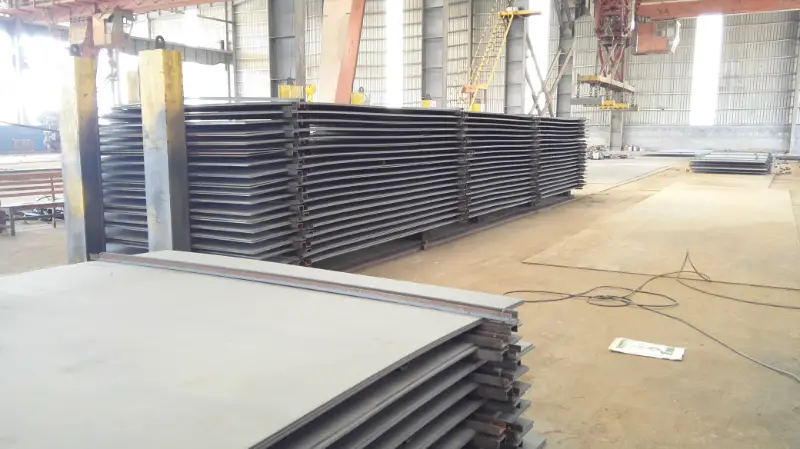
S235JR (EN 10025-2) Non-alloy Structural Steel
S235JR (EN 10025-2) Non-alloy Structural Steel - Ideal for SSAW Pipes & General Fabrication
Comprehensive data sheet for S235JR steel per EN 10025-2: chemical composition, mechanical & thermal properties, international equivalents, and application guide for spiral submerged arc welded (SSAW) pipes.
Hot rolling, normalizing rolling, welding (including SSAW), cold forming, punching, machining, and bolting
- Phone : +8618037372205
- Email : [email protected]
- WhatsApp: Contact via Whtsapp
- WeChat: +8618037372205
S235JR Non-alloy Structural Steel Introduction
S235JR is a widely used non-alloy structural steel grade defined in EN 10025-2. It offers good weldability, moderate strength, and excellent formability, making it a standard choice for general structural applications. The 'JR' designation indicates that the steel provides a minimum impact energy of 27 J at +20 °C (longitudinal Charpy V-notch). S235JR is typically delivered in the as-rolled or normalized condition and is suitable for manufacturing SSAW (spiral submerged arc welded) pipes, structural sections, plates, and a variety of welded components. Its balanced composition and reliable mechanical properties ensure cost-effective performance in construction, bridge building, machinery, and pressure vessel construction when operating at moderate temperatures.
S235JR Non-alloy Structural Steel Chemical Composition
The following table lists the typical chemical composition limits for S235JR in accordance with EN 10025-2:2019. Elements not listed may be present as residual; the values are maximum unless a range is specified. Copper is an optional element and must be declared if required. The carbon equivalent (CEV) is applicable for thickness-dependent weldability assessment.
| Chemical Element | Standard Value (wt%) | Remarks |
|---|---|---|
| C (Carbon) | ≤ 0.17 | For thickness ≤ 40 mm; ≤ 0.20 for thickness > 40 mm |
| Mn (Manganese) | ≤ 1.40 | For thickness ≤ 40 mm; ≤ 1.60 for thickness > 40 mm |
| Si (Silicon) | Not specified | Typical residual; may be added for deoxidation |
| P (Phosphorus) | ≤ 0.035 | Maximum admissible |
| S (Sulfur) | ≤ 0.035 | Maximum admissible |
| N (Nitrogen) | ≤ 0.012 | Maximum admissible; higher values permitted if sufficient nitrogen binding elements are present |
| Cu (Copper) | ≤ 0.55 | Optional element; must be agreed at the time of order if required |
| Ceq (Carbon equivalent, optional) | ≤ 0.35 / 0.38 / 0.40 | Depending on thickness; CEV = C + Mn/6 + (Cr+Mo+V)/5 + (Ni+Cu)/15 applied when specified |
S235JR Non-alloy Structural Steel Physical Properties
The following physical properties are typical for S235JR and similar low-carbon structural steels at ambient temperature unless otherwise noted. These values are not part of EN 10025-2 but are based on widely accepted engineering references. They are essential for design calculations involving heat transfer, thermal expansion, and electrical conductivity.
| Property | Standard Requirement | Unit | Test Conditions / Remarks |
|---|---|---|---|
| Density (ρ) | ≈ 7850 | kg/m³ | At 20 °C |
| Modulus of elasticity (E) | ≈ 210 | GPa | At 20 °C, tension/compression |
| Shear modulus (G) | ≈ 81 | GPa | At 20 °C |
| Poisson's ratio (ν) | ≈ 0.3 | - | At 20 °C, in elastic range |
| Coefficient of thermal expansion (α) | ≈ 12.0 × 10⁻⁶ | K⁻¹ | 20–100 °C linear expansion |
| Thermal conductivity (λ) | ≈ 51.9 | W/(m·K) | At 20 °C |
| Specific heat capacity (c) | ≈ 486 | J/(kg·K) | At 20–100 °C |
| Electrical resistivity (ρ_e) | ≈ 0.16 × 10⁻⁶ | Ω·m | At 20 °C |
S235JR Non-alloy Structural Steel Mechanical Properties
The mechanical properties of S235JR depend on the product thickness and the test direction (longitudinal samples are standard for flat and long products). The following table presents the minimum yield strength, tensile strength range, minimum elongation, impact energy (at +20 °C, longitudinal), and bend test requirements as specified in the standard. All properties refer to the as-rolled or normalized condition.
| Property | Standard Requirement | Unit | Test Conditions / Remarks |
|---|---|---|---|
| Upper yield strength (ReH) | ≥ 235 | MPa | Nominal thickness ≤ 16 mm |
| Upper yield strength (ReH) | ≥ 225 | MPa | Nominal thickness > 16 mm ≤ 40 mm |
| Upper yield strength (ReH) | ≥ 215 | MPa | Nominal thickness > 40 mm ≤ 100 mm |
| Upper yield strength (ReH) | ≥ 195 | MPa | Nominal thickness > 100 mm ≤ 150 mm |
| Upper yield strength (ReH) | ≥ 185 | MPa | Nominal thickness > 150 mm ≤ 200 mm |
| Upper yield strength (ReH) | ≥ 175 | MPa | Nominal thickness > 200 mm ≤ 250 mm |
| Tensile strength (Rm) | 360 – 510 | MPa | Nominal thickness ≤ 100 mm |
| Tensile strength (Rm) | 350 – 500 | MPa | Nominal thickness > 100 mm ≤ 150 mm |
| Tensile strength (Rm) | 340 – 490 | MPa | Nominal thickness > 150 mm ≤ 250 mm |
| Elongation after fracture (A) | ≥ 26 | % | Longitudinal, thickness ≤ 40 mm, gauge length 5.65√S₀ |
| Elongation after fracture (A) | ≥ 25 | % | Longitudinal, thickness > 40 mm ≤ 63 mm |
| Elongation after fracture (A) | ≥ 24 | % | Longitudinal, thickness > 63 mm ≤ 100 mm |
| Elongation after fracture (A) | ≥ 22 | % | Longitudinal, thickness > 100 mm ≤ 150 mm |
| Elongation after fracture (A) | ≥ 21 | % | Longitudinal, thickness > 150 mm ≤ 250 mm |
| Charpy-V impact energy (KV) | ≥ 27 | J | At +20 °C, longitudinal test specimen, standard size (10×10 mm) |
| Bend test (bend angle 180°) | Mandrel diameter = 1t | - | Thickness ≤ 16 mm; t = specimen thickness |
| Bend test (bend angle 180°) | Mandrel diameter = 2t | - | Thickness > 16 mm ≤ 100 mm |
| Bend test (bend angle 180°) | Mandrel diameter = 3t | - | Thickness > 100 mm ≤ 150 mm |
| Bend test (bend angle 180°) | Mandrel diameter = 4t | - | Thickness > 150 mm ≤ 250 mm |
S235JR Non-alloy Structural Steel Completely Equivalent Material Standards and Replacement Recommendations
| Country/Region | Standard | Grade | Remarks |
|---|---|---|---|
| USA | ASTM A36/A36M | A36 | Very close chemical and mechanical equivalent; widely considered interchangeable for general structural applications. |
| Japan | JIS G3101 | SS400 | Similar strength and weldability; suitable replacement with minor adjustments to some thickness tolerances. |
| China | GB/T 700 | Q235B | Equivalent non-alloy structural steel with comparable tensile properties and impact energy at +20 °C. |
| International | ISO 630-2 | S235B | Identical chemical and mechanical specification; direct replacement. |
| Russia | GOST 380 | St3sp | Similar grade used in Eastern European markets; confirm phosphorus and sulfur limits for exact match. |
S235JR Non-alloy Structural Steel Application Introduction
S235JR is a versatile structural steel that excels in applications where moderate strength, good weldability, and cost-efficiency are paramount. Its use in SSAW pipes is highly common for fluid transportation and piling. The following guide highlights typical industries, products, and specific components fabricated from this grade.
Product Applications: Spiral submerged arc welded (SSAW) pipes, Hot-rolled plates and coils for welded pipes, Structural sections (I-beams, H-beams, channels, angles), Welded built-up beams and columns, Structural hollow sections (SHS, RHS, CHS), Pressure vessels operating at moderate temperatures, Storage tanks and silos, Bridge components and steel frameworks
Processed into products: Pipe barrel and joint ends of SSAW pipes, Steel beams and girders for building frameworks, Flanges and base plates for structural connections, Stiffeners, brackets, and gusset plates, Rolled rings and flanges for pressure vessels, Machine frames, cutter heads, and chassis parts, Pile casings for foundation engineering, Offshore platform walkways and handrails
Application industries: Construction and civil engineering (buildings, bridges, halls), Oil & gas (pipeline systems, casing, SSAW pipes), Water management (water transmission pipes, penstocks), Shipbuilding and offshore structures (non-critical sections, platforms), Machinery and industrial equipment (frames, supports, housings), Transportation (railway wagons, truck chassis, guardrails), Energy (transmission towers, wind tower internals), Storage tank manufacturing
S235JR Non-alloy Structural Steel Closely Matching Substitute Materials and Analysis
| Country/Region | Standard | Grade | Remarks / Analysis |
|---|---|---|---|
| EU | EN 10025-2 | S235J0 | S235JR with improved impact properties (27 J at 0 °C); slightly higher toughness for slightly lower service temperature. |
| EU | EN 10025-2 | S235J2 | S235JR with further improved impact properties (27 J at -20 °C); used when better low-temperature toughness is required. |
| EU | EN 10025-2 | S275JR | Next strength level non-alloy structural steel (min. yield 275 MPa); possible upgrade where higher strength is needed, though weldability slightly less favorable. |
| EU | EN 10025-2 | S355JR | Higher strength steel (min. yield 355 MPa); may be substituted with design adjustments for weight reduction. |
| USA | ASTM A283/A283M | Grade C | Moderate strength structural carbon steel with comparable composition; slightly lower tensile requirements but still suitable for many non-critical structures. |
Notes:
- S235JR is not intended for heat treatment (quenching and tempering); its strength is achieved through controlled rolling or normalizing rolling.
- For thicknesses ≤ 30 mm, the steel is fully killed and has fine-grain practice implied for JR quality.
- For welded SSAW pipe production, the strip ends are joined by spiral welding; careful control of heat input is recommended to avoid grain coarsening in the HAZ.
- When used in environments with risk of corrosion, adequate surface protection (painting, galvanizing, or coating) is required.
- CEV values higher than stated limits may require preheating before welding; consult the relevant welding standard (e.g., EN 1011-2).
- Delivery conditions: the standard delivery is hot-rolled; option +AR (as-rolled) or +N (normalized) must be stated at the time of order.
- Share



