
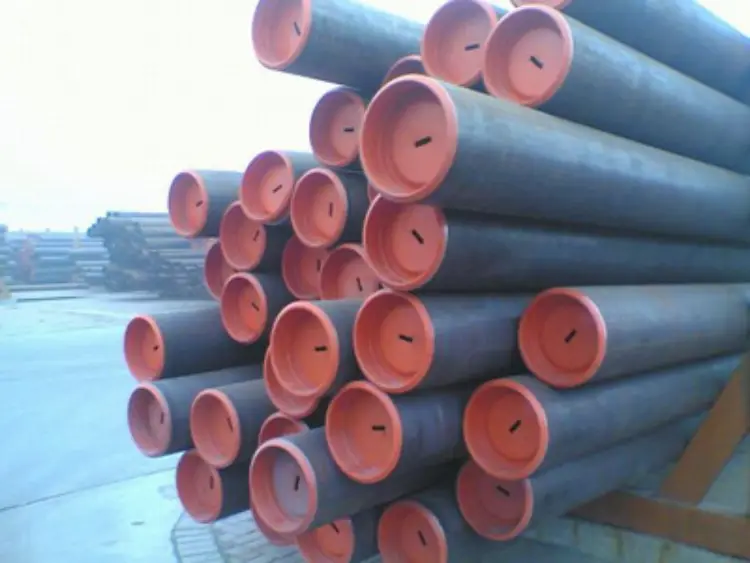
S420J0 Steel for ERW Pipe
S420J0 ERW Pipe under EN 10025-2: Hot-rolled structural steel for welded tubes
Comprehensive material data for S420J0 steel used in electric resistance welded (ERW) pipes according to European standard EN 10025-2, including chemical composition, mechanical properties, and physical characteristics.
Electric resistance welding (ERW), cold forming, hot forming, bending, machining, hot-dip galvanizing
- Phone : +8618037372205
- Email : [email protected]
- WhatsApp: Contact via Whtsapp
- WeChat: +8618037372205
S420J0 Steel for ERW Pipe Introduction
S420J0 is a hot-rolled, weldable fine-grain structural steel specified in EN 10025-2. With a minimum yield strength of 420 MPa and guaranteed impact energy of 27 J at 0 °C, it offers a balanced combination of high strength and good toughness. This grade is typically supplied in normalized or as-rolled condition and is widely used to produce ERW (Electric Resistance Welded) pipes for structural applications. Key features:
- Minimum yield strength 420 MPa (thickness ≤ 16 mm)
- Excellent weldability due to low carbon equivalent
- Notch toughness tested at 0 °C (27 J minimum)
- Fine grain structure achieved through Al, Nb, V or Ti microalloying
S420J0 Steel for ERW Pipe Chemical Composition
Heat analysis according to EN 10025-2:2004 for grade S420J0. Microalloying elements (Nb, V, Ti) may be added individually or in combination for grain refinement. Aluminium content of at least 0.020% is required if fine grain practice is used. The steel is fully killed and has a controlled carbon equivalent to ensure good weldability.
| Element | Standard Value | Remarks |
|---|---|---|
| C | ≤ 0.20 | If CEV exceeds 0.45, additional measures may apply |
| Mn | ≤ 1.70 | Higher Mn improves strength and hardenability |
| Si | ≤ 0.50 | Deoxidizer; promotes strength |
| P | ≤ 0.030 | Phosphorus restricted for toughness |
| S | ≤ 0.025 | Sulfur restricted for formability and weldability |
| N | ≤ 0.015 | Nitrogen controlled to avoid strain aging |
| Al (total) | ≥ 0.020 | Required for fine grain practice |
| Nb | ≤ 0.05 | Microalloy, grain refiner (optional) |
| V | ≤ 0.12 | Microalloy, precipitation strengthening (optional) |
| Ti | ≤ 0.05 | Microalloy, grain refiner (optional) |
| Ni | ≤ 0.80 | Residual; included in CEV if > 0.3% |
| Cr | ≤ 0.30 | Residual; included in CEV if > 0.3% |
| Mo | ≤ 0.10 | Residual; included in CEV if > 0.1% |
| Cu | ≤ 0.55 | Residual; included in CEV if > 0.4% |
S420J0 Steel for ERW Pipe Thermal and Electrical Physical Properties
Typical physical properties for structural carbon-manganese steel at room temperature. These values are not specified in EN 10025-2 but are representative for the S420J0 grade. Density is assumed as standard for steel. Elastic moduli and thermal expansion follow common values for low-alloy steels. Actual properties may vary with heat treatment and specific chemistry.
| Property | Typical Value | Unit | Test Condition / Remarks |
|---|---|---|---|
| Density (ρ) | 7.85 | kg/dm³ | Room temperature |
| Modulus of elasticity (E) | 210 | GPa | Tension, room temperature |
| Shear modulus (G) | 81 | GPa | Calculated from E and Poisson's ratio |
| Poisson's ratio (ν) | 0.3 | — | Elastic range |
| Thermal expansion coefficient (α) | 11.5 × 10⁻⁶ | /K | 20 – 100 °C |
| Thermal expansion coefficient (α) | 12.5 × 10⁻⁶ | /K | 20 – 200 °C |
| Thermal expansion coefficient (α) | 13.5 × 10⁻⁶ | /K | 20 – 400 °C |
| Thermal conductivity (λ) | 45 | W/(m·K) | At 20 °C |
| Specific heat capacity (cp) | 460 | J/(kg·K) | At 20 °C |
| Electrical resistivity (ρ_e) | 0.23 × 10⁻⁶ | Ω·m | At 20 °C |
S420J0 Steel for ERW Pipe Mechanical Properties
Tensile and impact properties for S420J0 as per EN 10025-2. Values apply to flat products (plates/coils) in the as-rolled or normalized condition. For ERW pipe produced from this steel, the pipe standard (e.g. EN 10219-1 for cold-formed hollow sections) may specify slightly different requirements that take into account the forming and welding process. Yield and tensile strength are thickness dependent. Impact energy is tested on longitudinal Charpy V-notch specimens at 0 °C.
| Property | Standard Requirement | Unit | Test Condition |
|---|---|---|---|
| Yield strength (ReH) | ≥ 420 | MPa | t ≤ 16 mm |
| Yield strength (ReH) | ≥ 400 | MPa | 16 < t ≤ 40 mm |
| Yield strength (ReH) | ≥ 390 | MPa | 40 < t ≤ 63 mm |
| Yield strength (ReH) | ≥ 370 | MPa | 63 < t ≤ 80 mm |
| Tensile strength (Rm) | 520 – 680 | MPa | t ≤ 40 mm |
| Tensile strength (Rm) | 500 – 660 | MPa | 40 < t ≤ 80 mm |
| Elongation after fracture (A) | ≥ 19 | % | l₀ = 5.65√S₀, longitudinal, t ≤ 40 mm |
| Elongation after fracture (A) | ≥ 17 | % | l₀ = 5.65√S₀, longitudinal, 40 < t ≤ 63 mm |
| Elongation after fracture (A) | ≥ 15 | % | l₀ = 5.65√S₀, longitudinal, 63 < t ≤ 100 mm |
| Charpy impact energy (KV) | ≥ 27 | J | 0 °C, longitudinal, standard specimen |
| Bend test (mandrel diameter) | 2 t < (≤40 mm) 3 t (40–80 mm) | 180° bend, specimen width ≥ 50 mm |
S420J0 Steel for ERW Pipe Completely Equivalent Material Standards and Substitute Grades
| Country/Region | Standard | Grade | Remarks |
|---|---|---|---|
| Europe | EN 10025-2 | S420J0 | Identical – base standard |
| International | ISO 630-2 | S420J0 | Equivalent fine-grain structural steel |
| Germany | DIN EN 10025-2 | S420J0 | Identical to EN |
| United Kingdom | BS EN 10025-2 | S420J0 | Identical to EN |
| France | NF EN 10025-2 | S420J0 | Identical to EN |
| Italy | UNI EN 10025-2 | S420J0 | Identical to EN |
| Spain | UNE EN 10025-2 | S420J0 | Identical to EN |
| Russia | GOST 19281-2014 | S420 | Similar strength level, but verification of chemical and impact requirements needed |
| China | GB/T 1591-2018 | Q420D | Comparable yield, 0°C impact; need check full equivalence |
S420J0 Steel for ERW Pipe Application Introduction
S420J0 ERW pipe combines high strength with good formability and weldability, making it suitable for heavy-duty structural applications where weight reduction is desired. Its fine-grain structure ensures reliable impact behavior at 0 °C. The material can be cold-bent to tight radii and galvanized without risk of liquid metal embrittlement. Typical applications include:
- Structural hollow sections: columns, beams, trusses in steel buildings
- Infrastructure: bridge members, sign gantries, lighting poles
- Offshore: secondary structural components, handrails, grating supports
- Machinery: crane booms, excavator arms, agricultural equipment frames
- Energy: transmission line towers, wind turbine towers, solar tracker structures
Product Applications: Structural ERW tubes (round, square, rectangular), Cold-formed hollow sections for steel framing, Scaffolding and falsework systems, Telecom and lighting columns, Conveyor rollers and tubular components, Greenhouse frames and storage racking
Processed into products: Welded box columns, Truss chord members, Boom and jib sections for mobile cranes, Hydraulic cylinder body tubes, Piling casings, Tubular bridge railing, Solar panel torque tubes, Wind turbine internal platforms and ladders
Application industries: Construction and civil engineering, Offshore and marine engineering, Heavy machinery manufacturing, Energy and power transmission, Infrastructure and bridge building, Agricultural and forestry equipment
S420J0 Steel for ERW Pipe Similar / Near-Equivalent Substitute Materials
| Country/Region | Standard | Grade | Remarks |
|---|---|---|---|
| Europe | EN 10025-2 | S420J2 | Higher impact energy (27 J at -20 °C), otherwise identical chemistry and strength |
| Europe | EN 10025-3 | S420N | Normalized rolled, improved toughness, similar strength |
| Europe | EN 10025-4 | S420M | Thermomechanically rolled, higher toughness and reduced CEV for better weldability |
| USA | ASTM A572 / A572M | Grade 60 (415 MPa) | Minimum yield 415 MPa, similar chemistry, but impact test requires supplementary requirement |
| USA | ASTM A1011 / A1011M | HSLAS Grade 60 | High-strength low-alloy hot-rolled sheet, yield 415 MPa; not identical but often acceptable for ERW tubing |
| Japan | JIS G 3106 | SM490B | Yield 325-365 MPa, lower strength but similar weldability; S420J0 is stronger |
| China | GB/T 1591-2018 | Q420D | Minimum yield 420 MPa, impact at -20 °C (more stringent), but same strength class, may substitute with care |
Notes:
ERW pipe considerations: The actual ERW pipe made from S420J0 is typically produced according to EN 10219-1 (cold-formed welded structural hollow sections) with the grade designation S420J0H. In that standard, the yield strength requirement for the final product is slightly modified (e.g., ≥ 420 MPa for t ≤ 16 mm) and the weld seam must meet specific toughness requirements. Weldability: The carbon equivalent (CEV) is generally ≤ 0.45, ensuring good weldability without preheat for typical thicknesses. Corrosion resistance: As a carbon-manganese steel, S420J0 has no inherent atmospheric corrosion resistance; protective coatings (paint, hot-dip galvanizing) are required for outdoor exposure. Further processing: The material is suitable for cold expansion, flattening tests and can be supplied with a certificate 3.1 per EN 10204.
- Share



