
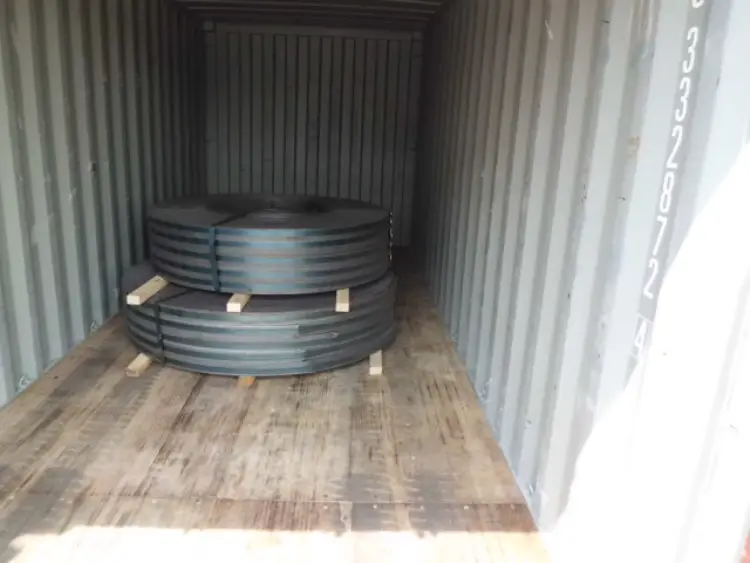
S235J2W Weathering Structural Steel Coil
S235J2W Weathering Structural Steel Coil - EN 10155-1993 Grade with Superior Atmospheric Corrosion Resistance
Detailed material datasheet for S235J2W mild high-strength weathering steel in coil form under EN 10155-1993, covering chemical composition, mechanical properties, thermal and electrical physical properties, international equivalents, and application guidance.
Hot rolling, cold forming, welding, oxy-fuel cutting, plasma cutting, drilling, machining (with appropriate tools)
- Phone : +8618037372205
- Email : [email protected]
- WhatsApp: Contact via Whtsapp
- WeChat: +8618037372205
S235J2W Weathering Structural Steel Coil Introduction
S235J2W is a weather-resistant structural steel specified in EN 10155-1993, designed for improved atmospheric corrosion resistance through small additions of alloying elements such as copper, chromium, and nickel. The grade S235J2W indicates a minimum yield strength of 235 MPa for thicknesses up to 16 mm, with guaranteed Charpy impact energy of 27 J at –20 °C (longitudinal J2 quality). Under exposure to outdoor environments, the steel develops a protective patina that slows further corrosion, often eliminating the need for painting.
Typical chemical composition includes 0.40–0.80% Cr, 0.25–0.55% Cu, ≤0.65% Ni, with controlled maximum carbon, phosphorus and sulfur contents to ensure good weldability and toughness. This material is supplied in a hot-rolled coil or cut-to-length plate condition and is used extensively in bridges, railway vehicles, containers, and architectural structures where maintenance-free durability is valued.
- Atmospheric corrosion resistance – self-protecting rust layer.
- Good weldability – low carbon equivalent and suitable for all common welding methods.
- Cold forming capability – minimum bend radii as per standard.
- Notch toughness at low temperature – J2 quality for –20 °C service.
S235J2W Weathering Structural Steel Coil Chemical Composition as per EN 10155-1993
The chemical composition of S235J2W is designed to form a dense, adherent oxide layer (patina) that impedes further corrosion. The elements chromium, copper, and nickel are key to the weathering performance. Phosphorus is kept at a moderate level to enhance atmospheric resistance, while sulfur is strictly limited for toughness. The steel is fully killed with aluminium (Al total ≥ 0.015%) to ensure fine grain structure and good notch toughness. All values are weight percent (%).
| Element | Value (%) | Remarks |
|---|---|---|
| Carbon (C) | ≤ 0.13 | Ladle analysis |
| Silicon (Si) | ≤ 0.40 | Deoxidant, improves strength |
| Manganese (Mn) | 0.20 – 0.60 | Strength and toughness balance |
| Phosphorus (P) | ≤ 0.040 | Controlled for atmospheric corrosion and welding |
| Sulfur (S) | ≤ 0.020 | Minimised for cold toughness |
| Chromium (Cr) | 0.40 – 0.80 | Essential for protective patina |
| Copper (Cu) | 0.25 – 0.55 | Major contributor to weathering resistance |
| Nickel (Ni) | ≤ 0.65 | Enhances corrosion resistance and toughness |
| Nitrogen (N) | ≤ 0.009 | Applicable to aluminium-killed steels |
| Aluminium (Altotal) | ≥ 0.015 | Required for fine grain (killed steel) |
S235J2W Weathering Structural Steel Coil Thermal and Electrical Physical Properties
Physical properties are not explicitly stated in EN 10155-1993. The values below are the conventional reference data for structural steels with similar chemistry, as recommended in EN 1993-1-1 (Eurocode 3) and widely accepted material handbooks. They are suitable for preliminary design calculations. Density, elastic moduli, thermal expansion, and thermal conductivity are essential for structural analysis. The electrical resistivity is taken from standards for carbon and low-alloy steel.
| Property | Typical Value | Unit | Condition / Remarks |
|---|---|---|---|
| Density (ρ) | 7 850 | kg/m³ | At 20 °C |
| Modulus of elasticity (E) | 210 000 | MPa | Longitudinal, at 20 °C |
| Shear modulus (G) | ≈ 81 000 | MPa | Calculated from E and Poisson's ratio |
| Poisson's ratio (ν) | 0.3 | – | For elastic range |
| Coefficient of thermal expansion (α) | 12 × 10⁻⁶ | K⁻¹ | Mean value for the range 20–100 °C |
| Thermal conductivity (λ) | ≈ 50 | W/(m·K) | At 20 °C, typical for low-alloy steel |
| Specific heat capacity (cp) | ≈ 460 | J/(kg·K) | At 20 °C |
| Electrical resistivity (ρe) | ≈ 0.21 × 10⁻⁶ | Ω·m | At 20 °C, typical for carbon–manganese steel |
S235J2W Weathering Structural Steel Coil Mechanical Properties
The mechanical properties are guaranteed for the specified delivery condition. Yield strength and tensile strength depend on the product thickness. Elongation is measured on gauge length A5 for thicknesses above 3 mm and A80 for thin products. Charpy impact energy is tested longitudinally at –20 °C for the J2 quality. Values apply to flat products in the hot-rolled as-rolled or normalised condition.
| Property | Specified Value | Unit | Test Condition / Remarks |
|---|---|---|---|
| Yield Strength (ReH), t ≤ 16 mm | ≥ 235 | MPa | Transverse direction; t = nominal thickness |
| Yield Strength (ReH), 16 < t ≤ 40 mm | ≥ 225 | MPa | Transverse direction |
| Yield Strength (ReH), 40 < t ≤ 63 mm | ≥ 215 | MPa | Transverse direction |
| Yield Strength (ReH), 63 < t ≤ 80 mm | ≥ 205 | MPa | Transverse direction |
| Yield Strength (ReH), 80 < t ≤ 100 mm | ≥ 195 | MPa | Transverse direction |
| Tensile Strength (Rm), t ≤ 100 mm | 360–510 | MPa | All thicknesses |
| Elongation after fracture (A80), 0.5 ≤ t ≤ 1.5 mm | ≥ 16 | % | Longitudinal, gauge length 80 mm |
| Elongation (A80), 1.5 < t ≤ 2.0 mm | ≥ 17 | % | Longitudinal, gauge length 80 mm |
| Elongation (A80), 2.0 < t ≤ 2.5 mm | ≥ 18 | % | Longitudinal, gauge length 80 mm |
| Elongation (A80), 2.5 < t ≤ 3.0 mm | ≥ 19 | % | Longitudinal, gauge length 80 mm |
| Elongation (A5), t > 3.0 mm | ≥ 26 | % | Longitudinal, gauge length 5.65√S₀ |
| Charpy Impact Energy (KV2), J2 quality | ≥ 27 | J | Longitudinal, at –20 °C, average of three specimens |
| Cold Bend Radius, t ≤ 16 mm | 2 t | – | 180° bend, no cracking; t = thickness |
S235J2W Weathering Structural Steel Coil Identical or Fully Equivalent Material Standards and Grades
| Country/Region | Standard | Grade | Remarks |
|---|---|---|---|
| Europe | EN 10025-5:2004 | S235J2W | Direct successor to EN 10155-1993; identical product concept |
| Germany | DIN EN 10155 (withdrawn) | S235J2W | Original German adoption of the European standard |
| China | GB/T 4171-2008 | Q235NH | Close Chinese equivalent for weathering structural steel (yield 235 MPa) |
| Japan | JIS G 3114:2008 | SMA400AW | Hot-rolled atmospheric corrosion resisting steels for welded structure; yield 235 MPa, impact test option |
| USA | ASTM A588/A588M-15 | Grade A | High-strength low-alloy structural steel with atmospheric corrosion resistance, yield 345 MPa (higher) but similar weathering concept; not identical but often interchanged with S235J2W in some applications |
S235J2W Weathering Structural Steel Coil Application Introduction
S235J2W is optimised for structures exposed to outdoor atmosphere where its superior corrosion resistance can be exploited, typically in unpainted condition. The self-protecting rust layer (patina) develops over 1–3 years of cyclic wet/dry exposure and then stabilises, reducing long-term corrosion to a very low rate. It is important to design details that avoid water traps and ensure good drainage. The steel is readily weldable, formable, and machinable, making it suitable for a wide range of construction and engineering components.
Product Applications: Steel bridge girders, bridge deck panels, Railway rolling stock (side panels, underframes), ISO shipping containers and container houses, Architectural weathering-steel cladding and facades, Transmission line towers and poles, Road side barriers and noise barrier panels, Agricultural trailers and chassis, Offshore walkways and structural members (where unprotected corrosion is acceptable)
Processed into products: Welded I-beams, box sections, and fabricated bridge parts, Pressed, formed, and folded sheet metal enclosures, Laser-cut architectural brackets, connectors, and stiffeners, Drilled and bolted joint plates, Turned and milled custom fasteners (with proper tooling), Corrugated roofing and siding for agricultural buildings, Container corner castings and hinge parts
Application industries: Civil engineering and infrastructure (bridges, viaducts), Architectural metalwork (facades, canopies, sculptures), Railway industry (freight and passenger railcar bodies), Container shipping (corrosion-resistant shipping containers), Electric power transmission (tower structures), Agricultural equipment (exposed machinery parts), Mining and mineral processing (conveyors, chutes)
S235J2W Weathering Structural Steel Coil Similar/Alternative Weathering Steel Grades with Comparable Characteristics
| Country/Region | Standard | Grade | Description of Similarity |
|---|---|---|---|
| Europe | EN 10155-1993 | S355J2WP | Higher strength grade (min 355 MPa) with enhanced phosphorus content for superior atmospheric resistance; same J2 impact at –20 °C |
| Europe | EN 10155-1993 | S235J0W | Same yield strength but impact tested at 0 °C instead of –20 °C; slightly lower cost for non-cold temperature applications |
| USA | ASTM A709-50W | Grade 50W (A588) | Structural weathering steel with 345 MPa yield strength, used in bridge construction; can be substituted for S235J2W when higher strength is acceptable |
| China | GB/T 4171 | Q345GNH | Low-alloy weathering steel with protective patina and 345 MPa yield; similar compositions but with added rare earth elements in some cases |
Notes:
- Welding precautions: Although weathering steel is weldable, the presence of copper and chromium may require slightly higher preheat and interpass temperatures than plain carbon steel. Use of low-hydrogen welding consumables is recommended to avoid hydrogen-induced cracking.
- Patina formation: For the protective patina to develop uniformly, surfaces should be free of oil, dirt, and loose mill scale. Usually a natural outdoor exposure is sufficient; accelerated wet/dry cycles can speed up the process.
- Limited application in marine atmospheres: The steel's atmospheric corrosion resistance is less effective in very high chloride environments (e.g., splash zones). In such cases, painting or a higher-alloy weathering grade may be required.
- Availability: S235J2W coils are typically stocked in thicknesses from 1.5 mm up to 16 mm and widths up to 2000 mm. Larger gauge plates can be sourced from mills to order.
- Share



