
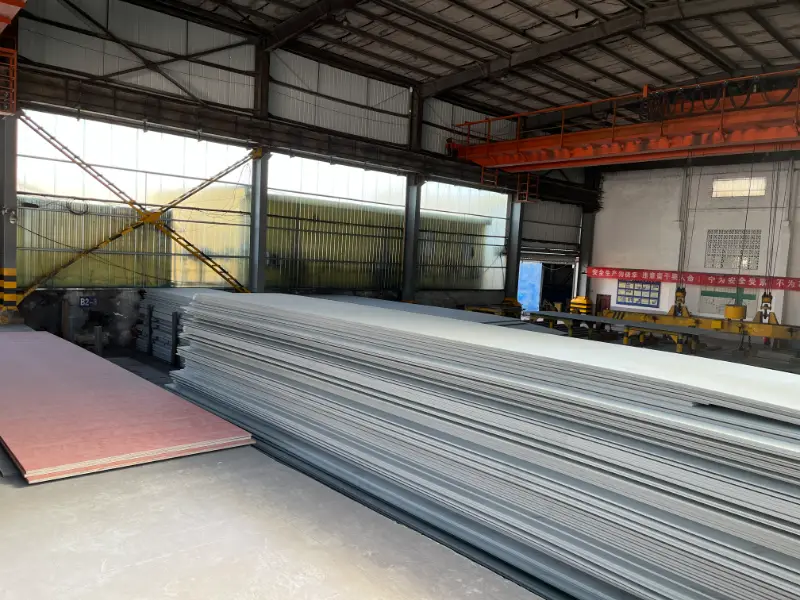
EN 10155-1993 S235J0W Structural Steel Coil & Plate
EN 10155-1993 S235J0W Atmospheric Corrosion Resistant Structural Steel Coil & Plate
Comprehensive technical data for S235J0W weather resistant steel according to EN 10155-1993, including chemical composition, mechanical properties, thermal and electrical properties, international equivalents, and application guidance.
Hot rolling, cold forming, welding, cutting, bending, punching
- Phone : +8618037372205
- Email : [email protected]
- WhatsApp: Contact via Whtsapp
- WeChat: +8618037372205
EN 10155-1993 S235J0W Structural Steel Coil & Plate Introduction
EN 10155-1993 S235J0W is a hot-rolled structural steel with improved atmospheric corrosion resistance (weathering steel). It is designed for use in welded, bolted, and riveted structures exposed to open air environments. The steel develops a stable, protective oxide layer (patina) when subjected to alternating wet and dry conditions, eliminating the need for painting in many applications. Key properties: minimum yield strength of 235 MPa, guaranteed impact energy at 0°C (J0), and a chemical composition enriched with copper, chromium, and nickel to enhance corrosion resistance. The steel is suitable for thicknesses up to 150 mm and is typically delivered in the as-rolled (+AR) or normalized (+N) condition. Commonly used shapes include coils, sheets, plates, and sections for structural and architectural purposes.
EN 10155-1993 S235J0W Structural Steel Coil & Plate Chemical Composition
The chemical composition of S235J0W as per EN 10155-1993 is designed to provide enhanced corrosion resistance while maintaining weldability and strength. Elements promoting weathering: Copper (Cu) increases atmospheric corrosion resistance; Chromium (Cr) and Nickel (Ni) further improve the protective patina. Silicon (Si) and Manganese (Mn) provide solid-solution strengthening. Phosphorus (P) has some beneficial effect on weathering but is kept low to avoid embrittlement. Nitrogen (N) is limited, and aluminum is typically added for grain refinement.
| Element | Specified Value (max % unless range) | Remarks |
|---|---|---|
| Carbon (C) | ≤0.13 | For thickness ≤16 mm; for >16 mm provide adequate weldability |
| Silicon (Si) | ≤0.40 | Deoxidizer and strength contribution |
| Manganese (Mn) | 0.20 – 0.60 | Strength and toughness; may be increased for thickness >30 mm (see standard) |
| Phosphorus (P) | ≤0.040 | Limited for toughness; residual from steelmaking |
| Sulfur (S) | ≤0.040 | Kept low for ductility and weldability |
| Chromium (Cr) | 0.40 – 0.80 | Key element for weathering resistance |
| Nickel (Ni) | ≤0.65 | Enhances atmospheric corrosion resistance and toughness |
| Copper (Cu) | 0.25 – 0.55 | Primary element for protective patina formation |
| Molybdenum (Mo) | ≤0.30 | Residual element; not intentionally added |
| Zirconium (Zr) | ≤0.15 | Optional grain refiner; residual limit |
| Aluminum (Altotal) | ≥0.020 | Required for fine grain practice; or other grain refining elements (Nb, V, Ti) may be used |
| Nitrogen (N) | ≤0.009 | Restricted to avoid strain aging; if Al is present, N is bound as AlN |
EN 10155-1993 S235J0W Structural Steel Coil & Plate Thermal and Electrical Physical Properties
Physical properties are not mandatory in EN 10155 but are essential for design. Values are typical for low-alloy weathering steels and may vary slightly with composition and processing. Density is approximately 7.85 g/cm³. The modulus of elasticity decreases with temperature. Thermal expansion coefficient influences joint design. Thermal conductivity and specific heat affect heat transfer. Electrical resistivity is typical for carbon-manganese steels. These data serve as a general engineering guide.
| Property | Typical Value | Unit | Test Conditions / Remarks |
|---|---|---|---|
| Density (ρ) | 7.85 | g/cm³ | At 20°C |
| Modulus of Elasticity (E) | 210 | GPa | Static; at 20°C |
| Shear Modulus (G) | 81 | GPa | Calculated from E and ν; at 20°C |
| Poisson's Ratio (ν) | 0.3 | - | In elastic range; at 20°C |
| Thermal Expansion Coefficient (α) | 11.1 | 10-6/K | Between 20°C and 100°C |
| Thermal Expansion Coefficient (α) | 11.9 | 10-6/K | Between 20°C and 200°C |
| Thermal Expansion Coefficient (α) | 12.5 | 10-6/K | Between 20°C and 300°C |
| Thermal Expansion Coefficient (α) | 13.0 | 10-6/K | Between 20°C and 400°C |
| Thermal Conductivity (λ) | 42 | W/(m·K) | At 20°C |
| Specific Heat Capacity (cp) | 460 | J/(kg·K) | At 20°C |
| Electrical Resistivity (ρe) | 0.20 | μΩ·m | At 20°C; typical range 0.15–0.25 μΩ·m |
EN 10155-1993 S235J0W Structural Steel Coil & Plate Mechanical Properties
The mechanical properties are guaranteed for the delivery condition. Yield strength (ReH) is the minimum upper yield for thicknesses up to 16 mm, with decreasing values for thicker material. Tensile strength (Rm) range ensures adequate strength with sufficient ductility. Elongation is reported on a proportional gauge length (L0=5.65√S0) for flat products. Impact energy is verified at 0°C (longitudinal, for grades with designation J0) using Charpy V-notch specimens. Bending is a cold formability indicator. All values comply with EN 10155-1993.
| Property | Required Value | Unit | Test Conditions / Remarks |
|---|---|---|---|
| Yield Strength (ReH) | ≥235 | MPa | Nominal thickness ≤16 mm; transverse |
| Yield Strength (ReH) | ≥225 | MPa | 16 < thickness ≤40 mm |
| Yield Strength (ReH) | ≥215 | MPa | 40 < thickness ≤63 mm |
| Yield Strength (ReH) | ≥215 | MPa | 63 < thickness ≤80 mm |
| Yield Strength (ReH) | ≥215 | MPa | 80 < thickness ≤100 mm |
| Yield Strength (ReH) | ≥195 | MPa | 100 < thickness ≤150 mm |
| Tensile Strength (Rm) | 360 – 510 | MPa | Nominal thickness ≤100 mm; transverse |
| Tensile Strength (Rm) | 350 – 500 | MPa | 100 < thickness ≤150 mm; transverse |
| Elongation (A) | ≥26 | % | Thickness ≤16 mm; L0=5.65√S0; transverse |
| Elongation (A) | ≥25 | % | 16 < thickness ≤40 mm; transverse |
| Elongation (A) | ≥24 | % | 40 < thickness ≤63 mm; transverse |
| Elongation (A) | ≥23 | % | 63 < thickness ≤100 mm; transverse |
| Elongation (A) | ≥22 | % | 100 < thickness ≤150 mm; transverse |
| Impact Energy (KV2) | ≥27 | J | At 0°C; longitudinal V-notch; average of 3 tests; single minimum 70% of average |
| Bend Test (180°) | Crack free | - | Bend radius: 1a for thickness ≤16 mm; 2a for 16 < thickness ≤100 mm; a = specimen thickness |
EN 10155-1993 S235J0W Structural Steel Coil & Plate Exactly Equivalent Material Standards and Replaceable Grades
| Country/Region | Standard | Designation (Grade) | Remarks |
|---|---|---|---|
| European Union | EN 10025-5:2004 | S235J0W | Direct successor to EN 10155:1993; identical chemical and mechanical requirements; +AR or +N condition |
| International | ISO 4952:2006 | Fe235W-C | Similar weathering steel with minimum yield 235 MPa; designation S235W in later editions |
| Germany (DIN) | DIN EN 10025-5 | S235J0W | Adopted EN standard; identical |
| United Kingdom (BS) | BS EN 10025-5 | S235J0W | Adopted EN standard; identical |
EN 10155-1993 S235J0W Structural Steel Coil & Plate Application Introduction
S235J0W is designed for outdoor structural applications where long-term corrosion resistance and minimal maintenance are required. The steel's patina protects the base metal in most non-marine, non-industrial atmospheres. Typical industries and products:
Product Applications: Hot-rolled coils and cut sheets for subsequent cold forming, Heavy plates for welded bridge girders and box sections, Structural sections (I-beams, channels, angles) for building frames, Corrugated sheets for roofing and cladding, Pipes and hollow sections for lattice structures
Processed into products: Bridge main girders, cross beams, and stiffeners, Container corner posts and side panels, Rail car side frames and bolsters, Architectural mesh and perforated panels, Transmission tower legs and bracings, Pipe supports and outdoor walkways, Welded T-joints and brackets in aggressive atmospheres
Application industries: Civil engineering and infrastructure (bridges, overpasses, highway components), Rolling stock and transportation (railway wagons, truck chassis, containers), Architecture and construction (facade panels, roofing, structural frames, sculptures), Energy and utilities (transmission towers, poles, wind turbine components), Shipbuilding and offshore (limited to non-immersed structural parts where weathering is beneficial)
EN 10155-1993 S235J0W Structural Steel Coil & Plate Closely Related / Similar Substitute Materials
| Country/Region | Standard | Designation (Grade) | Remarks |
|---|---|---|---|
| European Union | EN 10025-5 | S235J2W | Higher toughness variant with impact test at -20°C; otherwise same strength and chemistry; may be used where low-temperature toughness is needed |
| European Union | EN 10025-5 | S355J0W | Higher yield strength (≥355 MPa) weathering steel; for applications requiring greater load-bearing capacity |
| USA | ASTM A588/A588M | Grade A (K11430) | Weathering steel with similar atmospheric corrosion resistance; typical yield 345 MPa (50 ksi) – somewhat higher strength; commonly used for structural shapes |
| Japan | JIS G3114 | SMA400AW | Hot-rolled atmospheric corrosion resisting steel for welded structures; minimum yield 235 MPa; comparable to S235J0W |
| China | GB/T 4171 | Q235NH | Atmospheric corrosion resisting structural steel; yield strength ≥235 MPa; similar chemistry concept but different deoxidation practice |
Notes:
Welding: S235J0W is readily weldable using conventional methods (MAG, MMA, SAW) with low-hydrogen procedures. Preheating may be required for thick sections (>30 mm) or low ambient temperatures. Typical filler metal: matching weld consumables for weathering steel (e.g., EN ISO 2560-A E 38 Z W). Painting: Even though the steel develops a patina, specific environmental conditions (marine, heavy industrial) or design requirements may demand a protective coating system. In such cases, surface preparation must remove the oxide layer adequately. Cold forming: Bend radii should follow the recommendations based on thickness and ductility (minimum 1t for t ≤ 16 mm). Hot forming is also possible. Tolerances: Dimensional and shape tolerances comply with EN 10051 for continuously hot-rolled strip and plate.
- Share



