
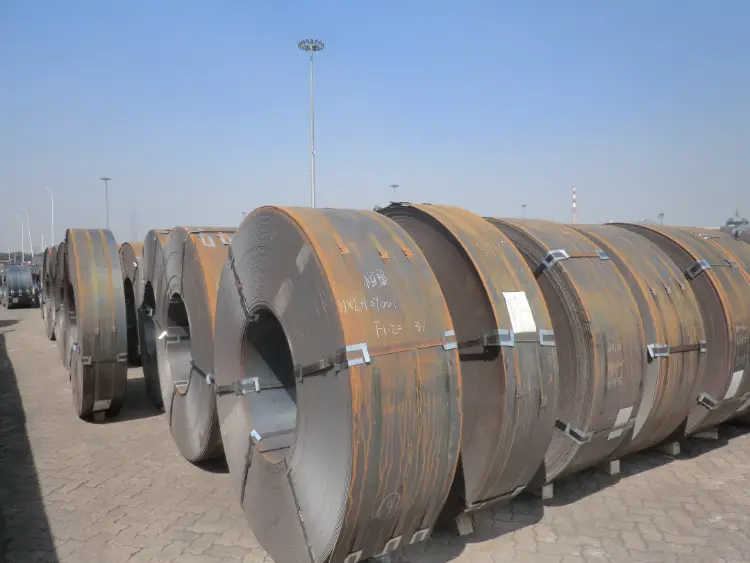
RINA Grade D Shipbuilding Steel Coil
RINA Grade D Shipbuilding Steel Coil - Comprehensive Material Data & Equivalents
Detailed material analysis of RINA Grade D shipbuilding steel coil, including chemical composition, mechanical and physical properties, international equivalents, and application guidelines per RINA Rules.
Hot rolling, Normalizing (if required)
- Phone : +8618037372205
- Email : [email protected]
- WhatsApp: Contact via Whtsapp
- WeChat: +8618037372205
RINA Grade D Shipbuilding Steel Coil Introduction
RINA Grade D is a normal strength shipbuilding steel grade certified by the Registro Italiano Navale (RINA). It is primarily used in the construction of ship hulls and marine structures where moderate strength and good weldability are required. The steel is designated for service at temperatures down to -20 °C, meeting impact toughness requirements at that temperature. Typical delivery forms include hot-rolled coils and plates. The steel is fully killed and produced with controlled chemistry to ensure reliable mechanical properties. It is widely accepted in international shipbuilding and is equivalent to grades from other classification societies.
RINA Grade D Shipbuilding Steel Coil Chemical Composition
The following table lists the chemical requirements for RINA Grade D shipbuilding steel as specified in the RINA Rules. The steel is fully killed and fine-grain treated. All elements are given in weight percent (%). Residual elements are controlled to ensure weldability and toughness. The carbon equivalent (Ceq) is typically not specified for normal strength steel but may be reported for compatibility.
| Chemical Element | Standard Value (%) | Remarks |
|---|---|---|
| Carbon (C) | ≤ 0.21 | Maximum |
| Manganese (Mn) | ≥ 2.5 × C (minimum 0.80) | Minimum; typical range 0.80 – 1.20 |
| Silicon (Si) | 0.10 – 0.35 | Killed steel requirement |
| Phosphorus (P) | ≤ 0.035 | Maximum |
| Sulfur (S) | ≤ 0.035 | Maximum |
| Aluminum (Al_ total) | ≥ 0.015 | If fully killed; fine grain practice |
| Copper (Cu) | ≤ 0.35 | Maximum residual |
| Chromium (Cr) | ≤ 0.20 | Maximum residual |
| Nickel (Ni) | ≤ 0.40 | Maximum residual |
| Molybdenum (Mo) | ≤ 0.08 | Maximum residual |
RINA Grade D Shipbuilding Steel Coil Thermo-Physical & Electrical Properties
These properties are typical for a low‑carbon steel similar to RINA Grade D and are not part of the standard specification. They are intended for design and heat transfer calculations. Actual values may vary slightly with heat treatment and composition.
| Property | Typical Value | Unit | Test Conditions / Remarks |
|---|---|---|---|
| Density (ρ) | 7850 | kg/m³ | At 20 °C |
| Elastic Modulus (E) | 205 – 210 | GPa | At 20 °C |
| Shear Modulus (G) | 80 – 82 | GPa | Calculated from E and Poisson's ratio |
| Poisson's Ratio (ν) | 0.29 – 0.30 | — | At 20 °C |
| Thermal Expansion Coefficient (α) | 11.5 | 10⁻⁶/K | Between 20 °C and 100 °C |
| Thermal Conductivity (λ) | 50 – 54 | W/(m·K) | At 20 °C |
| Specific Heat Capacity (cp) | 460 – 480 | J/(kg·K) | At 20 °C |
| Electrical Resistivity (ρe) | 0.15 – 0.18 | µΩ·m | At 20 °C |
RINA Grade D Shipbuilding Steel Coil Mechanical Properties
The mechanical properties below are per RINA Rules for Grade D shipbuilding steel. Tensile testing is performed in the transversal or longitudinal direction (usually transverse for plates). Impact test specimens are Charpy V-notch taken in the transverse direction. The values apply to quenched/ tempered or normalized conditions as agreed. Bending test may be required for certain applications.
| Property | Standard Requirement | Unit | Test Conditions / Remarks |
|---|---|---|---|
| Yield Strength (ReH) | ≥ 235 | MPa | Thickness ≤ 50 mm |
| Yield Strength (ReH) | ≥ 215 | MPa | Thickness > 50 mm |
| Tensile Strength (Rm) | 400 – 520 | MPa | For all thicknesses |
| Elongation (A) | ≥ 22 | % | Gauge length L₀ = 5.65√S₀; thickness ≤ 50 mm |
| Elongation (A) | ≥ 21 | % | Gauge length L₀ = 5.65√S₀; 50 mm < thickness ≤ 70 mm |
| Elongation (A) | ≥ 20 | % | Gauge length L₀ = 5.65√S₀; 70 mm < thickness ≤ 100 mm |
| Charpy Impact Energy (KV₂, -20 °C) | ≥ 27 (average), ≥ 20 (single) | J | Full-size specimen (10×10 mm), transverse; thickness ≥ 10 mm |
| Bending Test | 180°; no cracks | - | Bend diameter = 3 × thickness (t); optional, when specified |
RINA Grade D Shipbuilding Steel Coil Exact Equivalent Material Standards & Substitutable Grades
| Country/Region | Standard | Grade | Remarks |
|---|---|---|---|
| International (IACS) | ASTM A131 | Grade D | American standard; widely accepted |
| International (IACS) | ABS Rules | Grade D | American Bureau of Shipping |
| International (IACS) | DNV Rules | Grade D | Det Norske Veritas |
| International (IACS) | LR Rules | Grade D | Lloyd's Register |
| International (IACS) | BV Rules | Grade D | Bureau Veritas |
| International (IACS) | CCS Rules | D | China Classification Society |
| International (IACS) | NK Rules | Grade D | Nippon Kaiji Kyokai |
| International (IACS) | KR Rules | Grade D | Korean Register |
RINA Grade D Shipbuilding Steel Coil Application Introduction
RINA Grade D steel is primarily designed for marine and offshore applications where good weldability, moderate strength, and low-temperature toughness (to -20 °C) are required. It is employed in welded structures subjected to dynamic loads and corrosive saltwater exposure. Typical products and components include:
Product Applications: Ship hulls and superstructures, Deck plates and bulkheads, Offshore platform decks and jacket legs, Barge hulls and oil/chemical tanker internals, Marine structures such as quay walls and lock gates
Processed into products: Longitudinal stiffeners and transverse frames, Webs, flanges, and brackets, Stiffened panels and corrugated bulkheads, Rudders and stern frames (non-forged), Hatch covers and coamings, Pillars and deck girders, Cut-to-length sheets for fabrication
Application industries: Shipbuilding, Offshore Engineering, Marine Construction, Barge and Tug Construction, Docks and Harbor Equipment
RINA Grade D Shipbuilding Steel Coil Closely Related / Alternative Material Recommendations
| Country/Region | Standard | Grade | Remarks |
|---|---|---|---|
| USA | ASTM A36 | A36 | General structural steel; similar strength, weldability; impact requirements not inherent |
| Europe | EN 10025-2 | S235JR | Non-alloy structural steel; lower toughness guarantees (20 °C instead of -20 °C) |
| Japan | JIS G3101 | SS400 | General structural steel; no guaranteed impact temperature |
| China | GB/T 700 | Q235B | Similar to S235JR; good weldability and forming; not certified for marine environments |
Notes:
Certification: All RINA Grade D material is supplied with RINA certification and marked accordingly. Weldability: Excellent, with standard welding procedures (SMAW, SAW, GMAW) and low-hydrogen electrodes. Preheating may be applied for thick sections (>30 mm) to avoid cold cracking. Dimensional Tolerances: As per RINA Rules and agreed order standards (e.g., EN 10029). Corrosion Protection: Coil may be supplied with light oiling; for marine environment coating and cathodic protection are recommended in service.
- Share



