
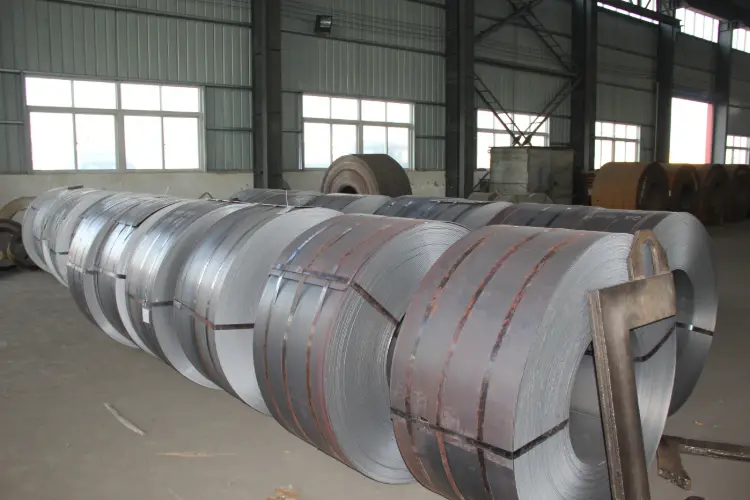
RINA F460 Shipbuilding Steel Coil
RINA F460 Shipbuilding Steel Coil: High-Strength Marine Grade for Extreme Cold
Comprehensive data for RINA Grade F460 shipbuilding steel coil, including chemical composition, mechanical properties, thermal and electrical physics data, equivalent grades, and application guide.
Hot rolling, controlled rolling, normalizing, quenching and tempering, welding, bending, cutting
- Phone : +8618037372205
- Email : [email protected]
- WhatsApp: Contact via Whtsapp
- WeChat: +8618037372205
RINA F460 Shipbuilding Steel Coil Introduction
RINA F460 is a high-strength shipbuilding structural steel defined by the Italian Register of Shipping (RINA). It belongs to the high-strength quenched and tempered (Q&T) steel category with a specified minimum yield strength of 460 MPa. The 'F' designation indicates guaranteed impact toughness at -60°C, making it suitable for cryogenic marine environments. This grade is typically supplied in normalized or quenched and tempered condition, and is widely used in critical structural components of offshore platforms, ice-class vessels, and high-stress areas of hulls.
RINA F460 Shipbuilding Steel Coil Chemical Composition
Typical chemical composition for RINA F460 according to RINA Rules. Values are maximum unless a range is indicated. The composition is designed to achieve high strength and excellent low-temperature toughness.
| Element | Standard Value % | Notes |
|---|---|---|
| Carbon (C) | ≤0.18 | For quenched and tempered (Q&T) grades |
| Silicon (Si) | ≤0.55 | Usually 0.10-0.50 |
| Manganese (Mn) | 1.00–1.70 | Typical range for strength |
| Phosphorus (P) | ≤0.020 | Strict control for toughness |
| Sulfur (S) | ≤0.010 | Low S for clean steel |
| Aluminum (Al) | ≥0.015 total | Grain refinement |
| Nitrogen (N) | ≤0.012 | Control of nitrides |
| Niobium (Nb) | ≤0.05 | Grain refinement and precipitation strengthening |
| Vanadium (V) | ≤0.10 | Precipitation strengthening, limited for weldability |
| Titanium (Ti) | ≤0.02 | Grain refinement, in combination with Al |
| Copper (Cu) | ≤0.50 | Residual element |
| Chromium (Cr) | ≤0.25 | When specified |
| Nickel (Ni) | ≤0.80 | Improves low-temperature toughness |
| Molybdenum (Mo) | ≤0.08 | Optional for thick products |
| Boron (B) | ≤0.0005 | May be added for hardenability |
| CEV (Carbon Equivalent) | Typically ≤0.45 | Depending on thickness and delivery condition |
RINA F460 Shipbuilding Steel Coil Thermal and Electrical Physical Properties
Typical physical properties for high-strength quenched and tempered steel of this class. These values are not specified in RINA rules but are representative for design purposes.
| Property | Standard Required Value | Unit | Test Condition |
|---|---|---|---|
| Density (ρ) | 7.85 | g/cm³ | Room temperature |
| Elastic Modulus (E) | 205–210 | GPa | Room temperature |
| Shear Modulus (G) | 80 | GPa | Room temperature |
| Poisson's Ratio (ν) | 0.3 | Room temperature | |
| Thermal Expansion Coefficient (α) | 11.5–13.0 | 10⁻⁶/K | 20°C to 100°C; typical range for ferritic steel |
| Thermal Conductivity (λ) | 35–45 | W/(m·K) | Room temperature; decreases with temperature |
| Specific Heat Capacity | 460 | J/(kg·K) | Room temperature |
| Electrical Resistivity (ρ_e) | 0.15–0.25 | μΩ·m | Room temperature |
RINA F460 Shipbuilding Steel Coil Mechanical Properties
Mechanical properties for RINA F460 in the quenched and tempered condition. Values are minimum unless specified otherwise. Transverse properties may be agreed upon. Tested in accordance with RINA requirements and generally follow IACS UR W11.
| Property | Standard Required Value | Unit | Test Condition |
|---|---|---|---|
| Yield Strength (ReH) | ≥460 | MPa | Room temperature, t≤50 mm |
| Tensile Strength (Rm) | 570–720 | MPa | Room temperature |
| Elongation (A) | ≥17 | % | Gauge length 5.65√S₀ |
| Bend Test | d=4a (for t≤25 mm), d=5a (for t>25 mm) | 180° bend over mandrel diameter; no cracks | |
| Impact Energy (KV2) | ≥60 (longitudinal) | J | at -60°C, average of 3 tests |
| Impact Energy (KV2) | ≥41 (transverse) | J | at -60°C, average of 3 tests |
| Hardness | ≤380 | HV10 | Single values, if required |
RINA F460 Shipbuilding Steel Coil Equivalent Material Standards and Substitute Grades
| Country/Region | Standard | Grade | Remarks |
|---|---|---|---|
| Italy / International | RINA | F460 | Original specification |
| Norway / IACS | DNV | NV F460 | Identical requirements per IACS UR W11 |
| United States | ABS | F460 | Identical requirements per IACS |
| United Kingdom | LR | F460 | Identical requirements per IACS |
| France | BV | F460 | Identical requirements per IACS |
| China | CCS | F460 | Identical requirements per IACS |
| South Korea | KR | F460 | Identical requirements per IACS |
| Japan | NK | F460 | Identical requirements per IACS |
| Europe | EN 10225 | S460G2+M (offshore structural) | Comparable yield strength; differs in alloy content; not identical for ship hull |
| United States | ASTM A131 / A131M | EH46 | Yield strength 460 MPa but CVN requirements may differ (EH46 is at -40°C) |
RINA F460 Shipbuilding Steel Coil Application Introduction
RINA F460 steel is intended for highly stressed structural members in marine and offshore environments, particularly where cryogenic toughness is required at -60°C. It is suitable for quenched and tempered delivery condition, ensuring high strength-to-weight ratio. Welding procedures must be qualified with regard to the high strength level and low temperature impact requirements.
Product Applications: Ice-class hulls, Jack-up rig legs, Column stabilizers (spar, semi-submersible), Deck plates of VLOC/ULCS, Mega yacht structures
Processed into products: Hull shell plating for high stress zones, Deck stringer plates, Longitudinals and stiffeners, Rudder horns and rudder stocks, Crane pedestals and slew rings, Tow hooks and mooring brackets, Submarine pressure hull sections
Application industries: Shipbuilding, Offshore oil & gas, Arctic engineering, Naval vessels, Heavy lifting equipment
RINA F460 Shipbuilding Steel Coil Materials with Similar Properties
| Country/Region | Standard | Grade | Remarks |
|---|---|---|---|
| Europe | EN 10025-6 | S460QL / S460QL1 | Quenched and tempered structural steel; not for ship classification but similar strength and toughness |
| United States | ASTM A514 / A514M | Grade E / S / Q | High yield strength (≥690 MPa) quenched and tempered; overmatching but can be considered with caution |
| Russia | GOST | 12KhM | Not directly equivalent; some high-strength hull steel grades exist |
| Japan | JIS G 3128 | SHY685 | High yield strength (≥685 MPa) for pressure vessels; close but higher strength |
Notes:
- RINA certification requires mill test certificates with lot traceability. Mechanical tests are performed per heat and heat treatment condition. Impact testing is mandatory at -60°C.
- Through-thickness properties (Z-quality) may be specified for critical welded joints according to Z15, Z25, or Z35 per EN 10164 or RINA requirements.
- Welding consumables should match the strength and toughness; preheat and interpass temperature control is essential.
- Maximum thickness for guaranteed properties may be limited, e.g., 150 mm; consult the rule book for specific thickness ranges.
- Share



