
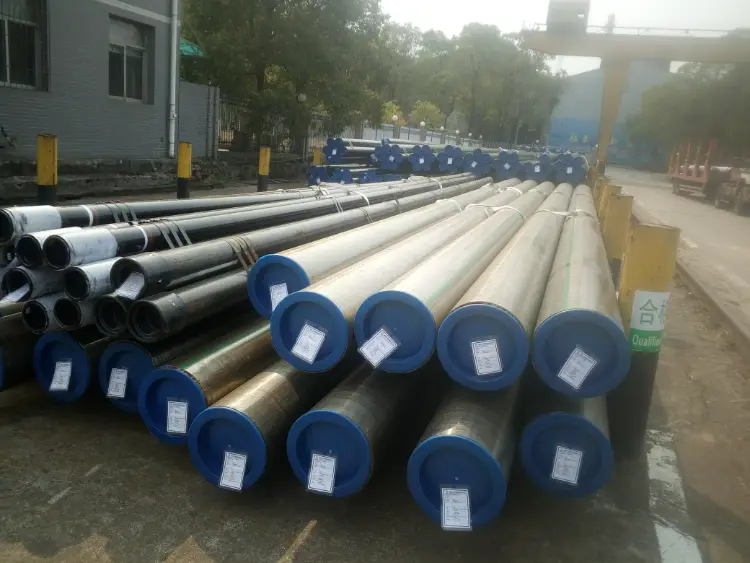
DIN 17400 1.4550 Stainless Steel Pipe
X6CrNiNb18-10 (1.4550) Stainless Steel Pipe – DIN 17400 Grade Data & Equivalents
Complete materials data for 1.4550 (X6CrNiNb18-10) stainless steel pipe according to DIN 17400. Includes chemistry, mechanical & physical properties, international equivalents, and application guidance.
Hot forming, cold forming, machining (work-hardening tendency), welding (all common methods), solution annealing
- Phone : +8618037372205
- Email : [email protected]
- WhatsApp: Contact via Whtsapp
- WeChat: +8618037372205
DIN 17400 1.4550 Stainless Steel Pipe Introduction
1.4550 (X6CrNiNb18-10) is a niobium-stabilized austenitic stainless steel originally specified under DIN 17400. It is designed to prevent intergranular corrosion after exposure to temperatures in the sensitization range (425–815°C). The niobium addition combines with carbon, leaving chromium in solution to maintain corrosion resistance. Key features include:
- Excellent resistance to intergranular corrosion as-welded or after stress relieving
- Good high-temperature strength and oxidation resistance up to approx. 800°C
- Non-magnetic in the solution-annealed condition
- Good toughness at cryogenic temperatures
This grade is widely used in chemical equipment, boiler tubes, heat exchangers, and oil & gas piping where reliable performance under thermal cycling is required.
DIN 17400 1.4550 Stainless Steel Pipe Chemical Composition
Chemical composition according to EN 10088-1 (supersedes DIN 17400). The niobium content is tied to the carbon level to ensure complete stabilization against chromium carbide precipitation. Tantalum may also be present as part of the Nb-stabilization, and the limit applies to the sum of Nb+Ta. Impurities are tightly controlled to preserve corrosion resistance and hot workability.
| Chemical Element | Standard Value (%) | Remarks |
|---|---|---|
| Carbon (C) | ≤0.08 | |
| Silicon (Si) | ≤1.00 | |
| Manganese (Mn) | ≤2.00 | |
| Phosphorus (P) | ≤0.045 | |
| Sulfur (S) | ≤0.030 | Value from DIN 17400; EN 10088 may specify ≤0.015 |
| Chromium (Cr) | 17.0 – 19.0 | |
| Nickel (Ni) | 9.0 – 12.0 | |
| Niobium (Nb) + Tantalum (Ta) | 10×C to 1.00 | Stabilization element |
DIN 17400 1.4550 Stainless Steel Pipe Thermal and Electrical Physical Properties
Typical physical properties at room temperature and selected elevated temperatures in the solution-annealed condition. These values are representative for 1.4550 and similar 18Cr-10Ni-Nb grades. The thermal expansion and conductivity change noticeably with temperature and should be considered in design. Data are sourced from EN 10088-1 and material datasheets.
Values listed for thermal expansion are mean coefficients between 20°C and the indicated temperature.
| Property | Standard Value | Unit | Test Condition |
|---|---|---|---|
| Density (ρ) | 7.9 | g/cm³ | Room temperature |
| Modulus of Elasticity (E) | 200 | GPa | Room temperature |
| Shear Modulus (G) | 77 | GPa | Room temperature |
| Poisson's Ratio (ν) | 0.30 | – | Room temperature |
| Coefficient of Thermal Expansion (α) | 16.5 | 10⁻⁶/K | 20–100°C |
| Coefficient of Thermal Expansion (α) | 17.0 | 10⁻⁶/K | 20–200°C |
| Coefficient of Thermal Expansion (α) | 17.5 | 10⁻⁶/K | 20–300°C |
| Coefficient of Thermal Expansion (α) | 18.0 | 10⁻⁶/K | 20–400°C |
| Thermal Conductivity (λ) | 15 | W/(m·K) | 20°C |
| Thermal Conductivity (λ) | 16 | W/(m·K) | 100°C |
| Thermal Conductivity (λ) | 18 | W/(m·K) | 200°C |
| Thermal Conductivity (λ) | 19 | W/(m·K) | 300°C |
| Specific Heat Capacity (c) | 500 | J/(kg·K) | 20°C |
| Electrical Resistivity (ρ_e) | 0.73 | Ω·mm²/m | 20°C |
DIN 17400 1.4550 Stainless Steel Pipe Mechanical Properties
Room temperature tensile and impact properties for solution-annealed (+AT) condition, as commonly referenced for pipes and flat products. Values are minimum requirements unless a range is given. Elongation is measured on a proportional gauge length (A5 or A). The impact toughness confirms the ductile behavior even at low temperatures.
- Test orientation: longitudinal samples
- Plate/pipe wall thickness ≤50 mm
| Property | Standard Required Value | Unit | Test Condition |
|---|---|---|---|
| Yield Strength (Rp0.2) | ≥ 200 | MPa | Room temperature, longitudinal |
| Tensile Strength (Rm) | 500 – 700 | MPa | Room temperature, longitudinal |
| Elongation at Break (A5) | ≥ 35 | % | Room temperature, gauge length 5.65√S₀ |
| Impact Energy (KV2) | ≥ 60 | J | Room temperature, Charpy-V sample |
DIN 17400 1.4550 Stainless Steel Pipe Fully Equivalent Standards and Substitutable Grade Designations
| Country/Region | Standard | Grade Designation | Remarks |
|---|---|---|---|
| Europe (EN) | EN 10088-1 / EN 10088-2 / EN 10216-5 | 1.4550 / X6CrNiNb18-10 | Direct successor to DIN 17400 |
| USA | ASTM A240 / A312 | TP347 (UNS S34700) | Identical niobium-stabilized grade |
| Japan | JIS G4303 / G4304 | SUS347 | Equivalent chemistry and properties |
| China | GB/T 1220 / GB/T 14976 | 06Cr18Ni11Nb (0Cr18Ni11Nb) | Formerly 0Cr18Ni11Nb |
| International | ISO 9327-5 / ISO 9329-4 | X6CrNiNb18-10 | Based on EN designation |
DIN 17400 1.4550 Stainless Steel Pipe Application Introduction
1.4550 pipe and tube products are specified wherever welded structures must operate in corrosive environments without the risk of intergranular attack. The stabilized grade is preferred over standard 304 (1.4301) when sections thicker than 6 mm are welded, or when the equipment cannot be solution annealed after fabrication. Its high-temperature strength also makes it suitable for applications requiring creep resistance up to approximately 800°C. Typical end users are found in the chemical, nuclear, food processing, and power generation industries.
Product Applications: Seamless and welded stainless steel pipes, Boiler and superheater tubes, Heat exchanger tubes (shell & tube), High-pressure chemical reactors, Distillation columns and trays, Flanges, elbows, and fittings, Cryogenic piping systems
Processed into products: Reactor vessels and internal parts, Superheater and reheater tube bundles, Piping systems for corrosive media, Flame tubes and combustion chambers, Core support structures in nuclear reactors, Food processing kettles and stirrers, LNG vaporizer tubes
Application industries: Chemical & Petrochemical, Oil & Gas (refinery piping), Food & Beverage Processing, Pharmaceutical Manufacturing, Power Generation (boiler tubes, superheaters), Nuclear Engineering (structural components), Heat Exchanger & Pressure Vessel Fabrication
DIN 17400 1.4550 Stainless Steel Pipe Similar / Alternative Stainless Steel Grades
| Country/Region | Standard | Grade Designation | Remarks |
|---|---|---|---|
| Europe | EN 10088-1 | 1.4541 (X6CrNiTi18-10 | Titanium-stabilized austenitic; similar IGC resistance, AISI 321 equivalent |
| Europe | EN 10088-1 | 1.4301 (X5CrNi18-10 | Non-stabilized 304; requires low carbon to avoid sensitization in welded condition |
| Europe | EN 10088-1 | 1.4571 (X6CrNiMoTi17-12-2 | Molybdenum-bearing titanium-stabilized grade for higher pitting resistance, AISI 316Ti |
| USA | ASTM A240 | TP304H | Higher carbon 304 variant for elevated temperature strength, but may require post-weld heat treatment |
Notes:
- DIN 17400 has been officially withdrawn and replaced by the EN 10088 series; all current orders should reference the EN standard.
- Delivery condition is typically solution annealed at 1020–1120°C followed by rapid cooling (water or air).
- Material is normally supplied in the descaled/pickled finish; bright annealed finish is also available for decorative or food-contact applications.
- Weldability is excellent with all common fusion and resistance welding methods; filler metal 19 9 Nb or ER347 is recommended.
- Machining requires sharp tools, rigid setups, and adequate lubrication because of high work-hardening rate.
- Share



